Egyptian President Reaffirms Support for Arab States' Security and Sovereignty, Rejects Any Aggression Against Them
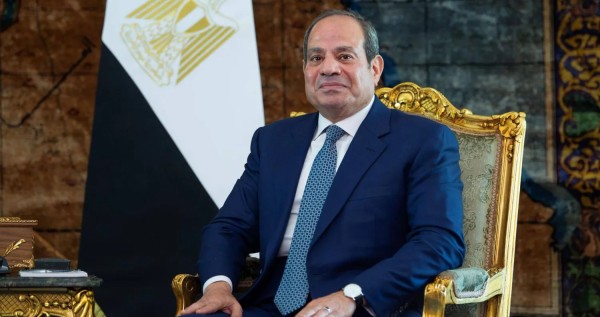
Egyptian President Abdel Fattah el-Sisi reaffirmed his support for the security and sovereignty of Arab states, and discussed with John Ratcliffe developments in the Middle East, Sudan, and Somalia.
Translated by Qiyas from السياسة — Original source
- Confirmed his country’s support for efforts to end the Iranian crisis and ensure freedom of international navigation
Egyptian President Abdel Fattah al-Sisi reaffirmed on Sunday his country’s firm stance supporting the security and sovereignty of Arab states and rejecting any aggression against them.
The official spokesperson for the Egyptian Presidency, Ambassador Mohamed El-Shenawy, stated in a press release that this position was expressed during a meeting between President Sisi and U.S. Central Intelligence Agency Director John Ratcliffe, in which they reviewed developments in the Middle East.
In this regard, Sisi affirmed Egypt’s full support for efforts aimed at “reaching a comprehensive agreement that ends the Iranian crisis, thereby contributing to restoring security and stability in the region and ensuring freedom of international navigation.”
According to the statement, he also stressed the importance of resolving regional crises through political and diplomatic channels and addressing their root causes comprehensively, in order to preserve national institutions, safeguard territorial integrity, and maintain the unity of states.
Regarding developments in the Palestinian issue, Sisi emphasized, according to the statement, the importance of fully implementing the second phase of the U.S. President’s plan aimed at consolidating the ceasefire in the Gaza Strip, commending the efforts made by mediators to reach a roadmap ensuring the implementation of this phase.
Sisi reiterated Egypt’s firm positions, foremost among which is the necessity of consolidating the ceasefire, protecting civilians, and ensuring adequate and sustainable access for humanitarian aid to the Strip, as well as creating suitable conditions to resume the political process leading to a just and comprehensive settlement of the Palestinian issue in accordance with international legitimacy resolutions and the two-state solution principle.
For his part, Ratcliffe affirmed the U.S. administration’s commitment to continuing work and close coordination with Egypt to enhance security and stability in the Middle East region, praising Egypt’s pivotal role in reaching the ceasefire agreement in Gaza and Cairo’s ongoing efforts to support the peace process and enhance stability in the region.
The meeting, according to the statement, also touched upon the Sudanese crisis, where Sisi reiterated Egypt’s firm stance supporting Sudan’s unity, stability, and preservation of its legitimate national institutions, noting that Sudan’s sovereignty, unity, and territorial integrity represent “constants that cannot be compromised.”
Sisi pointed out, according to the statement, Egypt’s “active and constructive” engagement in various international and regional frameworks addressing the Sudanese crisis, with the aim of halting the war, alleviating humanitarian suffering, and supporting the political settlement process.
The discussions also covered developments in the Horn of Africa region, where the Egyptian President, according to the statement, affirmed his country’s full support for efforts to achieve security and stability in Somalia and its firm rejection of any infringement on its sovereignty, unity, or territorial integrity.
For his part, the U.S. CIA Director expressed his country’s appreciation for Egypt’s active role in supporting security and stability across the African continent, emphasizing the importance of continued coordination and consultation between relevant authorities in both countries, particularly regarding the Sudanese crisis, the situation in Somalia, the Horn of Africa region, and international maritime security.
