"Roots Without Leaves"... A Visual Art Exhibition Narrates the Palestinian Burden
Organized by the Egyptian Museum of Art
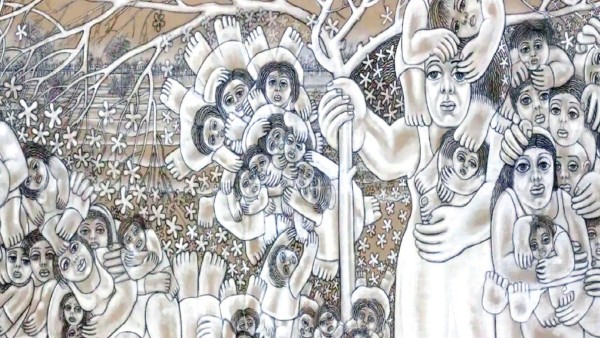
In his exhibition “Roots Without Leaves,” Egyptian visual artist Hani Razzak places the human being at the heart of the Palestinian plight, moving away from scenes of bombardment and destruction. Through striking paintings, he highlights suffering through wandering gazes amid feelings of fear and loss, and moments of prolonged silence.
At the Egyptian Museum of Modern Art, located in the Egyptian Opera House, the exhibition’s 20 works appear to transport viewers from the level of political events to something deeper and more intimately connected to daily life.
The figures here are not depicted in isolation; rather, their bodies and hands intertwine in compositions that bring them closer to a single body, as if the artist sought to move away from the notion of the “individual hero.” In his view, the tragedy experienced by Palestinians revealed the heroism of an entire community.
Consult a human rights lawyer
Local News
Video News
On a personal level, Razzak grew up in the countryside of Sharqia Governorate, where cooperation among villagers was part of the fabric of daily life—during celebrations, funerals, work, and various occasions. This is reflected in his paintings, which give ample space to crowds and families.
The woman occupies the center of this compositional structure as the guardian and pillar of life. She appears as the embrace that holds the family together and protects its cohesion, while children become an image of a threatened future, and the man plays the role of support and protection.
Through these elements, the family within the painting becomes a microcosm of a community striving to cling to life in the face of displacement, hunger, and loss.
In the painting “The Last Supper,” the artist recalls the well-known composition but replaces its traditional symbolism with a scene of children standing before empty vessels. The empty table thus becomes an entry point into discussions of hunger and betrayal without resorting to direct rhetoric.
One of the paintings depicts the atmosphere of a Palestinian wedding, a scene that sets joy against death, pointing to the human capacity to defend the right to life even in the harshest of circumstances.
The large scale of the paintings also grants the figures a near-epic presence. Each painting appears as an independent space containing multiple stories, inviting viewers to linger before them rather than merely glancing.
