'Darb Cultural'... Tracks 'Historical Relations Between Kuwait and Britain'
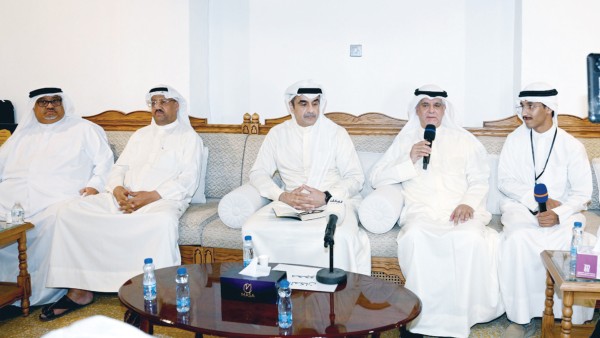
Lecture on historical relations between Kuwait and Britain
Translated by Qiyas from السياسة — Original source
During a lecture held at the Kuwaiti Heritage Society
A lecture on the key milestones in the historical relations between Kuwait and the United Kingdom was held at the Kuwaiti Heritage Society, organized by the “Darb Cultural Diwan.”
The lecture featured Faisal Al-Abd Al-Jalil, President of the Kuwaiti Heritage Society, and Engineer Salah Al-Fadil. The discussion was moderated by Badr Safer, head of the “Darb” platform, who emphasized the importance of such cultural gatherings in educating young people about Kuwait’s history and its international relations, and in connecting new generations with the country’s historical heritage.
For his part, Al-Abd Al-Jalil affirmed that Kuwaiti-British relations have deep historical roots dating back to the 18th century. He stressed that this relationship did not begin with the signing of the British Protection Agreement in 1899, but rather with the activities of the English East India Company following the end of Portuguese dominance in the region, which was succeeded by British and Dutch influence through the English and Dutch East India Companies.
Kuwait Weather
Social News
Political News
Al-Abd Al-Jalil discussed several important milestones in the history of Kuwaiti-British relations, most notably the relocation of the East India Company’s headquarters from Basra to Kuwait. He also addressed the British Protection Agreement, outlining the circumstances, motivations, and reasons behind Sheikh Mubarak Al-Sabah’s decision to sign the agreement during that critical period, amid the dangers facing the country at the time.
Al-Abd Al-Jalil also touched upon the visits of several British travelers to Kuwait, including James Buckingham and Stukely, as well as Louis Baily, the head of the Consulate in Bushehr. He highlighted what they documented in their memoirs and reports about life in Kuwait, which extended beyond political aspects to include social and economic conditions, as well as architectural features, through descriptions of the nature, structures, and forms of buildings and houses. These accounts represent a vital source for understanding the contours of Kuwaiti life during that historical era.
Al-Abd Al-Jalil noted that one of the primary reasons that led Sheikh Abdullah Al-Salem Al-Sabah to terminate the British Protection Agreement was to secure full sovereignty and independence for Kuwait. He also pointed to the role Britain played in providing support to Kuwait during World War II, as well as the visit of the first Kuwaiti delegation to the United Kingdom in 1919, which marked a significant milestone in the trajectory of communication between the two sides.
Al-Abd Al-Jalil explained that Kuwaiti-British relations have left positive impacts on Kuwait in the past across several fields, including the political sphere, where they contributed to providing protection for Kuwait against the threats it faced.
On the economic front, he indicated that these relations helped stimulate Kuwait’s commercial activity and strengthen its ties with the ports of Western India, which at the time was one of Britain’s most important colonies. This, in turn, reflected on Kuwaiti trade and maritime navigation, opening up broader horizons for Kuwaiti merchants in commercial exchange.
Al-Fadil spoke about the nature of the historical relationship between Kuwait and the United Kingdom, whether at the individual or official level, reviewing the key milestones that contributed to the emergence and development of this relationship.
He pointed out that the early beginnings at the individual level date back to Dr. Edward Evans, who met the Sheikh of Al-Qarin on Qeshm Island and requested that he transport goods from Basra to Aleppo, noting that he may be the first British person to record such details.
He clarified that in 1775, when Karim Khan Zand besieged Basra, the practical relations between Kuwait and the East India Company began to emerge more clearly. Ships, trade, and postal services were redirected to Kuwait. Although they had previously dealt with Zubair and Basra, Karim Khan Zand’s occupation of these areas prompted them to turn toward Kuwait, a shift that helped strengthen the relationship between Kuwait and the British, or the East India Company.
He added that 1793 marked another significant milestone in the history of these relations, with the transfer of the East India Company’s agency to Kuwait, where it remained for two years. This move enhanced direct communication and helped consolidate the relationship between Kuwait and Britain.
Al-Fadil discussed the British Residency in Kuwait, noting that formal relations began after the signing of the British Protection Agreement in 1899, culminating in the arrival of the first British Resident in Kuwait, Major Stuart George Knox, in 1904. He also presented the story of “Dixon’s House,” which was leased by the British agency in Kuwait, explaining its role from approximately 1904 until the end of the last British Resident’s tenure.
He explained that the house was named “Dixon’s House” after British Resident Harold Dixon, who served in Kuwait from 1929 to 1936. Dixon preferred to reside in this house and, after obtaining permission from the ruler of the time, made it his official residence.
He noted that Dixon remained in the house until his death in the late 1950s. Following his death, his wife, Violet Dixon—known in Kuwait as “Umm Saud”—applied to continue residing there and received approval. She remained in the house until the Iraqi invasion of Kuwait in 1990.
He added that Umm Saud was removed from the house and relocated to Britain, where she lived until her death. According to Mr. Al-Fadil, she was deeply attached to Kuwait and wished to die and be buried there, but the circumstances of the invasion prevented her wish from being fulfilled.
On the sidelines of the lecture, a documentary exhibition was held, featuring members of the Board of Directors, Saleh Al-Musbah and Hani Al-Asousi, who displayed a collection of artifacts and historical documents.
Saleh Al-Musbah stated that he presented a diverse array of books, magazines, newspapers, and stamp albums during the exhibition, documenting various aspects of Kuwait’s history and its relations with Britain. He noted that among the exhibits was an issue of the magazine “Al-Farasiyya” (Horsemanship), whose cover featured a photograph of Queen Elizabeth II and dated to 1979, alongside several newspapers that reported on the death of Queen Elizabeth II, as well as a collection of publications from the Center for Historical Research and Studies.
The exhibition also included publications and complete documents concerning “Dixon’s House” and its historical significance as an important witness to Kuwaiti-British relations, along with a number of artifacts highlighting key milestones in Kuwait’s history and its international relations.
