The Ministry of Education incorporates Iran's brazen assaults on Kuwait into the collective memory of generations
Tenth Grade to Receive Documentation on the Unjust Missile and Drone Attacks
Eleventh Grade to Attend a Lesson on the Heroism of the Armed Forces
In a move that transcends mere curriculum updates to document an exceptional phase in Kuwait’s modern history, the Ministry of Education has incorporated the unjust Iranian attacks on the country during 2026 into the tenth-grade history syllabus. This ensures that the details remain present in the collective memory of generations, transforming the crisis the state endured into educational material from which lessons on sovereignty, national unity, and national readiness can be drawn.
Astronomy
Opinion Columns
Newspaper Archive
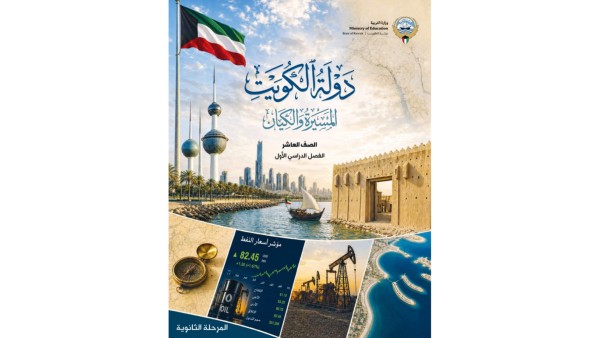
This documentation appears in the textbook "State of Kuwait: The Journey and the Entity," prescribed for tenth-grade students. Pages 56 and 57 are dedicated to presenting the attacks and their repercussions, Kuwait’s official stance, and the crisis’s demonstration of cohesion between the leadership and the people, as well as the readiness of state institutions to protect the country’s security and sovereignty.
The lesson does not merely recount the facts of the attacks; it presents them within a historical and political context that introduces students to the nature of the challenges Kuwait faced, while simultaneously highlighting the constants of its foreign policy and its position on regional and international conflicts.
The curriculum also reviews the attacks carried out by Iran and its militias in the region using missiles and drones, which targeted vital and government facilities and residential areas within Kuwait. These included electricity generation and water desalination plants, Kuwait International Airport, the General Organization for Social Security building, the Ministries Complex, as well as several residential areas.
The Ministry of Education accompanied the lesson with an image documenting the effects of the Iranian bombardment on Kuwait International Airport, providing students with a visual aspect of the event. This serves to document what the book describes as violations of Kuwait’s sovereignty and security, and the subsequent raising of readiness levels among state institutions.
On the political front, the curriculum clarifies that Kuwait affirmed its rejection of the attacks and its commitment to its right to defend its territory, alongside broad diplomatic efforts to preserve the security and stability of the region.
The book also highlights the leadership role of His Highness the Amir, Sheikh Meshal Al-Ahmad Al-Jaber Al-Sabah, during the crisis, in directing state institutions and enhancing their readiness, while reaffirming Kuwait’s firm position that the country is not a party to the ongoing conflict between the United States and Israel on one side, and Iran on the other.
It also covers the Amir’s communications with sister and friendly nations and international organizations, to underscore Kuwait’s position calling for respect for state sovereignty and adherence to international law, emphasizing that Kuwait will not allow its land, airspace, or waters to be used to attack any state.
The Ministry grants the event an educational dimension that goes beyond documenting the attack itself; the lesson links the crisis to concepts of loyalty and belonging to the homeland, unity of ranks, national solidarity, and protection of sovereignty, thereby enhancing students’ ability to understand contemporary events within their historical and national context.
The educational material emphasizes that the crisis demonstrated the importance of cohesion between the leadership and the people, the readiness of state institutions, and Kuwait’s ability to handle security challenges while maintaining its political and diplomatic constants, foremost among which are prioritizing dialogue, de-escalation, and respect for international law and state sovereignty.
The Ministry of Education’s plan does not stop at the tenth grade; the Guidance, Research, and Curricula Administration is moving to include a lesson in the eleventh-grade history curriculum, following its development during the 2027/2028 academic year, addressing the Iranian attacks on Kuwait alongside the heroic role played by the Kuwaiti Armed Forces in repelling them.
This step aligns with the Ministry’s policy of documenting recent historical events and incorporating the most significant local, Arab, and Islamic developments into new editions of textbooks, ensuring that major events experienced by the country are not excluded from the educational record, but instead become material that helps new generations understand their country’s present and comprehend the transformations shaping its history.
