Exhibition documents more than 130 buildings and streets in Kuwait through stamps and postcards
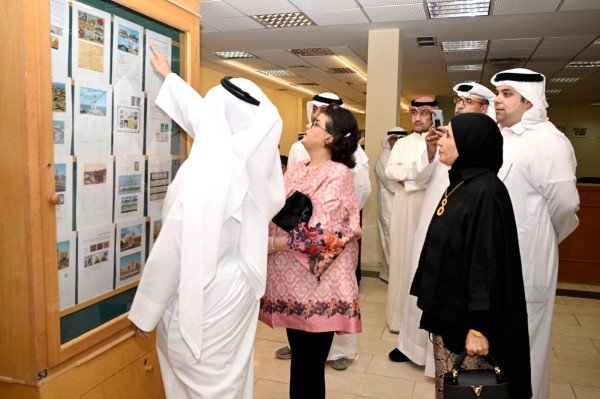
- Hala Al-Mohammed: Stamps preserve Kuwait’s architectural memory and document buildings that are no longer standing
- Al-Bilam: The postal stamp is the identity of the state and a document that records its urban and cultural development stages
Support international initiatives
Follow government decisions
Discover Arab events
Sheikha Hala Bader Al-Mohammed, honorary member of the Kuwait Philatelic and Numismatic Society, emphasized the importance of stamps and postal cards as documents that preserve Kuwait’s history and architectural memory, given their documentation of buildings, places, and events that formed part of the country’s history. She stressed the necessity of preserving heritage buildings, restoring those that can be saved, and converting some into museums and sites that attract visitors to Kuwait.
This came during the opening of the exhibition “Urban Renaissance in Kuwait through Stamps and Postal Cards,” organized by the Kuwait Philatelic and Numismatic Society. The exhibition features a personal collection from Hisham Qasim Al-Bilam, deputy chairman of the society’s board of directors, documenting more than 130 Kuwaiti buildings and streets, and reflecting aspects of the country’s architectural and heritage memory.
Al-Mohammed said the exhibition highlights the contribution of postal stamps in documenting a significant portion of Kuwait’s history by recording old buildings and events that took place in the country, while postal cards have preserved images and scenes of sites that are no longer standing today.
She added that “postal stamps have proven the existence of these buildings, so we hope officials will pay attention to them and investigate them, as they are part of our history,” noting that some have been demolished, while others remain but require restoration.
She stressed the importance of reviving heritage buildings and converting some into museums and historical sites, which would help introduce new generations to Kuwait’s history and enhance Kuwaiti heritage as a tourist and cultural destination.
She expressed regret over the loss of several old buildings that were once part of Kuwaitis’ daily landscape, noting that the exhibition brought back memories of buildings she knew in her childhood that no longer exist today.
She pointed out that several old buildings featured distinctive architectural designs, explaining that Kuwait has, at different stages, employed engineers from abroad to design some of its structures, making these buildings an important part of the history of Kuwait’s urban renaissance.
For his part, Hisham Qasim Al-Bilam, deputy chairman of the Kuwait Philatelic and Numismatic Society, affirmed that the postal stamp represents “the identity and symbol of every country,” and constitutes a historical document through which one can learn about the urban, cultural, and tourism development stages the country has undergone.
Speaking on the sidelines of his solo exhibition opening, Al-Bilam said the exhibition sheds light, through stamps and postal cards, on the urban development Kuwait has witnessed since the late 1950s and early 1960s, and the accompanying evolution in buildings, streets, and various landmarks.
