Deputy Foreign Minister for European Affairs: Kuwait proud of its respect for religions and 58 years of relations with the Vatican
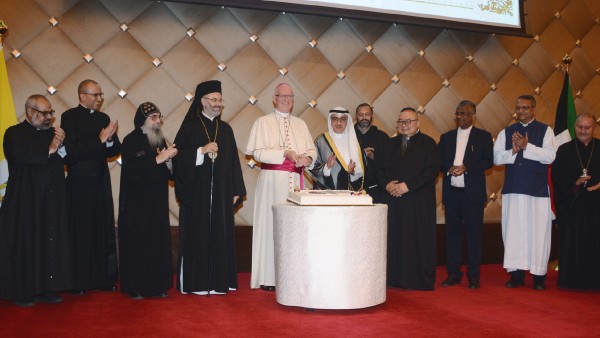
Officials and diplomats attended the farewell party hosted by the outgoing Vatican Ambassador Nugent: I came as a bishop to encourage people to have faith, but they encouraged me to have faith! I am leaving with deep app
Translated by Qiyas from السياسة — Original source
Officials and diplomats attended the farewell party hosted by the outgoing Vatican Ambassador
Nugent: I came as a bishop to encourage people to have faith, but they encouraged me to have faith!
I am leaving with deep appreciation for Kuwait’s approach based on moderation, dialogue, and peaceful coexistence
Second Gulf-European summit anticipated in the second half of October next year
Deputy Foreign Minister for European Affairs Ambassador Najib Al-Badr affirmed the profound distinguished relations between Kuwait and the Vatican, noting that diplomatic ties between the two sides date back to 1968, and that Kuwait was the first Gulf country to establish diplomatic relations with the Holy See.
This came during the farewell party hosted by the Vatican Ambassador to Kuwait, Archbishop Eugene Martin Nugent, on the evening of the day before yesterday at the Crowne Plaza hotel, marking the end of his five-and-a-half-year tenure in the country. The event was attended by a number of officials and diplomats.
Al-Badr expressed his best wishes for Ambassador Nugent’s success and achievement in his future assignments, praising the accomplishments he made during his time in Kuwait that contributed to strengthening bilateral relations.
Key milestones
He pointed out that the visit of Vatican Secretary of State Cardinal Pietro Parolin to Kuwait last January constituted an important milestone in the trajectory of relations between the two sides, alongside the elevation of the Holy Family Church in Kuwait to the status of a “minor basilica,” emphasizing that these steps reflect the growing level of relations. Al-Badr stressed that Kuwait takes pride in its respect for all religions and cultures, and that this approach extends to residents of the country regardless of their nationalities, backgrounds, or ethnicities, reflecting the values of coexistence and tolerance that characterize the state.
He stated that Kuwait-Vatican relations are developing across various fields, commending the Vatican’s stances on a number of political issues, foremost among them the Palestinian issue, and affirming the convergence of positions on many international and humanitarian matters.
Gulf-European summit
Regarding the continuation of the strategic dialogue between Gulf states and the European Union, Al-Badr pointed to an upcoming summit bringing the two sides together, which will be the second of its kind, expected to be held in the second half of October next year, with final details concerning participants and venue yet to be finalized.
Memories and friendships
For his part, Nugent affirmed that his years of service in Kuwait and the Gulf region would remain a distinctive station in his diplomatic and ecclesiastical career, praising the respect and appreciation he encountered for the Holy See, and Kuwait’s approach based on dialogue, moderation, and peaceful coexistence. He expressed deep appreciation and gratitude to His Highness the Amir Sheikh Meshal Al-Ahmad Al-Jaber Al-Sabah and His Highness the Crown Prince Sheikh Sabah Khaled Al-Hamad Al-Sabah, commending the respect and appreciation enjoyed by relations with the Holy See.
He thanked the Ministry of Foreign Affairs and its officials he worked with, noting that diplomacy, despite its protocols, memoranda, and carefully chosen words, is fundamentally about “building trust between peoples,” and affirming that he sensed this trust during his tenure in Kuwait.
A mission of faith
Nugent praised his colleagues in the diplomatic corps and the friendships and solidarity that united them during national and official occasions, as well as moments of sorrow and joy, affirming that these relationships formed an important aspect of his experience in Kuwait. He noted that his mission in the region was, above all, a “mission of faith,” directing his thanks to Bishop Aldo Berrardi, priests, nuns, brothers, and those working in service of the Catholic Church, along with thousands of believers he met in various churches and communities.
He noted that many members of Christian communities live far from their homelands and families, working hard, often silently and without recognition, yet they maintain their faith and mutual support. He added, “I came here as a bishop to encourage them in their faith, but they, more often than not, encouraged me in mine.”
From Kuwait’s warmth to Prague’s winter
Nugent departed Kuwait grateful rather than sorrowful, as he expressed in his speech, carrying with him years of memories and friendships forged through his experience in the country. As he prepared to begin a new diplomatic chapter in the Czech capital, Prague, he humorously recalled the stark contrast between Kuwait’s warmth and the cold of the Czech winter, saying, “One of my first challenges may be learning how to dress appropriately for January after spending years in the Gulf.”
