Kuwait's UN Representative: Starving Civilians in Conflicts Threatens International Peace and Security
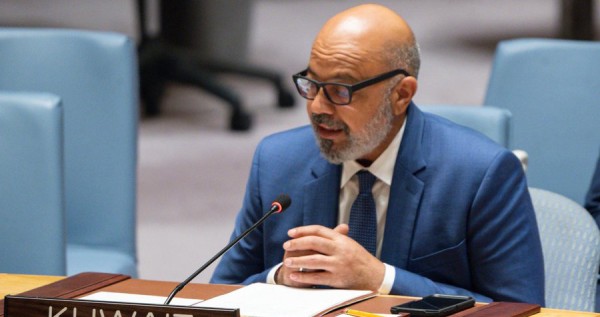
Ambassador Tariq Al-Bunayyan affirmed that food insecurity and the use of starving civilians as a method of warfare threaten international peace and security, and condemned Iran's continued closure of the Strait of Hormuz.
Translated by Qiyas from السياسة — Original source
Ambassador Al-Banna: Iran’s continued closure of the Strait of Hormuz poses a direct threat to global supply chain security
Kuwait has affirmed that food insecurity linked to conflicts is no longer solely a humanitarian issue, but is directly connected to the preservation of international peace and security. It emphasized the necessity of implementing existing international commitments and preventing the starvation of civilians as a method of warfare.
This statement was delivered by Kuwait’s Permanent Representative to the United Nations, Ambassador Tariq Al-Banna, on Tuesday evening, during a high-level open debate of the UN Security Council titled “Food Under Fire: The Role of the Security Council in Mitigating Global and Local Food Crises.”
Ambassador Al-Banna stated that the Security Council recognized early on the close link between conflict and food insecurity through its unanimous adoption of Resolution 2417 in 2018. He noted that Kuwait, during its tenure on the Council at that time, had the honor of co-sponsoring the resolution and advancing the issue to the core of the Council’s work and responsibilities.
He clarified that the significance of the resolution lies in establishing a clear international understanding of the relationship between conflict and hunger, and in condemning the starvation of civilians and the unjustified denial of humanitarian assistance. He stressed that with eight years having passed since its adoption, the priority today is to implement existing commitments and transform the Council’s resolutions and early warning mechanisms into tools that prevent famine before it is too late.
In this context, Ambassador Al-Banna also affirmed that the Gaza Strip today represents a glaring example of the repercussions of targeting the human right to food and restricting access to it. He pointed out that the Israeli blockade and restrictions on the entry of aid and goods, along with the widespread destruction of civilian infrastructure and production facilities, have led to famine in parts of the Strip.
He strongly condemned “the use of the occupying Israeli entity—the occupying Power—as a method of warfare to starve civilians,” denouncing the placement of innocent civilians in a dilemma of “either hunger or surrender” as a blatant violation of international law, international humanitarian law, and the most basic elements of human dignity.
On regional matters, Ambassador Al-Banna stated that recent developments in the Arab region have demonstrated that the repercussions of conflicts do not stop at their borders but extend to global supply chains and markets. He expressed Kuwait’s strongest condemnation of Iran’s continued closure of the Strait of Hormuz, given that it poses a direct threat to the security and stability of global supply chains.
He explained that the danger of this situation is not limited to energy security, but extends to global food security by disrupting trade, increasing shipping, fuel, and fertilizer costs, and driving up food prices, thereby disproportionately affecting the most fragile and import-dependent countries.
Ambassador Al-Banna highlighted the security dimension of food insecurity, warning that the erosion of livelihoods, the expansion of poverty and marginalization, and intensified competition for resources increase societal fragility, exacerbate tensions, and allow terrorist and extremist groups to exploit these conditions for recruitment, incitement, and fueling violence.
He noted that the Global Report on Food Crises 2026 showed that acute hunger has doubled over the past decade, while the number of people facing the most catastrophic levels of hunger has become nine times higher than in 2016. He affirmed that the occurrence of famine despite the existence of legal frameworks, early warning mechanisms, and international resolutions proves that the fundamental challenge lies in the availability of political will to implement them.
Ambassador Al-Binai concluded his statement by saying, “A society ravaged by hunger and stripped of its livelihoods cannot build lasting stability, and a world that allows civilians to starve to death before its eyes cannot claim to be steadily advancing toward sustainable peace.”
