In Al-Abdali, dates and tamarind... and its soil is gold
Farmers to “Al-Siyasa”: Our products are high-quality and competitively priced
Al-Zoubi: 45 farmers participate in the exhibition... Varieties sell out before closing
Al-Dhibbian: We monitor the product from the farm until it reaches the consumer
Al-Omani: The exhibition supports small-scale farmers... Production is lower than last season
Al-Hasan: “Tine Jasem” is 100% Kuwaiti fruit, and we have succeeded in supplying it in large quantities
Al-Duai: We convert surplus dates and figs into local value-added products
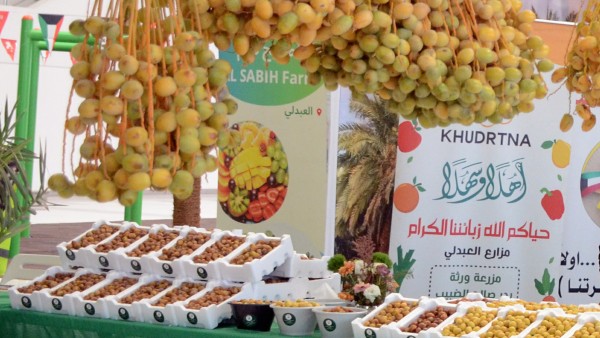
From the Al-Abdali farms to consumers’ tables, Kuwaiti fresh dates and figs are arriving this season in various varieties and with notable quality at the fourth edition of the Al-Abdali Fresh Dates and Figs Exhibition, held at the Al-Mawashi Company hall with the participation of approximately 45 farmers, amidst active purchasing and growing interest in local produce.
Al-Falak
“Al-Siyasa” toured the exhibition pavilions and interviewed several farmers regarding the level of interest, prices, crop diversity, and the journey of the fruits from the farm to points of sale, alongside efforts to expand date and fig processing and aspirations to open new markets for Kuwaiti agricultural produce.
Notable Interest
Faisal Al-Zoubi, supervisor of the Al-Abdali farm at the Al-Mawashi Company hall, confirmed that the Al-Abdali Exhibition, held during the production season in August and lasting two weeks, witnesses significant interest in local products. He noted that some varieties sell out before the end of daily sales hours, which run from 9 a.m. to 5 p.m.
Al-Zoubi stated that the exhibition features a wide range of fresh date varieties, including Wanana, Al-Sukkari Al-Ahmar, Al-Barhi, Al-Majdool, Al-Suqayyi, and Al-Khalas, along with about five fig varieties, most notably “Honey Brown,” Turkish, Spanish, and Tine Jasem.
He clarified that demand is heavily concentrated on “Honey Brown” figs, while Al-Khalas, Al-Barhi, Al-Majdool, and Wanana top the list of the most requested fresh date varieties among consumers. He pointed out that the key distinction of local produce is its freshness to the consumer, as fresh dates and figs are harvested on the same day and transported directly from the Al-Abdali farms to the Al-Mawashi Company hall, bypassing the long cooling and transportation stages typically associated with imported products.
Al-Zoubi emphasized that Kuwaiti farmers have proven their capability and ability to provide agricultural and food products, both during the “corona” pandemic and amid challenges imposed by geopolitical disruptions on supply chains. He explained that farmers faced difficulties in the past in securing some production inputs, including fertilizers, but managed to overcome them by seeking alternatives and continuing production. He noted that the Fresh Dates and Figs Exhibition is being held for the fourth season as part of a series of events aimed at supporting farmers and marketing their products, announcing readiness to hold a vegetable festival in about a month and a half, which will last approximately eight months in the same hall.
Al-Zoubi called on the public to visit the exhibition and get up close to the production of Kuwaiti farms, affirming that purchasing local produce constitutes direct support for farmers and encourages them to continue working and increase production.
A Marketing Outlet
For his part, farmer Saleh Badr Al-Dhibbian confirmed that the Al-Abdali Fresh Dates and Figs Exhibition represents an important marketing outlet for local produce, especially for small-scale farmers who face difficulties accessing commercial markets. Al-Dhibbian said, “The Al-Abdali farm includes about 120 varieties of fresh dates, while participants in the exhibition display about 12 varieties that receive high interest, including Al-Barhi, Al-Khalas, Al-Rathana, Al-Suqayyi, Al-Samran, Al-Zamiliya, and Al-Majdool, along with about six varieties of figs.”
He clarified that the products are monitored and inspected from the production stages on the farm until they reach the exhibition, noting that participating farmers oversee production quality alongside official oversight by the Public Authority for Food and Nutrition, the Ministry of Commerce, and the municipality.
He pointed out that monitoring begins during the palm pollination season, which typically occurs in March and April depending on weather conditions, through periodic visits every two to three weeks to ensure production safety and compliance with participation requirements.
He added that one of the participation conditions is that the farmer must be the owner of the displayed product, with the fruits produced on his own farm, in addition to providing transportation to the exhibition site.
He confirmed direct supervision by the Public Authority for Food and Nutrition inside the venue, explaining that farmers obtain the necessary license before displaying their products, while participants themselves strive to exclude any product that does not meet the required quality standards. Regarding prices, Al-Dhibban stated that the price of Barhi dates is approximately half a dinar per kilogram, while prices for some rare or premium varieties range between one and one and a half dinars per kilogram, emphasizing that prices have remained largely stable since the exhibition opened.
He noted that farmers are looking into exploring opportunities to export surplus production in the future, particularly Barhi and Majdool dates to the Saudi market, given the increase in production and demand. He added that the quality of some local varieties gives them a chance to compete in regional markets.
Diverse Varieties
Farmer Moutaz Saud Al-Omani, one of the festival organizers, said the exhibition represents an important outlet for farmers in Al-Abdali to market their produce, praising the Al-Mawashi company’s initiative to welcome farmers and consolidate their products in one location. Al-Omani explained that this season’s production was lower than last year’s due to unusual weather conditions, noting that rainfall extended into late April and May, which affected the ripening schedule of some fruits. Some palm trees still bear green fruits that have not yet reached the harvesting stage.
He pointed out that the festival allows consumers to discover a wide range of varieties, including Barhi, Khalas, Samran, Zamlia, Ibrahim, and Majdool, along with various types of figs.
He noted that some consumers have become familiar with each farm’s production and its distinctive varieties, offering feedback on quality and presentation. He emphasized that such feedback helps farmers improve their products. Al-Omani stressed the importance of attractive product presentation and packaging, explaining that some farmers offer minor incentives to buyers, such as adding an extra variety for tasting.
He affirmed the importance of the media’s role in introducing the public to local products, noting that some premium varieties are not easily available in commercial markets, while sales activity during the current season remains lower than last year.
A Kuwaiti Fruit
For his part, farmer Diab Al-Hasan confirmed the success of locally cultivating and producing “Jassam” figs, describing them as “100% Kuwaiti fruit,” after their cultivation in Kuwait yielded abundant quantities of high quality in terms of taste, appearance, size, and color. Al-Hasan said the exhibition serves as an important outlet for farmers to display and market their produce directly to consumers. He explained that the participating fig varieties include, in addition to Jassam, Spanish, Taif, and American varieties, which were initially cultivated from imported seeds, seedlings, or cuttings before successfully adapting to the Kuwaiti environment.
He clarified that the benefits of figs are not limited to consuming them fresh; they can be dried and processed into jams and other products, noting that several farmers have already begun utilizing the harvest to produce manufactured varieties. Regarding prices, Al-Hasan stated that the price of a box of figs starts at one dinar and reaches a maximum of 2.5 dinars, with weights ranging between approximately 950 grams and 1 kilogram, or 100 grams. He emphasized that the local product is distinguished by its freshness, reaching consumers shortly after harvest, and highlighted his commitment to participating in various outlets and festivals that contribute to marketing the products of Al-Abdali farmers and introducing them to the public.
Al-Hasan revealed plans to expand the cultivation and production of rare or high-demand varieties, including white okra and Spanish broccoli, alongside other products slated for future launch.
From Farming to Manufacturing
In another example reflecting the diverse utilization of the harvest, farmer Fahd Abdulrahman Al-Dai confirmed that his participation extends beyond selling fresh crops to manufacturing products on the farm, thereby adding value to the local product and extending its shelf life. Al-Dai stated that the farm’s products include Burhi pickles and date syrup, produced using a dedicated press, as well as fig jam, dried figs, and products based on figs and olive oil.
He explained that the objective of manufacturing is to diversify the ways in which the harvest is utilized and not limit its marketing to its fresh form, noting that preparing some products takes about two weeks of work, particularly during the stages of converting pickles into the final product.
He affirmed that manufactured products are receiving strong consumer interest, expressing his hope to provide additional marketing outlets for them, whether through associations or other channels, to enable them to reach a broader segment of consumers.
Al-Dai described the exhibition as a “marketing gateway” for farmers, while simultaneously stressing the importance of providing permanent sales outlets for their products, so that the marketing of local produce is not confined solely to seasonal festivals. Al-Dai’s experience highlights a trend toward expanding agricultural manufacturing, which enhances the economic value of the harvest, allows for longer utilization, and broadens the range of products bearing the identity of the farm and Kuwaiti production.
Egyptian-French-Kuwaiti Partnership to Import Potatoes
Farmer Saleh Al-Dhibbian revealed his entry into an Egyptian-French-Kuwaiti partnership in the field of importing, cultivating, and supplying potatoes. He explained that his experience began in 2026, and he has since become the agent for the product in Kuwait. He stated that the initiative leverages the agricultural expertise available in Egypt, rather than relying entirely on imports from European markets, within a cooperative framework involving parties from the three countries. He noted that the first order for the Kuwaiti market amounts to approximately 50 tons, confirming that quantities will gradually increase according to market needs and consumer demand.
Half a Dinar to 1.5 for Ruttab... and Figs from 1 to 2.5
Farmer Saleh Badr Al-Dhibbian stated that the prices of Ruttab (fresh ripe dates) at the exhibition have remained relatively stable since its launch. He clarified that the price of a kilogram of Burhi dates is approximately 500 fils, while the prices of some premium or scarce varieties range between one dinar and one and a half dinars per kilogram. He affirmed the farmers’ commitment to offering local products at prices suitable for consumers.
He noted that locally produced goods are distinguished by their freshness, as they move from the farm to the consumer within a short period, giving them a competitive edge over imported products. For his part, farmer Diab Al-Hassan emphasized that farmers are keen to keep fig prices affordable for consumers, explaining that the price of a small package starts at one dinar and reaches a maximum of 2.5 dinars.
He added that the weight of the package ranges approximately between 950 grams and 1 kilogram and 100 grams, depending on its size, stressing that the goal is to offer a local product of high quality and price that satisfies consumers.
From Farm to Processing
Some farmers in Al-Abdali are moving toward processing part of their crops on-site, rather than merely selling them fresh, a step that adds value to local produce and expands its utility.
Farmer Fahd Abdulrahman Al-Dai said his products include pickled vegetables, date syrup, fig jam, and dried figs, along with fig products infused with olive oil. He explained that date syrup is produced on the farm using a dedicated press. He added that the aim is to utilize the harvest in multiple forms and extend its marketing period, noting that preparing some products takes about two weeks, particularly during the stages of converting pickled vegetables into the final product. Al-Dai confirmed that processed products are receiving good consumer interest, expressing hope for additional marketing outlets through cooperatives and other entities, which would enable Kuwaiti farm products to reach a broader segment of consumers.
This experience reflects a trend toward agricultural processing as one of the pathways to enhance the economic value of crops, giving farmers a wider opportunity to benefit from their production rather than limiting marketing to fresh forms alone.
