Lebanese Finance Minister to 'Al-Siyasa': A package of economic reform legislation to restore Lebanon's international credibility
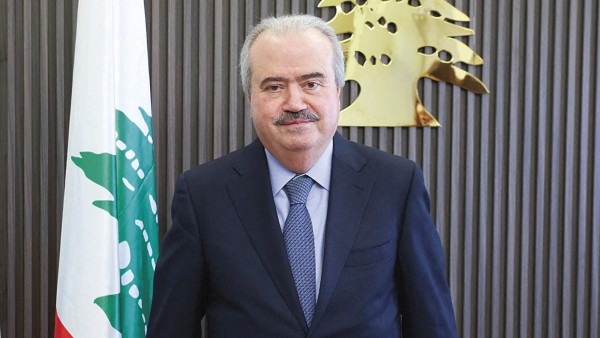
Jaber stressed that “banking sector reform” is a fundamental step to address the crisis Parliament’s approval of legal amendments received warm welcome from the US and international institutions Beirut – “Al-Siyasa” – By
Translated by Qiyas from السياسة — Original source
Jaber stressed that “banking sector reform” is a fundamental step to address the crisis
Parliament’s approval of legal amendments received warm welcome from the US and international institutions
Beirut – “Al-Siyasa” – By Omar Al-Bardan
Lebanese Finance Minister Yassin Jaber affirmed that “Lebanon is grateful for what sisterly Kuwait and the brotherly Gulf Cooperation Council (GCC) countries have done for it over many years, and for the support they have provided to Lebanese people across various levels.”
Speaking to “Al-Siyasa,” he said that “Lebanese people look forward to the role of Gulf states, with Kuwait at the forefront, in the reconstruction process in the coming phase. Kuwait has not faltered in extending a hand of assistance and support to the Lebanese people across all sects, amid the ongoing Israeli aggression.”
To manage
Al-Siyasa News
Seasonal Holidays and Occasions
He emphasized that “the Lebanese government is committed to implementing the economic and financial reforms outlined in its ministerial statement, to win Arab and international confidence, as well as to execute projects adopted on this front. This is what we are currently pursuing. Among the most important of these reforms is the approval by the Parliament of amendments to the law reforming the status of banks in Lebanon and restructuring them.”
Minister Jaber considered that “the Lebanese Parliament’s step is among the most significant achievements realized in the context of strengthening Lebanon’s economic and financial reform trajectory, which is one of the conditions set by international financial institutions.” He added, “What the Parliament has done constitutes a fundamental step in the path of addressing the banking crisis, complementing the law lifting banking secrecy, as part of a series of interconnected legislative reforms.” He stressed that “the law establishes a more robust framework for regulating the banking sector, but it does not constitute an isolated step; rather, it comes as part of a comprehensive package of reforms that remains incomplete without the approval of related laws.”
He affirmed “the necessity of completing the review of the Financial Regulation and Deposit Recovery bill, known as the Financial Gap Law, which has been referred by the government to the Parliament and is currently being discussed by the Finance and Budget Committee.” He stressed “the need to finalize its review and approve it as soon as possible, given its fundamental role in determining mechanisms to address losses, protect depositors’ rights, and restore the financial sector’s stability.” He continued, “These legislations collectively form the basis for restructuring the banking sector and addressing the financial crisis, paving the way for completing negotiations with the International Monetary Fund (IMF) and reaching a final agreement with it.”
The Finance Minister pointed out that “the banking reform law was approved after incorporating amendments that took into account the observations submitted by the government, which are expected to enhance its alignment with reform requirements and accepted technical standards.” He said, “What has been achieved represents an important step; however, completing the legislative process remains essential and necessary to restore confidence in the financial sector and protect depositors’ rights.”
Jaber affirmed that “the digital transformation agreement between Lebanon and the World Bank falls within the framework of the continuous cooperation between Lebanon and the Bank, which has entered several implementation phases.” He noted that additional loans are still pending approval, foremost among them being the “Social Security Loan.” He stated that the digital transformation project, funded by a $150 million loan from the World Bank, aims to strengthen the state’s infrastructure and digital capabilities, thereby contributing to improving the quality of public services that have a direct impact on citizens, facilitating access to them, and delivering them more efficiently and securely. It includes developing digital foundations by creating a modern, secure, and scalable infrastructure to host data, enhancing the cybersecurity system, alongside developing digital skills and updating the legal and regulatory environment.
The initiative also includes the creation of secure platforms for data exchange, the development of digital identity and electronic signatures, and the digitization of priority public services through a unified digital government portal and electronic platforms that enable citizens to access services more easily and efficiently.
Minister Jaber received a congratulatory message from Ernesto Ramirez-Hernandez, the IMF’s Regional Director for the Middle East and Central Asia, who commended him on the “approval of the Bank Restructuring Law,” describing it as “a very good step that reflects Lebanon’s commitment to aligning its legislation with international best practices.” He also revealed that the IMF would resume its meetings in Beirut in mid-September. The IMF praised amendments to the law addressing the situation of Lebanese banks, calling them an important step, while warning that implementation challenges could delay the recovery of an economy battered by the financial crisis and war. Among the key amendments are changes to governance procedures at the Central Bank of Lebanon, including the composition of the Higher Banking Council, and granting it the authority to determine the fate of banks, whether through restructuring or liquidation, and to take measures for their rehabilitation. The government estimates the financial crisis losses at around $70 billion, while experts believe the figure has risen since then.
In this context, the United States, through its embassy in Lebanon, welcomed the Lebanese Parliament’s approval of the Bank Restructuring Law, urging the government to “quickly proceed with completing the reform agenda by passing the Fiscal Gap Law.” This US position links the two pieces of legislation, considering them an essential part of addressing the repercussions of the financial collapse that began in 2019. The US embassy strongly urged the Lebanese government to “continue its efforts to pass the Fiscal Gap Law,” viewing these two legislative measures as “critical steps toward strengthening Lebanese state institutions, restoring confidence in the financial sector, and driving sustainable economic recovery.” It affirmed that “the United States remains firmly committed to supporting targeted, transparent, and accountable reforms that will enhance long-term stability and prosperity for the Lebanese people.”
