'Kuwaiti' foreign partnerships to develop the 'flying taxi' and its infrastructure
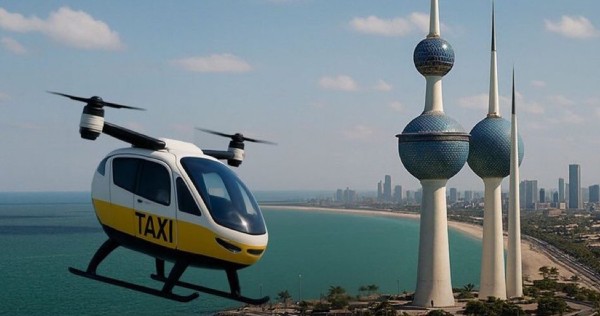
Kuwait-based Knetco, a provider of digital communications solutions and advanced infrastructure, signed a strategic memorandum of understanding with Skyports Infrastructure to develop advanced air mobility (AAM) infrastructure in Kuwait. This move goes beyond the establishment of vertiports for electric vertical takeoff and landing (eVTOL) aircraft, aiming instead to establish an integrated ecosystem encompassing infrastructure, communications, digital integration, operations, regulation, and investment. According to SUAS News, Skyports will serve as Knetco’s specialized partner in Kuwait, responsible for developing vertiports, market development, stakeholder coordination, and exploring future commercial opportunities. The agreement combines Knetco’s expertise in critical infrastructure and communications with Skyports’ global experience in vertical aviation infrastructure.
Infrastructure Deal
The true economic significance of the agreement lies in its focus on the ground layer of the new aviation economy. The commercial proliferation of eVTOL aircraft will not be achieved by aircraft availability alone; it requires a network of vertiports, charging and energy management stations, highly reliable communications, digital booking and monitoring systems, operational centers, and clear safety and regulatory standards. Here, Knetco can transition from a company with a historical background in communications infrastructure to a player in multi-sector infrastructure, linking communications with aviation, energy, and digital platforms. International sector estimates suggest that the majority of the future economic value of advanced air mobility will not come from aircraft sales alone, but from the surrounding ecosystem, including airports, vertiports, logistics, energy, software, and operational services. Some global market studies value the AAM market in the hundreds of billions of dollars in the long term, although estimates vary significantly due to the nascent nature of the sector and differing market definitions among institutions.
Kuwait Faces a Larger Economic Opportunity
The partnership comes at a critical time as Kuwait continues to develop its aviation infrastructure, most notably the new T2 passenger terminal project at Kuwait International Airport.
The significance here does not necessarily lie in directly linking vertiports to the new terminal from the outset, but rather in the potential to develop a multi-modal air transport system that will eventually connect airports, ports, commercial districts, and urban centers via short-range aerial solutions. This opens avenues for Kuwait to develop the concept of the “airport as a mobility hub,” rather than limiting the airport to its traditional function. Furthermore, the scale of Kuwait’s investment in aviation infrastructure adds another dimension to the agreement; the presence of a modern airport with substantial capacity could serve as a cornerstone for a new air transport network linking the airport to business centers, economic zones, coastal areas, and critical facilities, provided that technology and regulatory frameworks advance to the stage of commercial operation.
Political Analysis
Security News
Economic News
The announced memorandum of understanding (MoU) carries no financial value. According to available information, the agreement is an MoU for cooperation and opportunity development, not a declaration of a contract to build a network of vertiports at a fixed cost. This is a crucial economic point, as the potential value of the agreement may materialize later through several separate projects: feasibility studies, vertiport design, construction, operation, digital platforms, charging systems, maintenance, and logistics. Consequently, estimating the total investment value in Kuwait at this stage would be premature. However, Gulf experiences provide an indication of the spending required to build such infrastructure. In Dubai, Skyports, in collaboration with the Roads and Transport Authority, is developing a network of vertiports to serve aerial taxi operations, as part of a plan targeting commercial service launch in the coming years.
The Future Infrastructure Economy
The project aligns with Kuwait’s direction toward economic diversification and investment in sectors with added value. If the MoU transitions into execution projects, a series of opportunities may emerge for Kuwaiti companies in engineering, construction, telecommunications, energy, software, cybersecurity, logistics, and related fields.
The economic impact could extend to new sectors, such as low-altitude air traffic management services, electric aircraft maintenance, energy storage and charging systems, data management, insurance, and digital services. These sectors can generate added value and high-quality jobs that go beyond the direct investment in the vertiport itself.
Thus, the real bet is not on the “flying taxi” per se, but on creating a new infrastructure market that Kuwait can enter early in the Gulf region. If KNETCO and Skyports succeed in transforming the MoU into actual projects, the current agreement may be less significant in terms of its direct financial value and more important as Kuwait’s entry point into a nascent, not yet fully formed, economic value chain.
