Discovery of Fastest Star Orbiting Black Hole at the Heart of the Milky Way
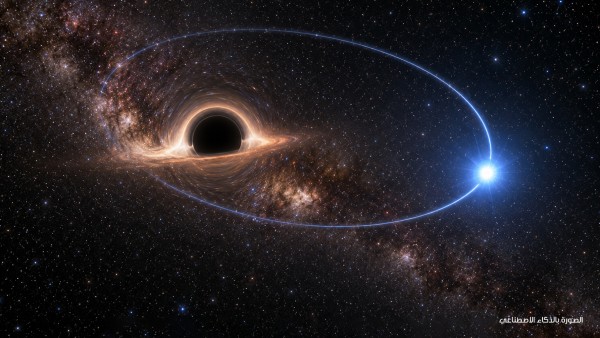
At the heart of the Milky Way, where gravity imposes its harshest laws, astronomers have observed a star hurtling at tremendous speed in an orbit extremely close to the supermassive black hole Sagittarius A*, a discovery that could pave the way for measuring the black hole’s spin for the first time.
The star, named S301, is the fastest known star orbiting the central black hole of our galaxy. During its orbit, its speed reaches approximately 90 million kilometers per hour, or about 8% of the speed of light.
S301 has a mass roughly 50% greater than that of the Sun, and its luminosity is about five times that of the Sun. To date, astronomers have not observed any other star, either within our galaxy or outside it, moving at such high speed in an orbit around a black hole.
The star follows an elliptical orbit around Sagittarius A*, taking approximately 8.7 years to complete a full revolution. Its closest approach to the black hole is about 11.5 astronomical units, slightly more than the distance between the planet Saturn and the Sun.
At its farthest point in the orbit, S301 is approximately 1,360 astronomical units away from the black hole.
Black holes are extremely dense objects with immense gravity, from which even light cannot escape. Sagittarius A* has a mass roughly four million times that of the Sun and is located at a distance of about 26,000 light-years from Earth.
The black hole is currently in a quiescent state, but its intense gravity enables it to swallow stars and material that venture too close. However, researchers rule out the possibility that S301 will meet this fate.
Stefan Gillessen, an astrophysicist at the Max Planck Institute for Physics in Germany and one of the leaders of the study published Wednesday in the journal Nature, stated that the star’s orbit will not decay anytime soon. He clarified that while its orientation will change, it is not at risk of being swallowed.
Researchers monitored the star using the interferometer of the Very Large Telescope operated by the European Southern Observatory in Chile.
Scientists believe that continuous observation of the gravitational influence of Sagittarius A* on S301’s orbit could provide an opportunity to understand the black hole’s properties more precisely, and perhaps enable the first measurement of its spin.
