7 major earthquakes in weeks... Has the 'Ring of Fire' awakened?
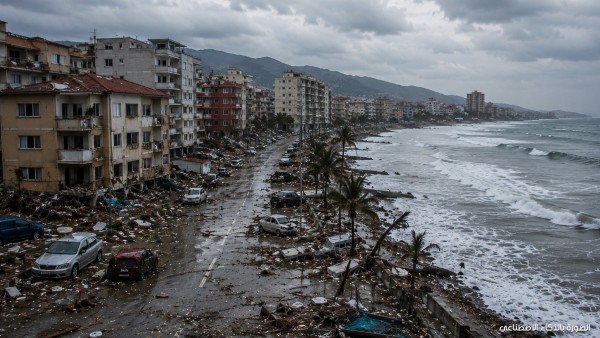
From Venezuela to Indonesia... Thousands of dead and injured, and widespread material losses
From the Caribbean to the western Pacific, the earth shook violently in distant regions over a few weeks, leaving behind devastated cities, thousands of victims, and scenes of destruction that brought to the forefront a recurring question whenever major earthquakes occur in close temporal proximity: Is the world witnessing exceptional seismic activity, or is what is happening merely a striking coincidence on a planet whose tectonic plates never cease to move?
The Arabs and the peoples of the Middle East
Information Technology
Over the course of approximately ten weeks, six countries experienced seven major earthquakes measuring magnitude 7.0 or higher, according to estimates by local or international monitoring agencies. These included the Philippines, Venezuela, Mexico, Japan, Colombia, and Indonesia, with two of them occurring in Venezuela less than a minute apart. Some of these earthquakes resulted in significant human and material losses, raising questions about whether this sequence reflects an unusual change in global seismic activity.
This series gains particular significance given that most of these earthquakes occurred in tectonically active regions, some of which are associated with the Pacific Ring of Fire, where several tectonic plates meet, making the area one of the most seismically and volcanically active in the world.
The Philippines: The beginning from Mindanao
The sequence began on June 8, 2026, when a magnitude 7.8 earthquake struck off the coast of Mindanao in southern Philippines.
The epicenter was located off the coast of Sarangani province, and the tremors were felt in wide areas of Mindanao. Tsunami warnings were issued before being later lifted. The death toll reached 37, with more than 400 injured, alongside damage to buildings and infrastructure.
The Philippines is one of the most earthquake-prone countries in the world due to its location in an active zone at the boundary of several tectonic plates, making it one of the prominent links in the Pacific Ring of Fire.
Venezuela: The deadliest disaster
About two weeks later, on June 24, Venezuela experienced an exceptional seismic event when two successive earthquakes of magnitude 7.2 and 7.5 struck wide areas of the country with less than a minute between them.
These two earthquakes became the deadliest in this series, with the death toll rising to more than 6,000, while tens of thousands received medical care as a result of the disaster.
The occurrence of two earthquakes of such magnitude within less than a minute drew widespread attention. However, the temporal proximity between them and the subsequent earthquakes that struck other parts of the world does not, in itself, constitute evidence that all these events belong to a single global seismic sequence.
Furthermore, Venezuela lies outside the "Ring of Fire" in the traditional geographical sense surrounding the Pacific Ocean, which confirms that seismic activity is not confined to this zone alone.
Mexico: A strong earthquake on the edge of the "Ring of Fire"
On July 17, a strong earthquake struck off the coast of Chiapas state in southern Mexico. The Mexican National Seismological Service estimated its magnitude at 7.4, while other agencies placed it at 7.3.
The earthquake triggered tsunami warnings for some coastal areas, but authorities reported no casualties or major damage.
Mexico is located in a geologically complex region where several tectonic plates interact, with much of its seismic activity concentrated along its Pacific coastline.
Japan... Earthquake, aftershocks, and tsunami warnings
On July 28, southern Japan was hit by a strong earthquake. The Japan Meteorological Agency estimated its magnitude at 7.1, while the United States Geological Survey placed it at 6.8.
The earthquake caused damage to several buildings and structures, while the casualty toll later rose to 34 dead. Authorities also issued warnings regarding the possibility of a tsunami following the tremor.
Japan is one of the most earthquake-ready countries in the world, yet it is simultaneously located in one of the most tectonically active regions, making seismic activity a recurring part of its geological reality.
Colombia... Strong earthquake and significant human losses
On August 10, a 7.4-magnitude earthquake struck western Colombia, causing widespread damage and significant loss of life.
The death toll rose to approximately 290, with around 4,000 injured and 140 missing. Thousands of homes were damaged, and the country recorded hundreds of aftershocks since the main quake.
Colombia is situated in a tectonically active zone due to the interaction between the Nazca Plate and the South American Plate. A significant portion of seismic activity is concentrated in the western part of the country near the Pacific Ocean.
Indonesia... The latest link in the chain
The latest link in this sequence occurred on August 15, when a 7.7-magnitude earthquake hit the Flores region in eastern Indonesia, triggering landslides, cutting off several roads, and complicating rescue operations.
The casualty count reached at least 53 dead and more than 130 injured, while approximately 5,000 people were evacuated from affected areas.
Authorities recorded nearly 1,000 aftershocks since the earthquake. Seismic activity and landslides hindered search and rescue efforts, prompting the deployment of more than 3,500 military and police personnel to the affected regions.
The Flores earthquake holds particular significance due to Indonesia’s location at the heart of the Pacific Ring of Fire. The country sits above a zone where multiple tectonic plates converge, frequently experiencing earthquakes and volcanic eruptions.
Six countries... Earthquakes exceeding magnitude 7
When placing these events in chronological order, a striking picture emerges: the Philippines on June 8 with a magnitude 7.8 quake; Venezuela on June 24 with two earthquakes of magnitudes 7.2 and 7.5; Mexico on July 17 with a magnitude 7.4 quake (according to Mexican estimates); Japan on July 28 with a magnitude 7.1 quake (according to Japanese estimates); Colombia on August 10 with a magnitude 7.4 quake; and Indonesia on August 15 with a magnitude 7.7 quake.
Thus, a period of no more than ten weeks saw seven major earthquakes across six countries, some of which were highly destructive, particularly in Venezuela, Colombia, and Indonesia.
However, the picture becomes more complex when examining the map. The Philippines, Japan, and Indonesia are clearly situated within the "Ring of Fire," while Mexico and Colombia are also linked to tectonic activity along the Pacific Rim. Venezuela, however, lies outside this zone in the traditional sense.
What is the "Ring of Fire"?
The "Ring of Fire" is not a single fault line or a connected geological system moving as a single unit, but rather a vast belt surrounding the Pacific Ocean where multiple tectonic plates meet.
Along much of its length, subduction processes occur, where one plate slides beneath another, alongside other types of plate movement. This leads to the accumulation and release of stress in the form of earthquakes and is associated with a high number of volcanoes.
Additionally, strong underwater earthquakes, particularly those causing significant displacement of the seabed, can generate tsunami waves. This explains the rapid issuance of warnings following several of the recent earthquakes.
Has the "Ring of Fire" awakened?
Although the succession of strong earthquakes over a short period is notable, describing the current situation as a "awakening of the Ring of Fire" is not yet supported by scientific evidence proving that these events are part of a single sequence.
Earthquakes primarily occur in tectonically active regions, and major quakes can, in some cases, trigger distant seismic activity through the transfer of dynamic stress. However, this does not automatically mean that earthquakes separated by thousands of kilometers are interconnected, or that one directly caused another.
Therefore, the occurrence of several strong earthquakes within a few weeks is not sufficient to prove an abnormal increase in global seismic activity, particularly since the “Ring of Fire” naturally experiences intense seismic and volcanic activity.
Nevertheless, the temporal clustering of several devastating earthquakes and their heavy human toll has made the recent weeks notable for their humanitarian impact, prompting intensive monitoring of global tectonic activity by observatories and researchers.
Ultimately, scientists cannot accurately predict the timing, location, and magnitude of the next major earthquake. However, science can estimate the probabilities of seismic events and associated risks, and develop early warning systems that may help mitigate losses.
As Indonesia continues to deal with the aftermath of its latest disaster, global attention remains fixed on the world’s tectonic activity map. Yet, the more scientifically precise question is not whether the “Ring of Fire has awakened,” but whether this temporal clustering will remain merely a striking coincidence of major earthquakes, or whether forthcoming data will reveal patterns warranting further study.
