From Uganda to Sudan... Kuwaiti initiative opens the path of return for Sudanese refugees
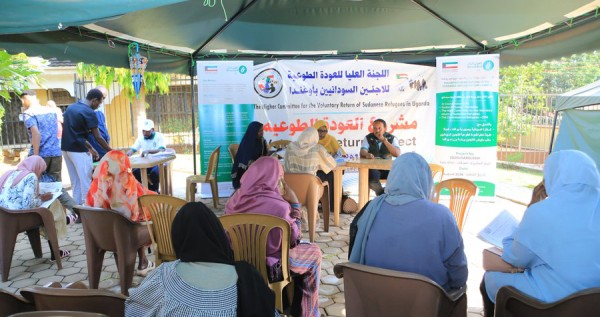
- Ambassador Al-Dhafiri: Voluntary repatriation project implemented under the guidance of the wise political leadership, extending Kuwait’s humanitarian role
The first flights of the voluntary repatriation project for Sudanese refugees in Uganda are set to launch today, Sunday, as part of the first phase of the initiative carried out by Kuwait’s Al-Aon Al-Mubashir Association, under the supervision of the Kuwaiti Embassy in Sudan. The project aims to return more than 1,000 refugees to their homeland within a month and a half, at a total cost of 300,000 Kuwaiti dinars ($971,088).
In a special statement to the Kuwait News Agency (KUNA), Kuwait’s Ambassador to Sudan, Dr. Fahd Al-Dhafiri, said the project is being implemented under the guidance of the wise political leadership, through cooperation between the embassy, the Sudanese Ministry of Foreign Affairs, and Kuwait’s Al-Aon Al-Mubashir Association, extending Kuwait’s humanitarian role in supporting the Sudanese people and mitigating the consequences of the war that has been raging since April 2023.
Ambassador Al-Dhafiri clarified that the project is the first of its kind, representing a practical model for contributing to the reunification of families separated by war, while responding to an urgent humanitarian need driven by the harsh conditions of exile in Uganda.
He expressed his gratitude to Al-Aon Al-Mubashir Association, emphasizing that the initiative has received warm welcome and appreciation from the Sudanese government and people, as an extension of Kuwait’s humanitarian role toward its brothers in Sudan. He noted their commitment to providing all necessary facilitations to ensure the project’s success, making it a model to emulate and an incentive encouraging other humanitarian organizations to support voluntary repatriation programs.
Governments
Technology Companies
News
For his part, Dr. Abdullah Al-Samit, Secretary-General of Al-Aon Al-Mubashir Association, told KUNA that “continuous support from the Kuwaiti government and the confidence of donors have enabled the Association to respond swiftly to one of the most severe ongoing humanitarian crises.”
Al-Samit explained that “the gradual recovery of some Sudanese cities from the war’s effects, the growing desire of refugees in Uganda to return, and the agreement of both governments to support the project, have made it an important step at this stage,” considering safe voluntary repatriation as a direct contributor to recovery and reconstruction.
In this regard, he noted that the Association has provided comprehensive financial and operational support enabling the return of more than 1,000 refugees, including covering flight tickets, logistical arrangements, travel documents, and coordination with the governments of both countries and the Kuwaiti Embassy, “according to an organized sequence that preserves the dignity and safety of beneficiaries until their arrival.”
He clarified that the first phase of the voluntary repatriation project for Sudanese refugees is scalable and integrates with the Association’s broader relief program in Sudan, “but the scale of need exceeds available capacities,” calling on donor agencies, governments, and international partners to increase support, as the availability of resources and partnerships will enable the expansion of the project in the future.
In a related context, Ambassador Onor Ahmed, Chairman of the Supreme Government Committee for the Voluntary Repatriation Project for Sudanese Abroad, told KUNA in a similar statement that the project falls within broader governmental efforts to enhance stability, support recovery, and promote reconstruction, with backing from Kuwait’s Al-Aon Al-Mubashir Association.
Ambassador Ahmed stated that the number of Sudanese refugees in Uganda is estimated at around 95,000, and that air travel represents the only safe option in the absence of suitable land routes. He explained that fulfilling everyone’s desire to return may require 1,000 flights, at a cost of $400 per ticket, despite discounts of 25 percent offered by two Sudanese airlines, making funding the most prominent challenge to expanding the program.
He clarified that beneficiary selection is carried out through a joint mechanism based on criteria that prioritize children, the elderly, patients, and cases of family reunification. He emphasized that voluntary return is an integral part of the recovery and development process, calling on humanitarian and international organizations to support and expand return programs. He commended the continuous support provided by the State of Kuwait to Sudan, as well as the role of host countries of Sudanese refugees, notably Uganda, Egypt, and Libya.
