Ahmed Al-Jarallah: Food manufacturing amidst farms benefits farmers and consumers
Farmers Praise Sheikh Fahad Al-Yousef’s Encouragement; The Future Looks Brighter Agricultural farms bring economic and social benefits to the country and its people. The Kuwaiti farmer is inherently creative; give him th
Translated by Qiyas from السياسة — Original source
Farmers Praise Sheikh Fahad Al-Yousef’s Encouragement; The Future Looks Brighter
Agricultural farms bring economic and social benefits to the country and its people.
The Kuwaiti farmer is inherently creative; give him the opportunity, and he will achieve more.
Al-Adwani: Resuming the distribution of subsidized diesel and the water shortage issue are challenging.
Al-Mutairi: Accelerating the disbursement of government subsidies to farmers is imminent.
Agricultural professionalism is on the rise in Kuwait, and the future is promising.
Al-Azmi: Agricultural journalism plays a significant role in developing agricultural wealth.
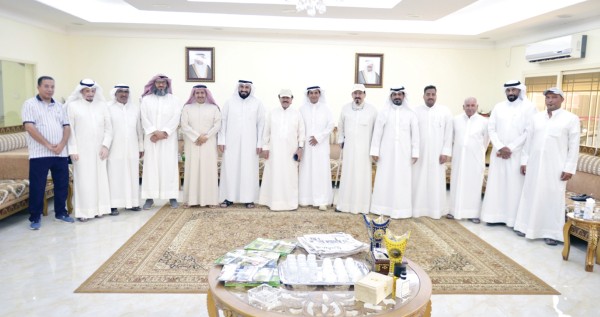
Former member of the board of directors of the Kuwait Farmers Union, Mohammed Ali Al-Mutairi, celebrated the safe return of the dean of Kuwaiti journalism, editor-in-chief of "Al-Siyasa" and "Al-Arabs Times," Mr. Ahmed Abdul Aziz Al-Jarallah, by hosting a banquet in his honor at Al-Wafra Farm last Saturday. The event was attended by the president of the Kuwait Farmers Union, Ahmed Al-Adwani, and its secretary-general, Ahmed Al-Shibak, along with Rashid Al-Azmi, director of the Agricultural Vouchers and Agricultural Support Committee at the Agriculture Authority, and a number of farmers, including Dr. Ahmed Zaid Al-Azmi, Abdullah Fahad Ayed, Sanitan Al-Zoubi, and colleague Saud Al-Farhan.
Time and Calendars
Cultural and Social Articles
Astronomy
The meeting featured an extensive discussion on agricultural affairs and farmers' issues. At the outset, Ahmed Al-Adwani, president of the Kuwait Farmers Union, thanked the veteran journalist Ahmed Al-Jarallah for dedicating a weekly agricultural page in "Al-Siyasa" newspaper to highlight the achievements of Kuwaiti farmers, who cultivate and produce across the northern and southern borders of our country (Kuwait), contributing to achieving a vital part of the food security essential for all residents of Kuwait, in times of ease and hardship.
Al-Adwani also informed Kuwaiti producing farmers that, following the kind renewal of the mandate by the Manpower Authority for the committee entrusted with managing the Kuwait Farmers Union, it has been decided to resume the distribution of subsidized diesel to each producing farmer according to their farm's actual needs within the next week.
He emphasized that the doors of the first agricultural union in Kuwait are open to every farmer to share their opinions on improving the union's services in all agricultural regions. He stressed that both the union and the farmers are deeply committed to steering the union on the right path and ensuring it moves in the correct direction, which is currently happening.
Diesel and Subsidies
Former president of the Al-Wafra Agricultural Association, Dr. Ahmed Zaid Al-Azmi, welcomed the loyal Kuwaiti media figure, Ahmed Al-Jarallah, and appreciated the voluntary work undertaken by the union president and his colleagues, which has culminated in numerous achievements, most notably an unprecedented savings in the budget of the Kuwait Farmers Union in recent years, according to the announced administrative and financial report distributed among union members.
He expressed his hope that the interim committee managing the union, chaired by farmer Ahmed Al-Adwani, would continue to lead the union to achieve further agricultural accomplishments, without failing to praise the role of the First Deputy Prime Minister and Minister of Interior, Sheikh Fahad Al-Yousef Al-Sabah, who has provided the union and its producing farmer members with numerous services contributing to the development and growth of agricultural wealth in Kuwait.
Farmer Mohammed Al-Mutairi commended Dr. Al-Azmi's remarks, affirming that matters within the union are progressing from good to better, thanks to the zeal, activity, and dedication of the committee. He noted that diesel for producing farmers will be available in two days, and the disbursement of delayed cash agricultural subsidies will follow within a few days.
Estimating the impact of Ahmed Al-Jarallah, the dean of Kuwaiti journalism, in the statement of demands from producer farmers, and conveying them to the relevant state authorities, most importantly, delivering treated biological water in large quantities to all farms in Al-Wafra and Al-Abdali as quickly as possible; for without treated water, the plight of Kuwaiti farmers will worsen, and the cost of their biological agricultural production will increase, especially following the steady rise in the prices of materials and agricultural supplies.
Through a fruitful agricultural discussion among the attendees, farmer Ahmed Al-Adwani, on behalf of himself and all farmers, expressed profound gratitude to the First Deputy Prime Minister and Minister of Interior, and head of professional syndicates, Sheikh Fahad Al-Yousef; highlighting some of the strenuous efforts he and his colleagues on the Union’s board of directors are making to resolve the difficult treated water issue. To achieve this, a large desalination plant could be established in the center of the Al-Wafra agricultural zone, with saline water discharged into the sea via “babiat” (traditional drainage channels), aided by the region’s topography which facilitates the flow of water to the sea.
He emphasized that modern science can solve every agricultural problem farmers face, and that solutions exist; the issue lies in the speed of implementation. However, it must be said that everyone in the country—leaders, government, and officials—pays attention to the demands of producer farmers regarding achieving food security, and those who hope for good will find it.
Tourist Farms
As for the dean of journalism, Ahmed Abdul Aziz Al-Jarallah, he called on the authorities concerned with agriculture and farmers to revive agri-tourism through qualified farms located in remote border agricultural areas, given their economic, social, and national benefits for all residents of Kuwait, citizens and expatriates alike, under conditions and regulations that ensure tourist farms fulfill their intended purpose to the fullest extent and with complete safety for children and adults.
Al-Jarallah stated that reinstating support for green fodder would develop and expand livestock resources. He added that restoring fair subsidies for every productive date palm in agricultural zones would help Kuwait become a leader in the global date production industry, particularly the delicious Barhi variety in the Arab world, similar to the great sister Kingdom of Saudi Arabia, where the number of productive date palms in the Qassim region alone reaches approximately 12 million, generating about four billion riyals annually from sales to around 100 countries worldwide.
He also called on the authorities concerned with agriculture and farmers to grant necessary licenses to encourage food processing, specifically for farmers wishing to establish food factories to process their abundant yields of fruits and vegetables. He noted that food processing within our remote farms benefits both farmers and consumers.
Al-Jarallah highlighted the importance of learning from productive agricultural experiences conducted in many Arab and non-Arab countries, mentioning Saudi Arabia and Morocco. He stated that modern agricultural technology is capable of achieving distinguished and unique agricultural production in Kuwait; citing numerous achievements realized by farmers today that many did not expect to occur in Kuwait’s environment and non-agricultural conditions. These range from the production of strawberries, figs, citrus fruits, bananas, grapes, and mangoes, to potatoes, onions, garlic, and corn, passing through continuous production of tomatoes, cucumbers, eggplants, zucchini, okra, squash, molokhia, and beans.
He added, without forgetting to praise Kuwait’s excellent production of broiler and laying chickens, farmed fish, cattle, sheep, and camels, not to mention various types of green fodder that the generous land of Kuwait yields continuously.
He stated that the forage cultivation project at Sheikh Salem Hamoud Al-Salem Al-Sabah’s farm in Abdali is a source of pride for Kuwait and its people.
He added that there is no greater evidence than what the president of the Kuwaiti Union of Farmers mentioned during this fruitful agricultural gathering, highlighting the substantial volume of diverse, fresh fruits produced, offered at affordable prices to all consumers. The union’s exhibitions alone sold 16.4 million cartons over seven months, a figure that does not include boxes sold by numerous agricultural companies in Al-Wafra and Abdali.
He commended the role of Kuwaiti farmers in ensuring the steady supply of various fruits and vegetables in markets and vegetable stalls throughout the lean days of the “corona” pandemic—may God not bring it back—and during the military conflicts in our region, from which God has protected us all.
He said, “We in Kuwait are fortunate that our farms provide us with a variety of fresh agricultural produce at reasonable prices compared to those in most countries. If only Kuwaiti innovative farmers were permitted to export their produce, they would achieve even greater creativity in productive agriculture, both in quantity and quality. We have previously exported roses and flowers abroad.”
Intensifying Agricultural Extension Services
Ahmed Al-Jarallah, Dean of Journalism, clarified that agricultural work in Kuwait, like any other endeavor, involves both successes and mistakes. Relevant authorities should not penalize all farmers or restrict the entire sector due to the missteps or violations of a few farmers in production or marketing.
He emphasized the importance of reorganizing agricultural holdings through transfer and expansion, and diversifying agricultural activities within a single designation, so that each farm becomes tripartite, encompassing plants, animals, poultry, and even farmed fish. He stressed the necessity of intensifying state agricultural extension services to encourage Kuwaiti farmers to cultivate water-efficient crop varieties, as is the case in the Kingdom of Morocco, which has long maintained robust agricultural production.
