Arab-Islamic meeting in Amman reaffirms rejection of Israeli violations in Jerusalem and calls for international action to protect holy sites
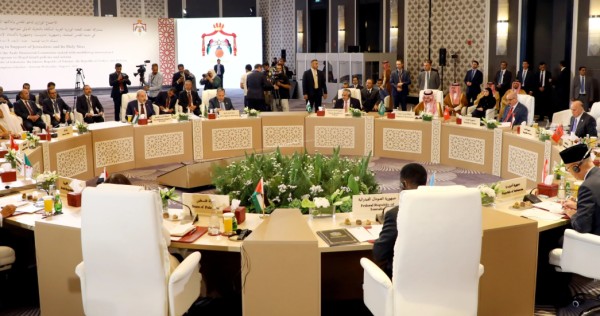
The foreign ministers of Arab and Islamic countries, during their ministerial meeting dedicated to supporting Jerusalem and its holy sites in the Jordanian capital, Amman, on Wednesday, rejected Israeli violations and me
Translated by Qiyas from السياسة — Original source
The foreign ministers of Arab and Islamic countries, during their ministerial meeting dedicated to supporting Jerusalem and its holy sites in the Jordanian capital, Amman, on Wednesday, rejected Israeli violations and measures aimed at altering the historical and legal status of the city of Jerusalem and its Islamic and Christian holy sites. They called on the international community to take practical steps to protect the holy city and support the resilience of the Palestinian people.
Safadi: The occupier has no sovereignty over occupied land, and Al-Aqsa Mosque is exclusively a Muslim place of worship.
Jordan’s Deputy Prime Minister and Foreign Minister Ayman Safadi opened the meeting by emphasizing that Israel, as the occupying power, holds no sovereignty over Jerusalem or its holy sites. He stressed that Al-Aqsa Mosque, covering its entire area of 144 dunams, is exclusively a place of worship for Muslims, and that the Jerusalem Waqf Administration, under the Jordanian Ministry of Endowments, is the entity with legal jurisdiction over its management. Safadi warned that the continuation of Israeli raids and measures, along with attempts to impose a new reality in the holy city, undermines peace prospects and pushes the region toward further tension. He reiterated the Hashemite Custodianship over the Islamic and Christian holy sites in Jerusalem under the leadership of King Abdullah II.
Shahin: Jerusalem faces its most dangerous phase of targeting and requires a collective rescue plan.
For her part, Palestinian Foreign Minister Faisal al-Shahin affirmed that Jerusalem is going through its most dangerous phase since its occupation, amid the ongoing war on the Gaza Strip, the accelerating pace of settlement, displacement, and annexation, as well as repeated attacks on Al-Aqsa Mosque and Christian holy sites. She called for adopting a comprehensive Arab and Islamic plan to rescue Jerusalem, which includes providing sustainable financial support to Palestinian institutions operating in the city, enhancing the resilience of its residents, and intensifying political and legal action to confront Israeli policies. She emphasized that East Jerusalem will remain the eternal capital of the State of Palestine.
Saudi Arabia: Altering the historical and legal status of holy sites is void and undermines peace prospects.
For his part, Saudi Foreign Minister Prince Faisal bin Farhan stressed that Jerusalem is facing continuous Israeli violations aimed at changing its historical and legal status and undermining its Arab, Islamic, and Christian identity. He affirmed that all unilateral measures, including settlement activities, land confiscation, raids, and attempts to change the status quo in holy sites, are null and void and carry no legal effect. He also reiterated that East Jerusalem is the capital of the State of Palestine, calling on the international community to assume its responsibilities and take practical steps to halt violations in the Gaza Strip and the West Bank, protect holy sites, and hold accountable those inciting violence, thereby preserving the chances of achieving peace.
Egypt: No security or stability in the region without a just solution to the Palestinian issue.
For his part, Egyptian Foreign Minister Badr Abdelatty affirmed that continuous Israeli violations in Jerusalem and the occupied Palestinian territories represent a dangerous escalation threatening regional security and stability. He noted that attempts to alter the historical and legal status of Islamic and Christian holy sites and undermine the Hashemite Custodianship constitute violations of international law and resolutions of the UN Security Council. He stressed that security and stability can only be achieved through ending the occupation, establishing an independent Palestinian state on the June 4, 1967 borders with East Jerusalem as its capital, and calling for an end to the aggression on the Gaza Strip and ensuring the delivery of humanitarian aid.
Arab League Secretary-General Calls for Urgent Action to Counter Occupation Policies in Jerusalem
Arab League Secretary-General Nabil Fahmy called for the launch of a comprehensive Arab program to support the resilience of Jerusalem’s residents, including strengthening the education, health, and housing sectors, alongside implementing diplomatic, legal, and media campaigns to counter Israeli plans aimed at altering the identity and historical and legal status of Jerusalem.
Pakistan’s Deputy Prime Minister and Foreign Minister, Muhammad Ishaq Dar, also called for a firm international move to halt settlement expansion and demographic changes in the occupied Palestinian territories. Meanwhile, Iraqi Foreign Minister Fawzi Hussein reaffirmed his country’s rejection of Israeli violations in Jerusalem, warning of their repercussions on security and stability. Tunisian Foreign Minister Mohamed Ali Nafti reiterated his country’s rejection of all Israeli measures aimed at changing the historical and legal status of Jerusalem, including settlement activities, forced displacement, and house demolitions.
The participants concluded the meeting by emphasizing the necessity of unifying Arab and Islamic efforts, and enhancing political, diplomatic, and legal actions to protect Jerusalem and its holy sites, and to counter Israeli measures aimed at imposing a new reality in the city, thereby preserving the prospects of achieving peace through a two-state solution.
