"Autumn of Dhofar"... Take it easy, beauty
Mountains shrouded in mist, valleys flowing with water, and lush green meadows... and kind people.
Sultanate of Oman - Dhofar - Susan Nasser
“Dhofar is my own paradise on earth, and nights that passed through it were brief.”
Thus, poetry summarized the beauty of Dhofar before images could tell its story. As soon as you arrive, you realize that poets did not exaggerate in their descriptions... “Greetings to whoever comes to Dhofar,” a phrase that welcomes you from the very first moment, leading you on a journey through mist, mountains, and greenery, where Dhofar’s autumn transforms from a tale told into an experience lived. Here in southern Oman, where mist blends with the cool air, you cannot help but admit, with the first gentle breezes, that “Dhofar’s autumn... is truly something else.” Along the way, drizzle was the constant companion of the journey, wetting faces with its mild chill, and giving the mountains, valleys, and plains a breathtaking green hue. Between pristine beaches, flowing valleys, and heights that embrace the clouds, a story unfolds before the visitor of a place that combines nature, history, and humanity, making Dhofar’s autumn an experience that cannot be condensed into a single photo or video clip, but must be lived in all its details. From these scenes, we began to document the details of our journey through the wilayats (governorates) of Dhofar, moving between sea and mountain, between heritage villages and ancient markets, in a journey filled with many stories and moments worth telling.
Our journey began at Salalah Airport, aboard an Air Arabia flight, where the first thing that greeted us was the air saturated with the scent of greenery after the rain. As soon as we left the airport heading toward the wilayat of Mirbat, we stopped at a vendor’s stall to taste the naranj; that fruit whose name is associated with Dhofar, and which visitors are keen to taste upon arrival... We continued our journey until we reached
military supplies
multilateral organizations
“Ayla Resort,” where the scene was completely different; low clouds and cold air, in a natural landscape that grants the place exceptional tranquility, making the visitor forget the hustle and bustle of cities as soon as they gaze at the sea and the mountains stretching before them.
“Mirbat”... Port and Fort
The next morning, our journey took us to “Mirbat Port,” where fishing remains an integral part of the locals’ lives. Between the moored boats and nets spread on the shore, we met several fishermen who spoke about fishing seasons and the most common types of fish in Dhofar’s waters, and how fishermen have passed this profession down from father to son.
From the port to “Mirbat Fort,” or “Sheikh Al-Wali’s House,” which took office in 1971, and was last held by Sheikh Amer Al-Amri. Within the fort’s ancient stone walls, pages of the wilayat’s history and its administrative and social role are embodied in a building that has retained its authenticity despite the passage of years.
“Bayt Kufan”
Since a journey in Dhofar is incomplete without stopping to see the features of the old Omani house, our next stop was “Bayt Kufan” in the wilayat of Taqah, whose design reflects the uniqueness of traditional Omani architecture, which harmonizes with the local environment using stone, wood, and natural materials, in a form that preserves the place’s identity and architectural heritage. Before continuing our journey, we passed by “Taqah Fort,” one of the most prominent historical landmarks in the wilayat.
...And here is lunchtime, and there is no doubt that fresh fish is the first choice for visitors to Dhofar, given this beautiful governorate’s reputation for diversity in marine resources and quality in its products.
“Wadi Darbat”
From there began one of the most beautiful stages of the journey: “Wadi Darbat.” But before reaching it, we stopped at “Abu Aref,” the stop almost everyone heading to the wadi agrees upon. Afterward, a natural tableau unfolded before us, one that cameras struggle to capture as it truly is; green mountains, waters flowing among trees, and mist gently cascading over the area, making the wadi one of the most beautiful natural sites in the Sultanate of Oman.
As evening approached, we moved to the “Return of the Past” event, where heritage seemed to come alive once again. Between marine, rural, Bedouin, and urban environments, the exhibits were not merely displays, but living scenes reflecting the details of old life in Dhofar, from traditional crafts and folk arts to ancient markets and social customs still present in the locals’ memory.
“Ain Hashir”
The next morning, we took the road toward “Ain Hashir,” where the adventure began with a mountain ascent via winding paths cutting through the fog. As soon as we arrived, the giant “Tbaladi” trees, known for their unique shapes and long lifespans, appeared like guardians of the place for hundreds of years. Amidst rocks and natural passages, the spring’s waters flowed, offering visitors a moment for contemplation before taking photos.
“Peace, O ‘Samhan’”
We continued our ascent to “Jabal Samhan,” a place that evokes a verse by the poet Ahmed Al-Jneibi:
“Peace, O Samhan, O lofty peak,
O the elevated one whose summit never falls.
As soon as we reached the summit, the fog began to drift below us, while mountains and valleys stretched as far as the eye could see, in a panoramic scene that captivates the eye. There, the nature of Dhofar reveals a new facet of its beauty, as if the place embodies the poet’s words in a living scene.
The journey was not limited to exploring nature, but extended to discovering the authentic Dhofari heritage. Amidst a heritage-rich atmosphere, we wore traditional attire, tasted local cuisine, and spent hours that transported us back to the time of our ancestors, showcasing a side of Omani identity that remains present in the details of daily life.
“Shu’at Fog”
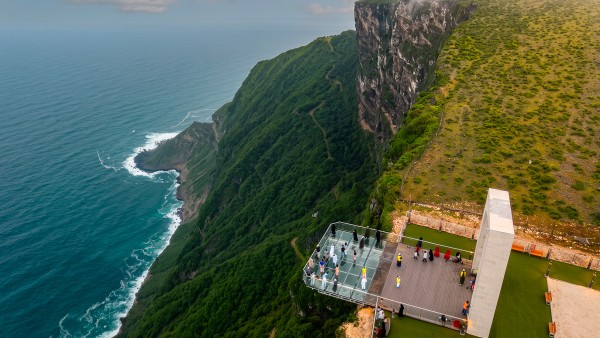
The road to “Jabal Shu’at” in the Rakhyut district was not merely a transition to a new stop, but an extension of the story; mist accompanied the journey, clouds drifted above the peaks, and a unique scene unfolded where the sea meets the mountain, making everything around us a living translation of the verses that sang of this place.
“The Hidden Beach” was not far from that tableau, serving as another worthy stop where the sea meets the mountain in a scene that instills a sense of tranquility in visitors and reveals another aspect of Dhofar’s natural diversity.
“Attin”: The Pulse of Autumn
As evening fell, “Attin Square” buzzed with activity and visitors. Cultural and entertainment events were distributed, folk arts resonated, and stalls displaying handicrafts, local products, and Omani cuisine were scattered throughout, making the square the beating heart of the Autumn Festival events.
Before closing the curtain on the journey, our stop was at the “Frankincense Land Museum,” which tells the story of this product linked to Dhofar’s history for thousands of years, documenting its role in the prosperity of ancient trade routes, until frankincense became one of the province’s most prominent symbols and a manifestation of its civilization. This also included the “Bilad” site, listed on the World Heritage List, as an essential part of the Frankincense Land.
From the museum, we headed to “Ain Rizat,” where water flows among dense trees in a scene reflecting another aspect of Dhofar’s natural beauty, before reaching our final stop: “Al-Hafit Market,” one of the oldest heritage markets in Salalah.
Amidst the scents of frankincense and incense emanating from perfume shops, traditional products, and souvenirs, no visitor can leave without carrying with them whatever memories of Dhofar’s richness they could gather.
As the departure time approached, the farewell was not easy. Dhofar is more than just a tourist destination; it is a story where the magic of nature blends with the fragrance of history and the authenticity of heritage, alongside the generosity of its people and their warm hospitality. We bid farewell to Salalah, our hearts overflowing with the warmth of its people, and our eyes filled with images of some of nature’s most beautiful creations on land, at sea, and in the sky.
We extend our sincere gratitude to the Ministry of Heritage and Tourism and to the Muttrah team for the warm reception, generous hospitality, and effective cooperation that facilitated travel arrangements, ensured the success of the visit, and helped achieve its objectives, while also reflecting the bright image of the Sultanate of Oman and its kind people.
Muammer Habis: “Frankincense” is Dhofar’s Identity and Its “White Gold”
Muammer Muslim Habis, who inherited the frankincense trade from his fathers and ancestors, stated that frankincense is not merely a natural product bestowed by the land, but an integral part of Dhofar Governorate’s identity and its ancient history.
Habis explained that Dhofari frankincense comes in various types and grades, with quality determined by the environment and geographical location where the frankincense tree grows. He noted that the most prominent and highest-quality type is Al-Hojari frankincense, which is considered the finest globally and the most valuable due to its high purity, its white color tinged with silver or light green, and its fragrant, sweet aroma. He added that this unique product has earned Dhofar worldwide recognition since ancient times, earning frankincense the title of “white gold.”
