Kuwait Stock Exchange reports net profits of 13.74 million dinars in the first half
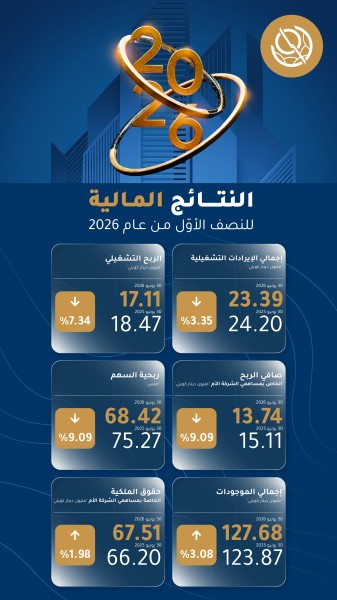
23.39 million KD in operating revenues and 17.11 million KD in operating profit, with earnings per share of 68.42 fils Badr Al-Kharafi: Kuwait Stock Exchange is the best-performing in the region; Q2 profit recovery confi
Translated by Qiyas from السياسة — Original source
23.39 million KD in operating revenues and 17.11 million KD in operating profit, with earnings per share of 68.42 fils
Badr Al-Kharafi: Kuwait Stock Exchange is the best-performing in the region; Q2 profit recovery confirms the resilience of our business model in the face of challenges
Our strategy is yielding results in the transition to a multi-asset market through the launch of the bonds and sukuk platform and the listing of Exchange-Traded Funds (ETFs)
Mohammed Al-Asimi: Positive growth in total return for the broad market index despite volatility... Trading volume reached 9.82 billion KD
Multilateral organizations
Vehicle laws and driving regulations
Governments
Institutional investors accounted for 70.08% of total trading, while international investors’ participation reached 18.79%
Kuwait Securities Bourse Company announced its financial results for the six months ended June 30, 2026, following its Board of Directors’ meeting held last Thursday, recording a net profit of 13.74 million Kuwaiti dinars.
The company stated in a press release that it recorded total operating revenues of 23.39 million Kuwaiti dinars for the six months ended June 30, while operating profit stood at 17.11 million Kuwaiti dinars. Earnings per share amounted to 68.42 fils for the period ended June 30, 2026. The company’s strong financial position was reflected in the growth of total assets to approximately 127.68 million Kuwaiti dinars, while shareholders’ equity reached 67.51 million Kuwaiti dinars as of June 30, 2026.
Business model resilience and restoration of growth momentum
Commenting on the financial results and the company’s strategic direction, Badr Al-Kharafi, Chairman of the Board of Directors of Kuwait Securities Bourse Company, said: “Kuwait Securities Bourse began 2026 amid a regional environment characterized by escalating geopolitical challenges and their impact on the broader economic landscape. Despite pressures affecting Q1 performance, including the precautionary suspension of trading in early March to protect the market and participants, the Kuwait Stock Exchange demonstrated a high capacity for adaptation and restored its growth momentum in Q2. Both operating revenues and net profit resumed their growth trajectory compared to the same period in 2025. Al-Kharafi added that the financial results trajectory confirms this momentum, as the year-on-year decline in net profit narrowed from 24.59% at the end of Q1 to 9.09% by the end of the first half, supported by improved operational performance and the recovery of Q2 results.
Al-Kharafi stated: “These results confirm that the Kuwait Stock Exchange is the best-performing in the region, and the Q2 profit recovery demonstrates the robustness and resilience of our business model in navigating economic and regional changes. This performance is built on diversified revenue sources and operational and financial discipline in cost management, which has contributed to enhancing operational efficiency and supporting performance sustainability. Amid ongoing regional uncertainty, we continue to manage our business with a methodology grounded in caution and discipline, while remaining committed to further developing Kuwait’s capital market, protecting investors’ interests, and strengthening its role as a cornerstone in supporting the national economy and achieving Kuwait’s development objectives.”
Market development and transition toward a multi-asset financial market
Al-Kharafi emphasized that regional crises and volatility have not deterred Kuwait Securities Bourse from continuing its ambitious strategy to develop the market’s structural infrastructure and expand its investment options. The first half witnessed milestone achievements in the market development program.
Al-Kharafi stated in this regard: “The launch of the bonds and sukuk trading platform in April, and the listing of exchange-traded funds (ETFs) in June, represent a strategic step in the development journey of the Kuwaiti capital market. They enhance the transformation of the Kuwait Stock Exchange from a market primarily focused on equities into a multi-asset financial market, thereby expanding investment options for a broader base of investors and opening new financing avenues for companies and financial institutions.”
He added, “The launch of the fixed-income platform and the listing of ETFs on the exchange complete the second part of the third phase of the Market Development Program (MD 3.2). This phase also included the implementation of the Central Counterparty (CCP) system and the upgrade of brokerage firms to the ‘Qualified Broker’ level.”
Concluding his remarks, Al-Kharafi expressed his gratitude, saying, “On behalf of the Board of Directors, I extend my sincere thanks to our shareholders for their continued trust, and to the executive management and company employees for their dedication and commitment. I also extend my thanks to the Capital Markets Authority and the capital market ecosystem for their continuous cooperation and support, and to investors and traders for their confidence. I reaffirm the Kuwait Stock Exchange’s ongoing commitment to developing a more efficient and transparent financial market that serves the national economy.”
Alongside financial results, the Kuwait Stock Exchange continued during the first half of 2026 to enhance market operational efficiency and implement its strategic priorities, which was reflected in market performance, trading stability, and the continued inflow of institutional and international investments.
Kuwaiti Market Performance... Resilience and Operational Efficiency
The exchange’s statement noted that the Kuwaiti capital market demonstrated a high capacity to maintain its stability and operational efficiency during the first half of 2026, overcoming regional geopolitical tensions and oil price fluctuations that had affected investor sentiment.
The market emerged as one of the most stable in the region, ranking third in the Gulf in terms of the “Total Return of the General Market Index,” following the Muscat Securities Market and the Saudi Exchange. The Kuwait Stock Exchange succeeded in being among only three Gulf markets to achieve positive returns during the first half, recording a 0.2% growth in total return. This figure reflects the actual value achieved by shareholders through price performance and sustainable cash dividends, while other regional markets experienced varying degrees of decline.
These indicators gain particular significance given the sensitivity of the regional environment and supply chain disruptions, underscoring the financial strength of listed companies and the efficiency of the market system across its operational and regulatory components, as well as its ability to sustain activity under the most difficult conditions.
Commenting on this, Mohamed Al-Asimi, CEO of the Kuwait Stock Exchange, said: “The Kuwaiti capital market’s positive growth of 0.2% in the total return of the General Market Index and its third-place ranking in the Gulf embody the capacity of our operational and regulatory systems to absorb geopolitical shocks with exceptional flexibility. This performance sends a clear message of confidence to the investment community regarding the financial strength of listed companies and their firm commitment to creating sustainable value and actual cash flows, thereby consolidating the Kuwait Stock Exchange’s position as a robust and reliable investment environment capable of protecting and growing capital amid regional challenges.”
In this context, Al-Asimi clarified: “Trading volume during the first half reached approximately KD 9.82 billion, with a daily average turnover of KD 84.64 million. These indicators reflect the continuity of market activity and the efficiency of its operational structure, despite the complex regional environment. We continue to work on enhancing the depth and sustainability of liquidity to support long-term market efficiency.”
Institutional Commitment... Trust, Transparency, and Efficiency
Kuwait Bourse stated in its announcement that it believes sustainable financial markets are built on solid pillars of trust, transparency, and efficiency, and that continuous development is a key element in strengthening its ability to meet investors’ expectations and global market requirements.
Guided by this approach, the company continues to work in coordination with the Capital Markets Authority, the Kuwait Clearing Company, and all stakeholders in the market ecosystem to enhance market efficiency and investment depth, and to develop its operational and technical infrastructure in accordance with the highest international standards.
Kuwait Bourse is also implementing its strategic initiatives aimed at enhancing the competitiveness of the Kuwaiti capital market and boosting its attractiveness to local and international investors. These efforts contribute to consolidating Kuwait’s position as a regional financial and investment hub and support the achievement of the objectives of Kuwait Vision 2035.
Trading Stability and Liquidity Enhancement
Kuwait Bourse maintained stable liquidity levels and regular trading operations during the first half, supported by continuous development of the market’s operational infrastructure. This helped contain the impact of regional challenges on trading activity and ensured efficient liquidity flow.
● Total value of traded shares during the first half: KD 9.82 billion
● Average Daily Trading Value (ADTV): KD 84.64 million
● Total market capitalization at the end of June: KD 52.16 billion
Diversifying the Investor Base and Enhancing Market Structure... Attracting Quality Listings
During the first half of 2026, Kuwait Bourse continued to strengthen the market structure and diversify its investor base by attracting quality listings on the “Main Market” and developing the investment environment. This contributed to maintaining market balance and continuity of activity despite regional challenges.
● Trading structure by investor type: Institutional investors accounted for the largest share, representing 70.08% of total market activity, while individual investors accounted for 29.92%.
● Trading structure by geography: International investors (including GCC nationals) accounted for 18.79% of total trading value, compared to 81.21% for local investors.
Al-Asimi emphasized the strategic importance of these data, stating: “Institutional investors accounted for 70.08% of total market activity during the first half, while international investors contributed 18.79% of total trading value. This reflects the continued presence of institutional investors and the diversification of the investor base despite regional volatility.
These indicators confirm the success of the Bourse’s efforts in providing an investment environment characterized by transparency and disclosure efficiency, which supports pricing efficiency and enhances confidence among various investor segments.”
Sustainable Operational Readiness and Enhancing International Investment Presence
The CEO of the Kuwait Stock Exchange emphasized that business continuity and the efficiency of technical systems formed the cornerstone for ensuring market continuity and protecting investors’ interests amid escalating geopolitical tensions. The exchange maintained full operational readiness of its technical infrastructure, relying on risk management frameworks and stress tests aligned with international best practices, thereby ensuring efficient trading operations and safeguarding participants’ rights under exceptional circumstances.
In line with the direct strategy to promote the Kuwaiti capital market and attract foreign investment:
● Global Presence: The exchange continued to strengthen engagement with the international investment community through its active participation in the fifth HSBC Conference for Gulf Cooperation Council (GCC) Stock Exchanges, and by organizing the 17th Institutional Day in London, the UK capital, with participation from representatives of listed companies and global financial institutions.
● Reinforcing Corporate Sustainability: The Kuwait Stock Exchange issued its fifth Sustainability Report for 2025, outlining developments in the implementation of Environmental, Social, and Governance (ESG) standards, in line with global best practices and aimed at enhancing sustainable value creation. Additionally, during the first half of 2026, it launched the updated version of the “Guide for Preparing Governance, Social Responsibility, and Environmental Reports” to support listed companies in improving disclosure quality, enhancing transparency, and consolidating sustainability practices within the Kuwaiti capital market.
