Palm Alloys... Shining in the Groves of Abundance and Al-Abdali
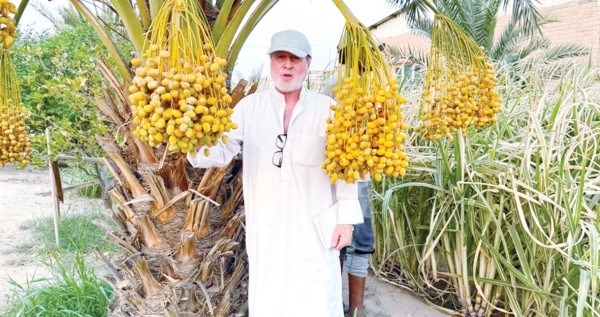
Al-Burhi dates have ripened, and production is promising in both quantity and quality.
Consumers prefer Al-Burhi in the Khalal (yellow) and Rutab (soft) stages, while Al-Khalas is preferred as dried dates.
Kuwait is the most renowned Arab country for producing the delicious yellow Al-Burhi.
Date palms in Kuwait’s orchards, particularly in the Al-Wafra and Abdali areas, have borne fruit. Clusters of yellow Al-Burhi hang like ingots of gold, awaiting harvest and consumption.
“Al-Siyasa” visited several farms and consulted with date palm production specialists, who noted that this season’s overall production is good and promising in terms of both quantity and quality.
Khalid Al-Sultan, supervisor at Mandou Abu Al-Saud’s farm in the Al-Wafra agricultural area, stated: “Demand for Al-Burhi, which Kuwait is famous for producing among other regional countries known for date cultivation, is strong.”
He explained that marketing Al-Burhi (Khalal) as whole clusters or bunches is difficult for several reasons, the most important being that the dates within a single bunch do not ripen simultaneously. Therefore, manual individual picking is the only option, which requires additional labor that is currently scarce, as well as significant effort and time. However, we have no alternative but to proceed this way, as the priority is that people can enjoy and appreciate the fruit, praise be to God, Creator of the soft and the hard. Especially since this season’s production promises high quality.
For his part, Majid Al-Sudani, deputy manager at Khalid Al-Awda’s farm in the Al-Wafra agricultural area, said: “Consumers generally prefer Al-Burhi in the Khalal (yellow) stage, as well as in the Munasif (soft/Rutab) stage, while they prefer eating Al-Khalas as dried dates. Currently, Kuwait is the most renowned across the entire Arab region for producing the delicious yellow Al-Burhi.”
Adding that he has extensive experience in cultivating, producing, and marketing dates, he noted: “The high humidity currently prevailing in Kuwait accelerates the softening of yellow Al-Burhi dates, causing them to transition within a few days into the Tamar stage—turning into brown, sticky dates that are not suitable for marketing unless processed in date packing factories in Kuwait, the most prominent of which is the ‘Saif’ factory in Al-Wafra.”
He clarified that most orchard owners prefer to market their dates in the Khalal (yellow) or Munasif (soft) stages, as selling yellow Al-Burhi is easier than selling it as dried dates. Additionally, the fruit weighs more in the Khalal stage, making it easier to pack and market, especially in the Munasif (soft) stage. I support this refined taste in consuming date palms, as Al-Burhi is only eaten as Khalal (yellow) and then as Rutab (Munasif).
He continued: “As for the famous or most widely cultivated variety in Kuwait’s orchards, namely Al-Khalas, it is preferred to be eaten as dried dates or in the Makbus stage, appearing as brown-colored dried dates. Nothing surpasses Al-Burhi when eaten as Khalal (yellow), and nothing surpasses Al-Khalas when eaten as dried dates.”
He explains that date palms do not ripen all at once, or even within a few days across the country. In fact, dates on a single palm tree do not ripen simultaneously, allowing them to be consumed over several months during the summer. In Kuwait’s residential streets, you will find dates ripening earlier than those in the Al-Awda orchards. Moreover, within a single cluster (uthq) on one palm tree in Al-Awda, the inner dates ripen or turn yellow before the outer ones. Often, a single cluster on one palm displays a gradient of colors—green, yellow, and brown—with intermediate stages known as "rutab" (semi-ripe), which exhibit a mix of yellow and brown hues within the same cluster and on the same tree.
He notes that production of the "Barhi" variety is low at the beginning of August, peaking at the end of the month. This variability necessitates hand-picking; specifically, harvesting only the ripe dates daily, followed by packaging and distribution to local markets, as cutting entire clusters is impractical since not all dates within them ripen simultaneously.
Spraying date palms with sulfur is harmful.
Furthermore, Hamza Al-Samkharati (Abu Islam), an expert in date palm cultivation, confirmed that hand-picking Barhi dates one by one is difficult, particularly during periods of extreme heat and severe shortages of agricultural workers in Kuwait.
He added: "There is a method to make dates in a cluster ripen or turn yellow more quickly and uniformly, which involves spraying them with sulfur. However, we do not use this method because dusting date palms with sulfur, although sometimes necessary to eliminate spider mites brought by dust or windy conditions, harms consumer health if the Barhi dates (which are yellow) or semi-ripe dates are not thoroughly washed with clean water and a cleaning solution."
Al-Samkharati pointed out that "date palm production in some Al-Awda orchards is better than last season, which is typical for large seasonal trees; they yield abundantly one year and less the next. This phenomenon is also said to apply to old seasonal olive trees in Mediterranean countries."
He expects that thousands of productive Barhi and Kholas date palms in the Al-Awda and Abdali farms will release hundreds of tons this season. He estimates that the number of productive date palms in these specialized farms, dedicated to cultivating and producing dates in Al-Awda and Abdali, is approximately 10,000 trees, placing Kuwait’s farms among the leading regional producers in date cultivation and production.
