Riyadh breaks the ice and unites Aoun and Berri's stance on negotiations and support for the army
Discovery of Hezbollah’s electrical communications network in Beirut Beirut – “Al-Siyasa” – From Omar Al-Bardan The meeting held yesterday at Baabda Palace between Lebanese President Joseph Aoun and Speaker of the Parlia
Translated by Qiyas from السياسة — Original source
Discovery of Hezbollah’s electrical communications network in Beirut
Beirut – “Al-Siyasa” – From Omar Al-Bardan
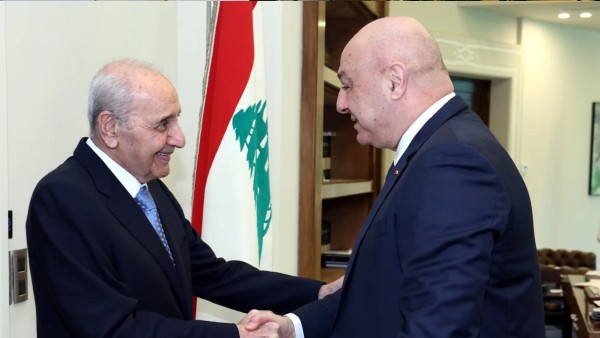
The meeting held yesterday at Baabda Palace between Lebanese President Joseph Aoun and Speaker of the Parliament Nabih Berri, the first between the two men since the launch of direct Lebanese-Israeli talks last March, served as an opportunity to break the ice between the presidency and the speakership, restoring normalcy to their relationship. More importantly, according to “Al-Siyasa” sources, the meeting took place with Saudi approval, as Riyadh played a key role in dispelling tensions between Aoun and Berri through the reconciliation efforts of Saudi envoy Prince Yezid bin Farhan. Based on this information, Saudi communications led by Bin Farhan focused primarily on bridging differences between the presidency and the speakership, aiming to unify the Lebanese front in the face of looming challenges, particularly regarding the completion of framework agreement talks between Lebanon and Israel scheduled for early August. This comes amid Arab and international support for Lebanon’s political and security choices, emphasizing national decision-making independence and the state’s authority over its entire territory. The meeting between Presidents Aoun and Berri took place on the eve of Prince Yezid bin Farhan’s return to Beirut to continue his efforts to strengthen national consensus among Lebanese components.
It was learned that upon Speaker Berri’s arrival at President Aoun’s office, the latter greeted him with “We missed you,” to which the Speaker replied, “We are with the majority.” The atmosphere at the Baabda meeting was described as “positive,” with both leaders agreeing to support the Lebanese Army, maintain civil peace, and back the government. Meanwhile, “Al-Siyasa” learned from presidential circles that Aoun and Berri emphasized the importance of a unified Lebanese position on the negotiation track, stressing the necessity of a final ceasefire covering all Lebanese territories, and ensuring Israel’s complete withdrawal from all lands, guaranteeing the return of residents, release of prisoners, and the start of reconstruction efforts. President Berri maintained his stance on direct talks, advocating for indirect negotiations and insisting that Lebanon’s primary demand be compelling the Israeli occupation to implement a sustained ceasefire. The meeting also reviewed general developments on the local and regional fronts, particularly the situation in the south amid ongoing Israeli attacks on southern villages and towns, including house demolitions and bulldozing, with emphasis on the need to halt such occupation practices. President Aoun briefed Berri on the outcomes of his recent visit to Washington and his discussions with top US officials, including President Donald Trump and Secretary of State Marco Rubio. Upon leaving Baabda Palace, President Berri clarified that the discussions covered the Washington visit and the southern situation, adding that, as usual, he was satisfied with the meeting.
International Relations
Subscription to Al-Siyasa Newspaper
Arabs and the Peoples of the Middle East
As President Aoun heads to Turkey today, where he is expected to meet his Turkish counterpart, Recep Tayyip Erdogan, to discuss a packed agenda encompassing economic files and their offshoots—such as energy, electricity, and security issues related to the Syrian displacement file in Lebanon and how to facilitate its repatriation to Syria—alongside updates on regional and international developments, Lebanese official sources stressed to "Al-Siyasa" the importance of the Saudi and Gulf role supporting Lebanon, whether through backing the Lebanese state and its institutions or in international forums. They considered the clearest affirmation of this supportive role to be that Saudi Arabia, like other Gulf Cooperation Council (GCC) states, does not interfere in Lebanon’s internal affairs, as evidenced by statements from Saudi and Gulf officials who emphasize that they support only the Lebanese state. This, they noted, has greatly helped to develop and strengthen bilateral relations across all fronts, underscoring the deep-rooted fraternal ties between Lebanon and all GCC countries, and explaining Lebanon’s efforts to preserve these historic relationships with its Gulf brothers.
In a serious security development, sources revealed that Lebanese security agencies discovered Hezbollah’s communication lines connected to electricity extensions in Beirut, similar to its network in the South, the Bekaa, and the suburbs. The sources pointed out that an international entity had revealed that Hezbollah exploited communication lines within Lebanon’s network, noting that US intelligence is monitoring the discovered communication network. It was also revealed that the company which installed Hezbollah’s communications receives support from leaders within the Shiite duo. Meanwhile, just days before the sixth anniversary of the Beirut port explosion on August 4, 2020, and the ensuing controversy over the storage of ammonium nitrate at the port—with Hezbollah and the regime of ousted Syrian President Bashar al-Assad accused of importing it for use in explosive barrels that Assad attempted to use against his opponents—the file has resurfaced. This is not due to the stalled judicial investigation hampered by political pressures and obstructions, but rather from UNIFIL forces discovering 4,000 kilograms of highly explosive ammonium nitrate in the southern town of Hawloun, which is believed to belong to Hezbollah, as no other entity has the capacity to import, transport, and store it without the party’s involvement.
