ISCESCO Magazine Opens File on Arabic Language and Cognitive Identity
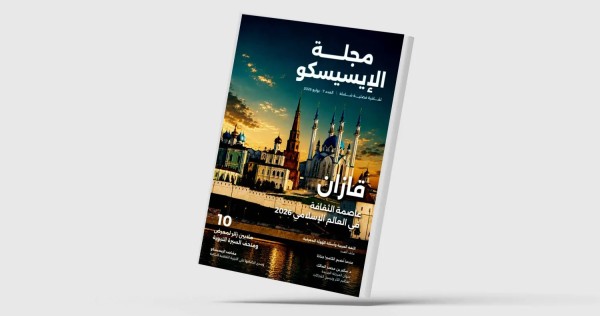
The new issue of "ISESCO" magazine presents a collection of cultural dossiers, alongside a panoramic intellectual section that brings together issues of culture and language, education, science, heritage, and philosophy.
The most prominent dossier of the issue is titled "The Arabic Language and Questions of Cognitive Identity," which addresses issues of language, identity, and the Arabization of sciences. Through several articles, it explores the relationship between language and knowledge production, the challenges facing Arabic in the era of artificial intelligence and digital transformation, and the prospects for renewing its presence in scientific research, education, and culture. This dossier emphasizes that the Arabic language is not merely a means of communication, but a vessel of identity.
On the occasion of the reappointment of Dr. Salem bin Mohammed Al-Malik as Secretary-General of the "ISESCO" organization, the Editor-in-Chief, poet Rawda Al-Hajj, conducted an interview with him. In the interview, he discussed the key priorities for the organization’s new phase, which are "maximizing impact and consolidating partnerships."
News Bulletin
Digital News Services
Newspaper Archive
Download the cover image of the issue, featuring the city of Kazan, "Capital of Islamic Culture for 2026," in celebration of a city that has managed to offer a unique model of creative interaction between civilizations, combining the authenticity of heritage with the spirit of the times, thus appearing as a spacious arena for coexistence and cultural diversity.
In her opening editorial for the issue, the Editor-in-Chief noted that, starting from this issue, the magazine will be published in three languages: Arabic, French, and English.
Under the title "The Arabic Language... Between a Rich Reality and a Weary Alienation," Ahmed Salim bin Ahmed Al-Armi, Secretary-General of the "Mauritanian Association for the Protection of the Arabic Language," wrote an article discussing the status of the Arabic language in the world from two contrasting perspectives; the first highlights the growing international status of Arabic, while the second tracks signs of decline within Arab societies themselves.
Another article in the same dossier is titled "Arabizing Medical Education: Between Restoring Identity and Enhancing Learning Quality," by Dr. Khalid Al-Abdulrahman, Professor of Family Medicine at Imam Muhammad bin Saud Islamic University in Saudi Arabia.
