Al-Musabih Explores the Memory of Kuwaiti Heritage: Place, People, and Identity
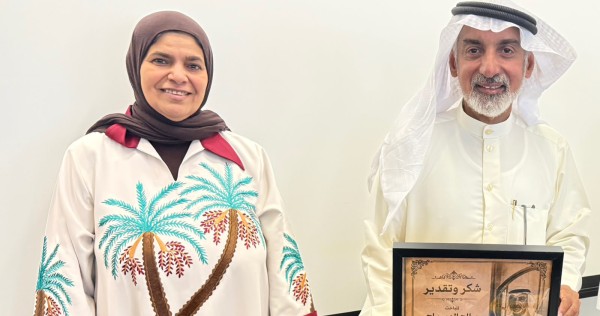
During a lecture hosted by Hessa Al-Sanousi at Kuwait University
Kuwait University faculty member Dr. Hessa Al-Sanousi hosted heritage researcher and board member of the Kuwait Heritage Society, Saleh Al-Musbah, as part of a national cultural and literary event titled “Memory of Kuwaiti Heritage: Place, People, and Identity” at Kuwait University. The event was attended by Dr. Latifa Al-Tamar and a large number of students, who actively engaged with the lecture’s themes, which aimed to strengthen Kuwaiti identity through numerous questions and inquiries, thereby fostering an atmosphere of dialogue and scholarly discussion.
At the outset of the meeting, Al-Sanousi emphasized that hosting Al-Musbah was in recognition of his significant contributions to documenting Kuwaiti heritage. She noted that he has authored many works and made substantial scientific contributions that have enriched the Kuwaiti literary corpus. She added that Al-Musbah is known for his love of books and his dedication to acquiring rare books and manuscripts, in addition to his continuous collaboration with researchers and heritage enthusiasts, making his sources and references available to them. This reflects his conviction regarding the importance of preserving and documenting heritage.
During the lecture, Al-Musbah explained that the manuscript by Sheikh Musaid bin Ahmed bin Muaid Al-Azmi is the oldest known manuscript in Kuwait’s history. Written by his own hand in 1682 CE on Failaka Island, it is a copy of Imam Malik bin Anas’s “Al-Muwatta.” He also presented the book “History of Kuwait’s Mosques” by historian Adnan Salem Al-Roumi, noting that it documents mosques in the Central, Jabla, East, Marqab, Fahaheel, Abu Hleifa, Al-Qurain, and Jahra areas up until the year the city wall was demolished in 1957. The book includes the names of the mosques, their founders, dates of construction and renovation, as well as the names of imams, muezzins, and staff who worked in them.
He also spoke about the book “Kuwaiti Camel Pilgrimage Caravans,” which he completed in collaboration with historian Adnan Salem Al-Roumi and Dr. Khalid bin Yousef Al-Shatti. The work documents 31 Kuwaiti camel pilgrimage caravans dating back to 1800. The team subsequently continued publishing the book “Kuwaiti Pilgrimage Caravans Through History,” which traced the evolution of Kuwaiti pilgrimage journeys using various modes of transport, along with the associated customs, traditions, and values of mutual support among Kuwaitis.
Furthermore, he discussed the manuscript “Qala’it Al-Ghawwas” (Shares of Divers), written by Jasim Mohammad Boudi in 1912 during the reign of Sheikh Mubarak Al-Sabah. He clarified that it documents the “Qala’it” system, which was practiced on pearl-diving vessels after the sale of the pearl harvest. He also reviewed the book “Encyclopedia of Kuwaiti Diving and Sailing Voyages” by researcher Shifa Al-Mutairi, praising the research effort invested in its preparation and noting that its second edition will be published in November 2026.
At the conclusion of the lecture, the swimmer highlighted several key publications documenting Kuwait’s history, including “History of Kuwait” by historian Abdulaziz Al-Rashid (1926), “Pages from Kuwait’s History” by Sheikh Yusuf bin Issa Al-Qanaei (1946), “From Kuwait’s History” by Saif Marzouq Al-Shamlan (1959), Rashid Al-Farhan’s “Abridged History of Kuwait” (1960), Abdullah Al-Hatim’s “And Here Kuwait Began” (1962), as well as Ahmed Bashir Al-Roumi’s articles (1968). He emphasized that these works serve as foundational pillars for preserving Kuwait’s history and heritage and transmitting them to future generations.
