Al-Waqian: Rural environment is disappearing and its remnants must be preserved
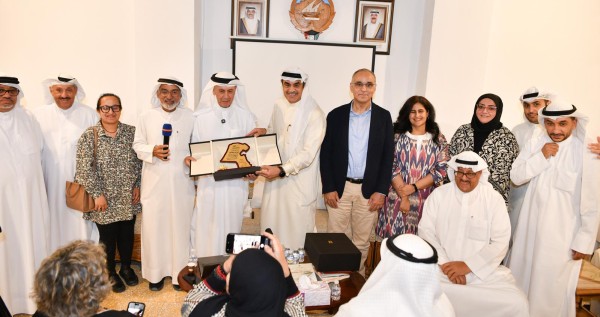
At the conclusion of the Kuwaiti Heritage Association’s Cultural Season
The Kuwaiti Heritage Association concluded its cultural season with a session titled “The Kuwaiti Countryside… A Fading Memory: Al-Jahra as a Model,” presented by writer Dr. Khalifa Al-Waqian and moderated by board member Saleh Al-Musbah. The event was attended by a distinguished group of writers, intellectuals, and individuals interested in cultural and heritage affairs.
In his introduction, Al-Musbah outlined aspects of Al-Waqian’s literary and intellectual career. Regarding the lecture’s theme on the countryside, he clarified that Al-Waqian wished to present his particular perspective on the subject.
For his part, Al-Waqian stated, “Kuwait is characterized by three distinct environments: the marine, the desert, and the rural. The marine environment gave rise to the profession of pearl diving for extraction, as well as seafaring for transporting goods. The desert environment supplied the city and villages with meat, dairy products and their derivatives, as well as wool and hides. The rural environment, meanwhile, served as a source of food through its abundant agricultural produce for humans, primarily wheat, followed by vegetables.
“Historian Sheikh Abdulaziz Al-Rashid, in his book ‘History of Kuwait,’ published in 1926, listed Kuwait’s exports, including pearls, oil, wool, leather, camels, foxes, cattle, sheep skins, and tomatoes.”
Al-Waqian added, “The rural environment was severely neglected until it virtually disappeared. What remains today are only a few small pockets that escaped neglect and destruction. Among these pockets are the farms of Al-Jahra. Fortunately, they became surrounded by residential developments. Consequently, those who benefited from acquiring state lands at bargain prices did not notice them at the time, allowing them to survive. I recognized this reality thirty years ago, when I began carrying the burden of preserving the Kuwaiti village, or at least one model of it, so that we could tell our children that their forefathers worked hard and provided much.
“The agricultural regions produced various crops: Al-Fintas, Al-Fahaheel, Al-Shuwaikh, Buhaifa, and Al-Munqaf in the south, and Al-Jahra in the north, even producing wheat.”
He clarified that the pockets that escaped destruction were the “farms of Al-Jahra.” Recalling his memories, Al-Waqian said his family spent about three months there each year, even though they did not own a farm, only a house. This was common among many Kuwaiti families who were accustomed to spending their spring vacation in Al-Jahra, while others extended their stays.
He added that these memories remained vivid in his heart, particularly the scenes of the farms where he would wake up to the sound of irrigation machinery.
He noted that these memories later prompted him to revisit the farms to verify what remained, expressing his delight upon finding several still standing as they were in the past, complete with earthen paths, buildings, and small rooms where farmers used to rest. He emphasized that they represent a complete model of an authentic Kuwaiti rural environment, requiring only care, restoration, and preservation. Dr. Al-Waqian pointed out that the Jahra wells are “distinctive,” as he described them, bearing the marks of history. They were constructed using a traditional method that suggests their antiquity, even though the stones were transported from other locations, such as the Al-Muta’a heights, and passed down through generations. He added that he documented these wells through photography and video, remarking, “I was confident that officials would feel happy when they see them.”
Al-Waqian clarified that since 1998, he had been addressing the National Council for Culture, Arts and Letters, proposing the preservation of the Jahra farms and their conversion into a “living agricultural museum” after rehabilitation, to serve as a cultural and tourist destination for future generations. He added that he resubmitted the proposal in 2000, but the project stalled due to bureaucratic procedures. He noted that he feared the farms might be demolished as part of the Jahra National Park project. Dr. Al-Waqian stated, “In 2016, I met with Brigadier Fahd Al-Amir, the former governor of Jahra, accompanied by Dr. Sultan Al-Duwish and Dr. Khalaf Al-Khatimi, and presented him with a copy of the memorandum. Brigadier Fahd Al-Amir made significant efforts that surpassed those of all relevant government entities. However, about a year ago, I learned that the jurisdiction of the National Park had been transferred from the city of Jahra to the Kuwait Municipality.”
During the meeting, Dr. Al-Waqian presented a photographic file documenting the Jahra farms, which included images capturing details of the agricultural environment, such as palm groves, traditional stone-lined wells, irrigation channels, and earthen roads, alongside agricultural fields that reflect the characteristics of the village. He affirmed that these images constitute an important visual documentation of an agricultural heritage worthy of preservation and conservation. He explained that the file contains both old and recent photos documenting the Jahra farms across different time periods, and also recorded the names of owners of several of these farms, which date back to the families of Al-Amir, Al-Huda, Mutairan Al-Habshi, Farah Mahous Al-Farah, and Al-Ayyar. Dr. Al-Waqian concluded his lecture by calling for concerted efforts to preserve what remains of the Kuwaiti countryside, saying, “I hope you feel a sense of urgency to preserve the remnants of what is referred to as the Kuwaiti countryside, or the Kuwaiti village, after most of its landmarks have disappeared, leaving only this model.”
