GCC countries and EU reaffirm strengthening strategic partnership and joint coordination
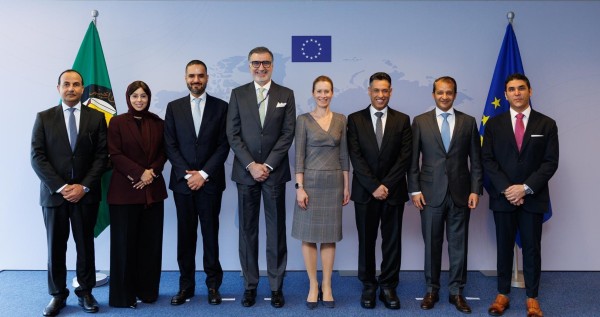
Nawaf Al-Anezi and Kaja Kallas emphasized the importance of strengthening Gulf-European partnership and cooperation in maritime security and the Strait of Hormuz.
Translated by Alqyas from Al-Seyassah — Original source
Ambassadors and representatives of the Gulf Cooperation Council (GCC) member states to the European Union, along with the EU’s High Representative for Foreign Affairs and Security Policy and Vice-President of the European Commission, Kaja Kallas, emphasized the importance of strengthening the strategic partnership between the two sides and intensifying coordination and consultation on regional and international developments of mutual interest.
In a statement to the Kuwait News Agency (KUNA) on Tuesday, Kuwait’s Ambassador to Belgium and Head of Kuwait’s missions to the European Union and the North Atlantic Treaty Organization (NATO), Nawaf Al-Anzi, said these remarks were made during a meeting held with Kallas at the European Commission headquarters in Brussels.
He added that the meeting discussed ways to consolidate Gulf-European cooperation, expressing Kuwait and the GCC states’ appreciation for European positions supportive of them since the onset of Iranian aggression, and looking forward to continued European support and solidarity with Gulf states.
Al-Anzi clarified that the discussions underscored that the serious escalation in the region and its repercussions on maritime security, energy security, and global supply chains reflect the close interconnection between Europe’s security and that of the Arabian Gulf and the Middle East, as well as their stability.
He noted that both sides also reviewed preparations for the upcoming third high-level Gulf-European Forum on Regional Security and Cooperation, which is scheduled to be hosted by the European Union in mid-July in Brussels, as part of continuing the strategic dialogue between the two sides.
For her part, Kallas reaffirmed the European Union’s commitment to continue working with GCC states as reliable partners in the region, emphasizing its dedication to enhancing cooperation in priority areas, particularly maritime security and the protection of freedom of navigation in international sea lanes, including the Strait of Hormuz.
She also reiterated the EU’s firm opposition to imposing any new fees or measures on navigation in the Strait of Hormuz, stressing the importance of maintaining the smooth flow of global trade and the security of sea lanes.
