International Online Conference Supports the 'Interim Government' of the Iranian National Council of Resistance
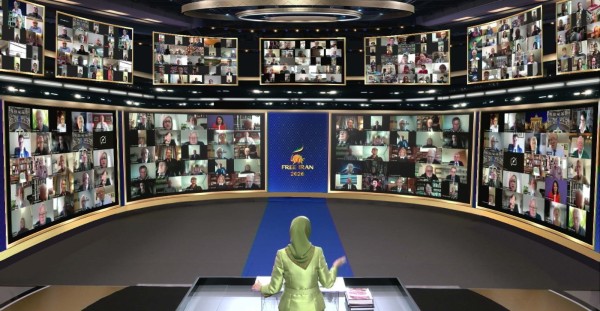
The conference announced its support for the ten-point plan for a democratic political transition in Iran
Translated by Alqyas from Al-Seyassah — Original source
The international arena witnessed, on Sunday, March 15, an online international conference titled “Support for the Interim Government of the National Council of Resistance of Iran Based on the Ten-Point Plan,” with the participation of prominent political, parliamentary, and diplomatic figures from Europe, North America, and several other countries. The conference aimed to discuss developments in Iran amid the ongoing war in Iran and the region, and to affirm the existence of an organized democratic alternative and a transitional roadmap that would prevent chaos.
The convening of the conference came at a moment that participants described as pivotal, given the overlap of Iran’s internal crisis with escalating regional tensions and growing international questions about the “day after” scenario and the prospects for political transition in Iran.
In this context, the announcement of the “Interim Government” by the National Council of Resistance of Iran received broad political support, as it was viewed as a time-bound transitional framework for transferring sovereignty to the Iranian people through elections for a constituent assembly within six months, paving the way for drafting a new constitution for the new republic.
Regaei outlined what she described as a long record of warnings and revelations by the Iranian Resistance over the past decades, including the exposure of secret nuclear sites in 2002, alongside the exposure of terrorist networks, regional interventions, and systematic human rights violations, which led to dozens of condemnation resolutions at the United Nations.
She stressed that, in her view, the Iranian regime “will not reform” and will not abandon its nuclear project or its expansionist policies, expressing her opposition to the continuation of appeasement policies.
She also presented the features of the Interim Government as a transitional mechanism for transferring power to the Iranian people, highlighting five elements that constitute the structure of the Resistance: a democratic coalition represented by the National Council of Resistance, which includes more than 450 members, half of whom are women; a strategy to remove the Islamic Revolutionary Guard Corps; a network of “Resistance Units” inside Iran; and a comprehensive program for the post-regime fall phase.
According to Regaei, this phase is based on the Ten-Point Plan, which includes fundamental principles such as the separation of religion from the state, equality between women and men, the abolition of the death penalty, guaranteeing the rights of nationalities and ethnic components, equality among followers of different religions and sects, and establishing an Iran free of nuclear weapons that lives in peace with the international community.
In presenting the field aspect, Regaei stated that the Resistance Units carried out approximately 3,000 anti-oppression operations during the past year, emphasizing that they played a significant role in organizing and expanding the January uprising, which, according to her, saw more than 2,000 missing persons whose fate remains unknown.
For his part, Italian Senator and former Foreign Minister Giulio Terzi considered that the conference reflected unprecedented international support for a democratic alternative in Iran, noting that more than a thousand international figures, including former heads of state and government, ministers, and parliamentarians, had signed a joint statement supporting the Interim Government announced by the National Council of Resistance of Iran.
He clarified that this support reflects growing recognition of the existence of an organized and legitimate framework for a peaceful political transition based on the will of the Iranian people, reiterating his support for the Ten-Point Plan as a clear vision for establishing a democratic state based on the rule of law, human rights, and gender equality.
For his part, former Canadian Foreign Minister John Baird affirmed that the post-1979 experience demonstrated that the policy of appeasement failed to change the behavior of the Iranian regime, instead contributing to its prolongation. He stressed that change cannot come through external military intervention, but rather through the will of the Iranian people and their opposition organizations.
Baird pointed out that the viable alternative lies in the existence of leadership, organizations, and networks capable of mobilizing the streets to overthrow the regime, considering these elements to be present within the National Council of Resistance of Iran (NCRI) led by Maryam Rajavi.
The conference was attended by several prominent international figures, including Charles Michel, Guy Verhofstadt, Yves Leterme, General Wesley Clark, and Carla Sands, alongside political and parliamentary figures from Europe and the United States.
Participants concluded the conference by affirming that the interim government and the Ten-Point Plan represent a practical pathway for the post-regime phase, ensuring an orderly transition toward a democratic republic and preventing a political vacuum.
They also called for intensified international pressure on the Iranian regime, including halting executions, releasing political prisoners, guaranteeing internet freedom, and cutting off funding sources for repressive apparatuses, as essential steps to support the Iranian people’s aspirations for freedom and popular sovereignty.
