Tanker War Erupts... Two Ships Targeted Near Dubai and Ras Al-Khaimah, Third in the Strait of Hormuz
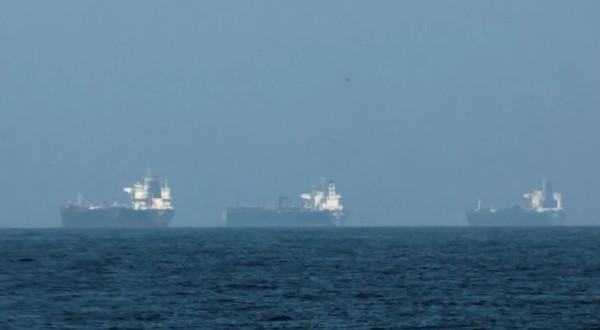
Damage to ships in the Gulf and Strait of Hormuz due to unknown projectiles, with threats from Iran and the United States.
Translated by Alqyas from Al-Seyassah — Original source
London and Bangkok – Agencies: The UK Maritime Operations Centre reported that two cargo ships sustained damage from unidentified projectiles near the UAE coast, one approximately 50 nautical miles northwest of Dubai and the other 25 nautical miles northwest of Ras Al Khaimah. The Centre stated that a bulk carrier reported being hit by an unidentified projectile near Dubai, with no crew injuries. The master of another vessel also reported damage from an unidentified projectile northwest of Ras Al Khaimah, noting that the crew was unharmed. In a separate incident, a third cargo ship was struck by a projectile in the Strait of Hormuz, 11 nautical miles north of the Sultanate of Oman, causing a fire on board. The crew requested assistance and began evacuating the vessel. The UK Centre said it had received approximately 17 reports since February 28 of incidents targeting ships in the Arabian Gulf, the Strait of Hormuz, and the Gulf of Oman, including 13 attacks and four suspicious activities.
Meanwhile, the Royal Thai Navy reported that a Thai-flagged cargo ship came under attack near the Strait of Hormuz, noting that operations were ongoing to rescue three of the 23 crew members. The navy said the Thai-flagged vessel “Mayuri Nari” was attacked while transiting the Strait of Hormuz, adding that investigations were underway to determine the cause and source of the attack. Shortly before, the UK Maritime Trade Operations (UKMTO) reported that a cargo ship had been targeted by an unidentified projectile in the Strait of Hormuz, resulting in a fire on board. The vessel requested assistance, and the crew was evacuating. UKMTO, part of the UK Royal Navy, also reported an incident 25 nautical miles northwest of Ras Al Khaimah in the UAE, stating that the master of a container ship reported damage from what was suspected to be an unknown projectile. The extent of the damage had not yet been determined, but all crew members were safe.
While Ali Larijani, secretary of Iran’s Supreme National Security Council, claimed that the Strait of Hormuz could become a pressure point against Iran’s adversaries if the war continues, dismissing U.S. President Donald Trump’s threats to his country regarding the strait as “empty,” and stating that the strait must either be a passage of relief for all or a chokehold for those dreaming of war, emphasizing that the Iranian people do not fear threats, President Trump announced the destruction of 10 mine-laying boats. He warned Iran of unprecedented military consequences if it laid mines in the Strait of Hormuz, stating on his Truth Social platform that if Iran had laid any mines in the strait—and there were no reports that it had—they would be removed immediately. He added that if mines were laid for any reason and not removed immediately, the military consequences would be at an unprecedented level. He continued, “We are using the same technology and missile capabilities deployed against drug traffickers to permanently eliminate any boat or ship attempting to lay mines in the Strait of Hormuz, and they will be dealt with swiftly and forcefully.”
While the spokesperson for Iran’s Khatam al-Anbiya Headquarters renewed threats that not a single barrel of oil would reach the United States or its allies, the UK Maritime Trade Operations (UKMTO) warned that continued disruption of navigation in the Strait of Hormuz would have indirect repercussions affecting energy markets, maritime shipping, marine fuels, fertilizers, and global supply chain costs. In an assessment posted on its X (formerly Twitter) account, the agency stated that the maritime threat environment in the region remains at a critical level, predicting that attacks on commercial vessels would continue while operating conditions at sea remained extremely hazardous. It noted, “In practical terms, the Strait of Hormuz continues to experience functional disruption for normal commercial shipping traffic. Current vessel traffic levels, shipowners’ behavior, and insurers’ positions indicate a continuing breakdown in confidence in the normal passage of commercial vessels.” Although the assessment confirmed that no confirmed attacks on commercial ships had been recorded in the past 72 hours, it clarified that credible threats persisted in the Arabian Gulf, the Strait of Hormuz, the Gulf of Oman, the Red Sea, the Bab al-Mandab Strait, and the Gulf of Aden. It pointed out that recent incident patterns suggested a campaign aimed at disrupting maritime operations and sowing uncertainty, with strikes targeting anchored vessels, drifting ships, and support vessels responding to incidents. The UKMTO strongly advised commercial vessels operating within the critical threat zone to maintain continuous communication and reporting with the agency, and urged mariners to remain vigilant for the possibility of unexploded ordnance on damaged vessels and to treat any suspected projectiles as posing a severe risk.
