Trump: Iran Wants to Reach an Agreement on Its Nuclear and Missile Programs
Trump calls for an agreement with Iran and responds to its demands, while Larijani confirms positive negotiation developments.
Translated by Alqyas from Al-Seyassah — Original source
Washington, Tehran, Capitals – Agencies: While U.S. President Donald Trump expressed his belief that Iran wants to reach an agreement with the United States regarding its nuclear program and its ballistic missile program, considering it would be “foolish” not to do so, Ali Larijani, Secretary of Iran’s Supreme National Security Council, affirmed that the negotiation track between Tehran and Washington has seen positive developments, noting that the next phase may bring opportunities for strategic de-escalation.
In an interview with Fox Business, Trump said, “We have a huge fleet currently heading to Iran. We’ll see what happens. I think they want to make a deal, and I think they would be fools if they didn’t,” adding, “We destroyed their nuclear capabilities last time, and we’ll see if we destroy more this time.” He reiterated Iran’s desire to reach an agreement, but only if it is a “good deal,” stressing that it must involve “no nuclear weapons, no missiles, neither this nor that, all the things you want.” In an interview with Israel’s Channel 12, Trump revealed he is considering sending a new aircraft carrier to the Middle East, stating that the United States would be forced to take very strict measures if no agreement is reached with Iran. Channel 12 quoted him as saying, “Either we reach an agreement or we will be forced to do something very strict.” Before meeting with Israeli Prime Minister Benjamin Netanyahu, Trump emphasized that the United States would not allow Iran to possess nuclear weapons or ballistic missiles, clarifying that Netanyahu is seeking a good deal with Iran and that Tehran is eager to reach an agreement. Meanwhile, officials told Reuters that the two U.S. aircraft carriers, the USS George Washington in Asia and the USS George W. Bush on the U.S. East Coast, are the closest, though both are about a week away from the Middle East. They added that the U.S. Department of Defense could also deploy the USS Ford from the Caribbean region. A source told CNN that Israel is preparing contingency plans in case talks with Iran fail, and confirmed that Israel insists on retaining freedom to take military action against Iran, noting that Netanyahu provided Trump with new information on Iran’s military capabilities.
For their part, U.S. officials said the American administration is considering options to compel Iran to reach an agreement, including seizing additional tankers transporting Tehran’s oil. According to The Wall Street Journal, the Treasury Department has imposed sanctions on about 20 ships carrying Iranian oil this year, making them potential targets for seizure. Upon arriving in Washington and before his meeting with the U.S. President at the White House, Netanyahu discussed with envoy Steve Witkoff and President Trump’s son-in-law Jared Kushner the course of talks with Iran and the possibility of reaching an agreement. Yedioth Ahronoth quoted Netanyahu’s office as saying the two sides discussed regional issues, and that envoys Witkoff and Kushner briefed attendees on developments from the first round of talks they held with Iran last Friday.
For his part, Larijani, who visited Doha and met with Qatar’s Emir, Sheikh Tamim bin Hamad, at the second Gulf stop of his two-day tour after the Omani capital Muscat, said his country is keen to engage in talks “as long as they are realistic.” In an interview with Omani television, he considered that if the nuclear file is successfully resolved, it could later be expanded to include other areas. He stressed that the success of the talks depends on the presence of genuine political will from both sides, emphasizing that adherence to a reasonable and realistic framework would ensure success, while adding further demands would lead to failure. He insisted that Tehran views war as no solution to differences with Washington and that regional disputes between Iran and the United States should be resolved through dialogue and negotiations. He considered that if the American goal is to prevent Iran from pursuing nuclear weapons, this is achievable; however, introducing other issues would complicate the process. He pointed out that existing regional differences constitute one of the main factors of tension, and addressing these issues would contribute to restoring stability and peace. He warned that escalating tensions resulting from military interventions would complicate the regional landscape, whereas resolving them would open the door to development and the progress of regional countries.
Oman has affirmed the importance of Iran and the United States returning to the negotiating table, bridging differences, and resolving disputes through peaceful means to establish peace and security in the region and the world. Larijani noted that the United States previously linked the nuclear file with military and missile files, whereas the focus is now confined to the nuclear file, which he described as a rational approach. He emphasized the importance of Muscat’s role in creating suitable conditions for dialogue between the Iranian and American sides, describing it as “very positive.” He said Oman accurately understands the region’s interests and is well-informed about the course of previous talks, considering that the Sultanate possesses a forward-looking vision that qualifies it to play a constructive and effective role. He clarified that there is no fixed schedule for the current talks and that the issues raised are solvable if there is seriousness, adding that his country desires to reach clear solutions without delay.
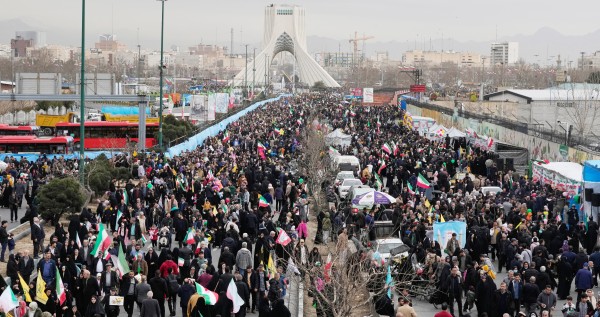
Tehran, Capitals – Agencies: Iranian President Masoud Pezeshkian yesterday apologized to those affected by the protests that took place in various Iranian cities and the violent crackdown that followed. In a speech delivered at Azadi Square in the capital Tehran on the occasion of the 47th anniversary of the Iranian Revolution, he said he recognizes the great pain people felt during the protests and the crackdown, and that he is ready to hear the people’s voice. At the same time, he highlighted the importance of unity in facing threats and conspiracies. He added, “We feel ashamed before the people and are obligated to help all those who were harmed. We are not seeking confrontation with the people; rather, our duty is to serve them.”
Regarding the nuclear file, Pezeshkian reiterated that Tehran does not seek to possess nuclear weapons, but stated that his country will not yield to excessive demands regarding its nuclear program. He said Iran is ready for all verification processes to confirm the peaceful nature of this program, explaining, “We are ready for any verification, but the high wall of distrust erected by the United States and Europe does not allow the talks to succeed.” He continued, “Iran will not submit to their transgressions. Nor will it back down in the face of injustice and aggression. But we are conducting talks with neighboring countries with all our strength for the sake of peace and stability in the region.”
