US: Gulf States Capable of Defending Themselves Against Tehran
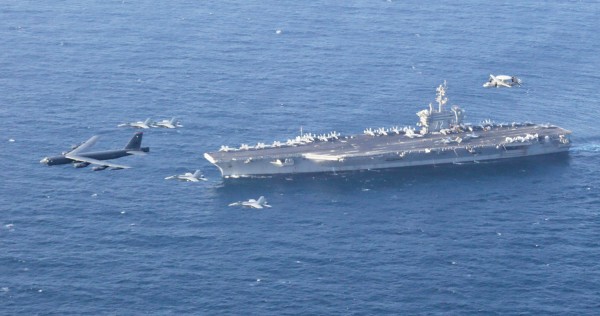
US enhances Gulf capabilities against Iran through advanced military systems
Translated by Alqyas from Al-Seyassah — Original source
Washington, Capitals – Agencies: The United States has confirmed that its partners in the Gulf region are now more prepared and capable of assuming a greater role in defending themselves against Iran and its proxies, as they expand their acquisition and operation of advanced U.S. military systems. It considers this development to open the door to additional opportunities for each Gulf state to enhance its self-defense capabilities, while also advancing military and security integration among regional partners, enabling them to cooperate more effectively in facing escalating security challenges in the region.
A national defense strategy issued by the U.S. Department of Defense, which included fundamental shifts, notably the expectation that U.S. allies manage their own security, praised the ability of U.S. allies in the Gulf to assume a greater role in defending themselves against Iran and its proxies. The document aligned with the orientation and focus of U.S. President Donald Trump on dominance in the Western Hemisphere, prior to its former objective of countering China. The document, the first of its kind since 2022, carried a clear political tone and criticized partners from Europe to Asia for their excessive reliance on previous U.S. administrations to support their defense. It translated this orientation into an explicit assessment calling on allies to bear a greater burden in facing countries such as Russia and North Korea. The opening sentence stated: "For far too long, the United States government – and even rejected – placing Americans and their concrete interests first."
For his part, U.S. President Donald Trump announced that a warship fleet is moving toward Iran, expressing hope that he would not be forced to use it. He warned Tehran against killing protesters or resuming its nuclear program, stating aboard Air Force One during his return to the United States from Davos: "We have a large number of ships moving in that direction, in case of any emergency. I don’t want anything to happen, but we are watching them closely." Meanwhile, Reuters reported that U.S. officials said the aircraft carrier Abraham Lincoln and several guided-missile destroyers would arrive in the Middle East in the coming days. One official clarified that additional air defense systems are also being considered for deployment to the Middle East, which could be crucial for defense if Iran were to launch any attack on U.S. bases in the region. Reuters noted that the deployment of military equipment expands the options available to Trump, whether to enhance the protection of U.S. forces in the region amid current tensions or to take any additional military action following the strikes on Iranian nuclear sites in June 2025.
For her part, Israel’s military radio reported yesterday that the scale of U.S. military deployment in the Middle East has reached record levels, the highest since the U.S. strike on Iran last June. The Israeli broadcasting authority confirmed that the defense establishment of the occupying state is analyzing the increase in U.S. troop deployment in the region as a step that could pave the way for a large-scale military attack to overthrow the Iranian regime, or as a credible military threat aimed at pressuring Tehran into reaching a better agreement than the one achieved by former President Barack Obama. Quoting a security source, it stated: "So far, there is no operational coordination between the United States and Israel regarding Iran, and it remains unclear how U.S. President Donald Trump will act."
For its part, an Iranian official confirmed that Iran is on maximum alert and prepared for the worst-case scenarios, threatening an unprecedented military response to any move targeting it and asserting that Tehran would treat any attack as a “total war.” Meanwhile, Turkish Foreign Minister Hakan Fidan stated that there are indications Israel is still seeking an opportunity to launch an attack on Iran, warning that such a step could further destabilize the region. “I hope they find a different path, but the truth is that Israel is looking for an opportunity to attack Iran, and there are signs of that,” he said.
Amid rising fears of a regional flare-up, many European airlines suspended flights to and through countries in the region. Air France announced it had canceled its flights between Paris and Dubai on Friday and Saturday due to the “current situation in the Middle East.” Royal Dutch Airlines (KLM) halted flights to Dubai, Riyadh, Dammam, and Tel Aviv until further notice, stating, “As a precautionary measure, we are currently avoiding flying in the airspace of several Gulf countries, as well as Iran, Iraq, and Israel.”
Washington, Capitals – Agencies: The US Department of Defense (Pentagon) confirmed that Iran is weaker and more vulnerable now than at any time in the past, warning that Tehran is determined to rebuild its forces despite the setbacks it has suffered. In a strategic defense document it issued, the Pentagon stated that Iran might again attempt to acquire a nuclear weapon while its leaders refuse to negotiate. The document also predicted that Iran’s proxies would seek to rebuild their infrastructure and ignite regional crises that threaten the lives of US soldiers in the area and undermine peace. It noted that the Iranian regime is weaker and more vulnerable than it has been in decades.
The document pointed out that the Iranian axis suffers from destruction similar to that of the Iranian regime itself. It also noted that Israel has demonstrated both the will and the capability to defend itself with decisive but limited US support. Meanwhile, US State Department Deputy Spokesperson Minyon Houston affirmed that only President Donald Trump has the authority to make decisions regarding any potential military action against Iran, noting that current US strategy focuses on supporting the Iranian people.
In contrast, Russia welcomed the gradual return to normalcy in Iran, reaffirming its solidarity with the Iranian people and calling for de-escalation and dialogue based on mutual respect. Russian Foreign Ministry spokesperson Maria Zakharova stated that the efforts of Iranian authorities to maintain security and order, alongside the actions of thousands of supporters of the constitutional system, sovereignty, and independence of the country, had helped thwart sabotage plots aimed at destabilizing the region. She added that some hostile foreign powers attempting what she described as a “color revolution” had been forced to admit failure, blaming them for the bloodshed in Iranian streets. She emphasized that Moscow maintains close and continuous contact with its Iranian partners, who share its assessments of developments, and reiterated Russia’s longstanding call to reduce tensions surrounding Iran and the region. She clarified that Russian diplomatic missions in Iran continue to operate normally and that Moscow’s recommendations for its citizens residing in Iran remain unchanged.
