His Highness Sheikh Nasser Al-Mohammed: Francophonie a renewed space for communication, creativity and cultural diversity
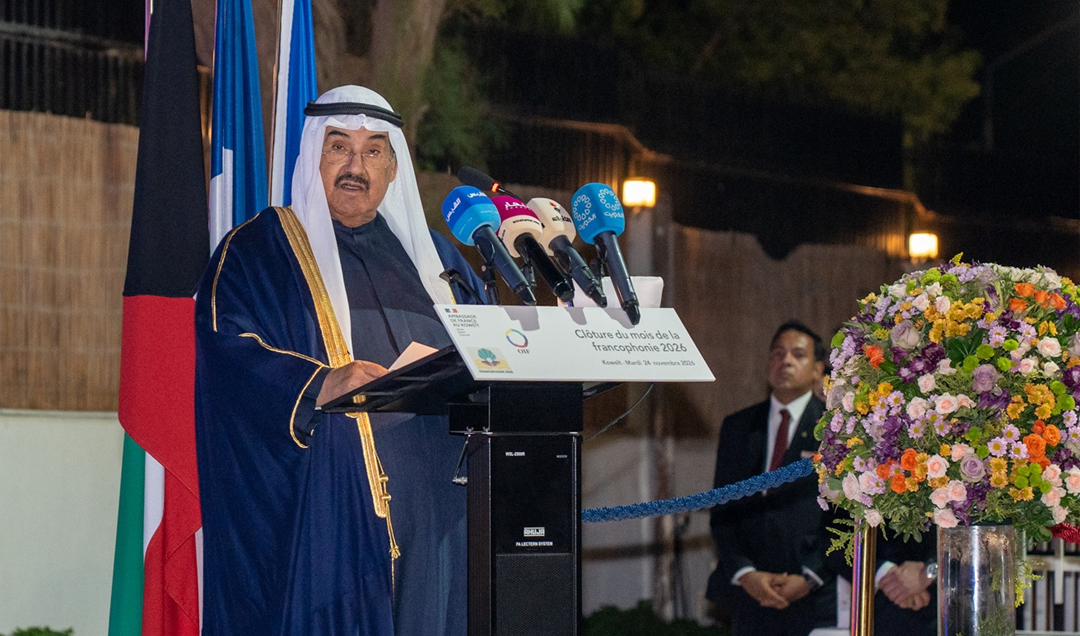
Sheikh Nasser Al-Mohammed and the French ambassador highlight the importance of Francophonie in Kuwait
Translated by Alqyas from Sarmad — Original source
• Francophonie does not compete with or replace English; rather, it offers a model of linguistic and cultural integration.
• Kuwait has a long-standing and active history with the French language that goes beyond celebrating World Francophonie Day.
• The achievements of the International Organization of La Francophonie have extended from culture to politics, education, economy, and sustainable development.
His Highness Sheikh Nawaf Al-Mohammad Al-Ahmad Al-Jaber Al-Sabah affirmed on Tuesday that Francophonie is no longer merely a cultural legacy, but has become a vibrant and dynamic space for communication, creativity, and knowledge exchange, serving as a vital source of cultural diversity that enriches human civilization.
Speaking at an event held under his patronage at the French Ambassador’s residence to mark the conclusion of Francophonie Month, His Highness stated that linguistic and cultural diversity represents a source of richness for humanity, and that dialogue and interaction among civilizations form the foundation for building a more open, understanding, and peaceful world.
He emphasized that Francophonie does not seek to compete with or replace the English language, but rather to present a model of linguistic and cultural integration.
He added that the celebration of World Francophonie Day and its official events in the State of Kuwait have been held annually since the beginning of the new millennium, specifically over the past two decades, before expanding to include a full month of Francophonie activities. These activities feature French spelling bees, film screenings, sports competitions, and discussion panels at the University of Kuwait, highlighting linguistic and cultural diversity.
He clarified that although Kuwait is not yet an official member of the International Organization of La Francophonie (OIF), it has a long and active history with the French language that extends beyond merely celebrating World Francophonie Day.
His Highness reviewed the historical roots of the organization’s establishment, noting that the intellectual initiative began in the late 1960s, spearheaded by non-French heads of state: Tunisian President Habib Bourguiba, Senegalese President Léopold Sédar Senghor, Nigerien President Hamani Diori, and Cambodian Prince Norodom Sihanouk. Their goal was to unite French-speaking countries into a single entity.
He pointed out that this initiative received support from several French presidents, including Charles de Gaulle, François Mitterrand, and Jacques Chirac, culminating in the signing of the Niamey Agreement on March 20, 1970. This agreement established the Agency for Cultural and Technical Cooperation (ACCT), which served as the nucleus for the current International Organization of La Francophonie.
His Highness Sheikh Nawaf Al-Mohammad noted that the organization continued to evolve over the past decades, leading up to the 20th Summit hosted by the Cambodian capital, Phnom Penh, in 2026, under the theme “Reinvesting in Peace for Shared Prosperity and Sustainable Stability,” reflecting Cambodia’s historical experience in overcoming war to move toward reconstruction and development.
He highlighted that a key indicator of the organization’s success is the continuous growth in the number of French speakers, which reached approximately 396 million according to its latest reports, compared to an estimated 321 million in previous assessments. Projections suggest this number could reach 590 million by 2050.
He added that more than 170 million people are currently learning French, reinforcing its status as one of the most widely spoken languages in the world.
He explained that the African continent has become the main center of gravity for the growth of Francophonie, with approximately 65 percent of the world’s French speakers currently residing there. Projections indicate that nine out of every ten French speakers in the future will be from the continent.
His Highness noted that the Democratic Republic of the Congo has surpassed France to become the largest French-speaking country by number of speakers, with approximately 68 million speakers according to recent estimates, reflecting the geographic and cultural shift in the center of gravity of Francophonie from Europe to Africa.
His Highness Sheikh Nasser Al-Mohammed Al-Sabah affirmed that the achievements of the International Organization of La Francophonie have not been limited to the cultural sphere, but have extended over the past decades to encompass politics, education, economy, and sustainable development, thereby enhancing its role in supporting cooperation and dialogue among nations and peoples.
For his part, Olivier Goffert, the French Ambassador to the State of Kuwait, said in a speech that “Francophonie in Kuwait today has become a living and dynamic reality, a fruit of the natural and sincere affection that Kuwaitis harbor for the language.”
Ambassador Goffert added that Francophonie is not merely an institutional or official story, but a story of friendship and love between the French language and all its speakers, highlighting key milestones in the development of French language education in Kuwait.
He emphasized the fundamental role played by the French Institute in Kuwait, both in teaching the language and in certifying language competencies and issuing recognized certificates, alongside the role of schools and universities that contribute to spreading the French language in the country.
This ceremony crowned several weeks of events, meetings, and cultural, educational, and sports initiatives organized as part of the Francophone Cultural Season, initiated by members of the Council for the Promotion of Francophonie in Kuwait.
