49th Kuwait International Book Fair discusses transformations in the concept of man in contemporary philosophy
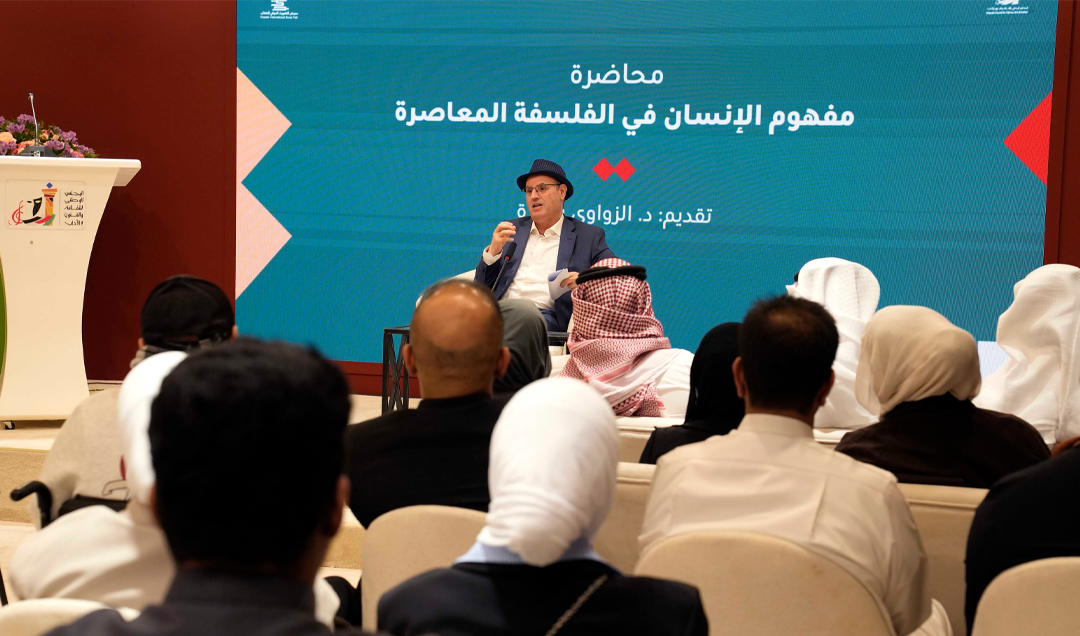
Dr. Al-Zawawi Bagoura discusses transformations in the concept of man in contemporary philosophy within the activities of the Kuwait International Book Fair
Translated by Alqyas from Sarmad — Original source
(KUNA) – Contemporary philosophy professor Dr. Al-Zawawi Bagoura delivered a lecture titled “The Concept of Man in Contemporary Philosophy” as part of the cultural and philosophical talks accompanying the 49th Kuwait International Book Fair. The lecture highlighted the major shifts in philosophical thought regarding the definition of human beings, their understanding of existence, and their relationship with culture, society, and the world.
The lecture, held at the Cultural Café, was introduced by Mohammed Al-Maghribi, a member of the Cultural Activities Committee at the Public Authority for Arts and Letters. He presented Dr. Al-Zawawi Bagoura, a professor of contemporary philosophy and head of the Philosophy Department at the College of Arts, highlighting his rich intellectual and academic career and his contributions to enriching the Arabic philosophical library through books, translations, and studies addressing issues of humanity, freedom, power, identity, political philosophy, and social philosophy.
Bagoura began his lecture by noting that the question “What is man?” is one of the most prominent questions posed by the German philosopher Immanuel Kant, linked to three fundamental philosophical questions: What can I know? What ought I to do? What may I hope for? He explained that these questions relate to knowledge, ethics, and the future, and together form an entry point for understanding humanity.
He clarified that the philosopher Ernst Cassirer attempted to answer this question in his work “An Essay on Man,” emphasizing that humans are not merely rational, moral, or social beings, but symbolic creatures who create culture and live through it. Culture manifests in language, art, religion, myth, science, and industry, representing various expressions of human experience.
Bagoura pointed out that Cassirer focused on understanding the functions of symbols and culture in human life rather than seeking a fixed essence of humanity. He noted that the humanities differ from the natural sciences in their methodologies and tools, as cultural phenomena cannot be subjected to a single quantitative or empirical logic.
Bagoura discussed the transformation brought about by existentialist philosophy, particularly by Jean-Paul Sartre, in understanding humanity through a focus on the individual and personal experience, and the principle that existence precedes essence. This means that humans first exist and then shape their lives and identities through their choices, alongside their freedom and responsibility in constructing their own projects.
He added that structuralism re-examined the existentialist view, which centered on the individual, asserting that humans cannot be understood in isolation from the network of relationships to which they belong, whether in the family, society, or culture. Citing the ideas of Claude Lévi-Strauss, he noted that structuralism also broadened the perspective on humanity to include other cultures and societies, moving beyond an exclusive focus on Western experience.
He highlighted that global transformations since the 1990s, marked by the rise of globalization and the decline of polarization between capitalism and socialism, have made the concept of humanity more complex amid environmental, ethical, and technological challenges, including climate change, scientific applications in weapons and genetic engineering, and rapid technological advancement.
He stressed that these transformations have revealed human limitations and fragility despite scientific and technological achievements, noting that recognizing human boundaries serves as an entry point for understanding and addressing many contemporary challenges.
Bagoura emphasized the importance of philosophy as a practice of critical thinking, clarifying that criticism does not mean destruction or personal attack, but rather understanding the limits of things and relying on knowledge. He regarded criticism as a virtue grounded in speaking the truth, which serves humanity and contributes to improving its reality and opening new horizons for it.
