Trump describes International Criminal Court authority as 'illusory'
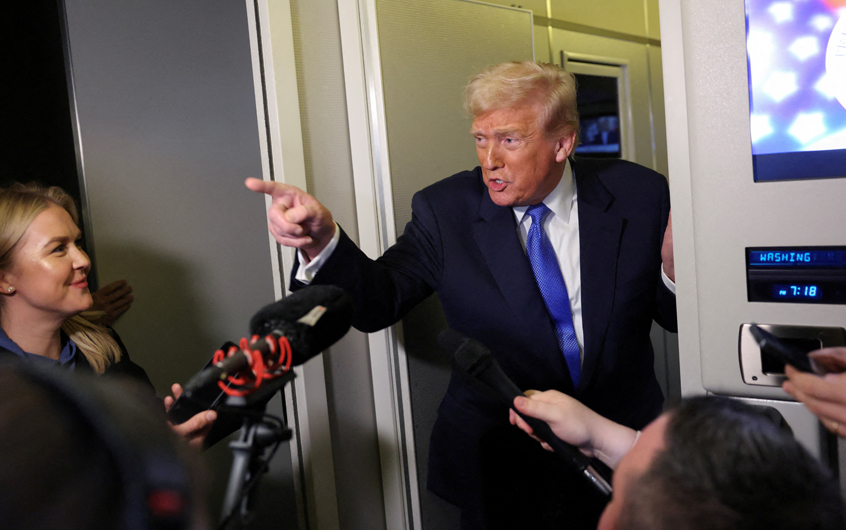
US President Donald Trump describes the International Criminal Court's authority as 'illusory', aligning with Russian President Vladimir Putin in criticizing the court's powers.
Translated by Alqyas from Sarmad — Original source
U.S. President Donald Trump described the jurisdiction of the International Criminal Court (ICC) as “fake” on Friday, asserting that it lacks the authority to arrest heads of state.
Trump told reporters during a press conference at the White House: “They have fake authority because they lack the backing power. They believe they can arrest heads of state, but they cannot do so.”
He clarified that the United States, Russia, and China, as some of the world’s most influential and technologically advanced nations, jointly condemned what they viewed as the ICC’s overreach in attempting to arrest heads of state, on the sidelines of the Asia-Pacific Economic Cooperation (APEC) forum summit.
Trump’s remarks followed a trilateral summit he held with Russian President Vladimir Putin and Chinese President Xi Jinping in Shenzhen, China, on November 19.
The joint statement issued after the summit emphasized the importance of respecting state sovereignty and the immunities granted to official representatives, stressing that the ICC and similar bodies should not abuse their jurisdictions.
For his part, Putin announced after the meeting that the three leaders had discussed the ICC’s activities, characterizing the court as having overstepped its mandate by making political rather than legal decisions, and noting a general understanding among the parties on this issue.
In response, the United Nations defended the court. On November 19, Farhan Haq, Deputy Spokesperson for the Secretary-General, affirmed that the ICC is a fundamental institution for achieving international justice, emphasizing the need to strengthen, not weaken, the rule of law.
On the same day, the European Union renewed its support for the court, affirming that it constitutes an essential part of the rules-based international order.
Earlier, the Trump administration had imposed sanctions on the ICC, including a ban on dealings with the court and measures aimed at disrupting its activities.
The court viewed those sanctions as an unprecedented step intended to undermine its work and intimidate its staff.
Previously, on November 14, U.S. Secretary of State Marco Rubio described the court as an “illegitimate” institution, defending the U.S. sanctions and accusing the court of attempting to impose its jurisdiction on countries that do not recognize its authority.
