Environment Ministry: Kuwait's Participation in COP31 Confirms Commitment to International Efforts to Combat Climate Change
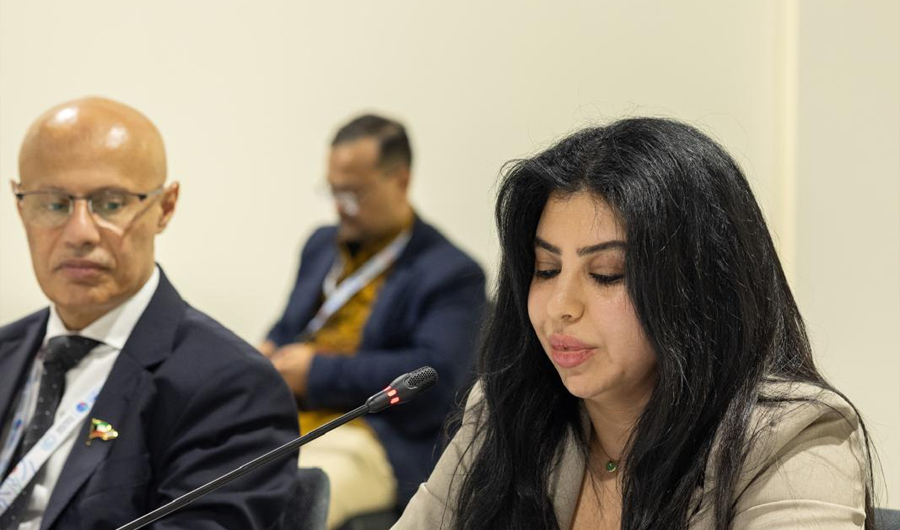
Kuwait's participation in the COP31 climate conference and presentation of the national low-carbon development roadmap until 2060
Translated by Alqyas from Sarmad — Original source
The Public Authority for Environment confirmed that Kuwait’s participation in the 31st Conference of the Parties (COP31) to the United Nations Framework Convention on Climate Change, recently held in Antalya, Turkey, reaffirms its commitment to international efforts to combat climate change and achieve sustainable development.
Nouf Al-Bahbahani, Acting Director General of the Authority and head of the Kuwaiti delegation, stated that Kuwait presented its National Low-Carbon Development Roadmap to 2060, approved by the Council of Ministers in 2025. This roadmap aims to build a low-emission economy and strive for carbon neutrality in key sectors by 2060.
Al-Bahbahani explained that achieving this goal involves expanding renewable and solar energy, gradually replacing heavy fossil fuels with natural gas in electricity generation, improving energy efficiency, managing waste, and enhancing natural carbon sinks, including mangrove trees.
She added that Kuwait is developing its third Nationally Determined Contributions (NDCs), targeting an unconditional emissions reduction of up to 15 percent of total emissions by 2035, based on national projects and measurable, verifiable scientific methodologies. Kuwait continues to adopt a circular carbon economy approach focused on reducing, reusing, recycling, and removing emissions, leveraging modern technologies while respecting national development priorities.
Al-Bahbahani noted that Kuwait also participated in the Fourth Ministerial Meeting of the Mangrove Alliance for Climate (MAC), held on the sidelines of the conference, where it showcased achievements of the national mangrove reforestation project launched in 2018 and implemented in nine phases.
The project resulted in the planting of over 8,000 seedlings and thousands of seeds, the rehabilitation of approximately 3,800 square meters in the Al-Jahra Nature Reserve, and the implementation of planting trials in other coastal sites. Since 2022, the trees have successfully produced seeds locally.
The project featured regional cooperation with the United Arab Emirates, leading to the planting of approximately 4,000 seeds during 2025 and 2026. Al-Bahbahani also praised contributions from the Sultanate of Oman, the Kingdom of Bahrain, and the Kingdom of Saudi Arabia.
She emphasized the continued development of national capacities for mangrove propagation through the marine nursery in Al-Jahra Reserve, the expansion of local seed usage, and the study of new planting sites to enhance climate change adaptation and preserve biodiversity and coastal ecosystems.
Al-Bahbahani stated that the Authority has adopted a unified system for environmental sustainability reports for government entities, based on measurable national indicators to enhance transparency and accountability, and to embed sustainability in government planning and decision-making.
She stressed the importance of balancing climate ambitions with energy security, economic stability, and development priorities, while fulfilling international commitments related to climate finance, technology transfer, and capacity building. This enables developing countries to implement mitigation and adaptation programs without compromising their right to sustainable development, respecting each country’s right to choose appropriate pathways and technologies according to its national circumstances, based on principles of equity, justice, and common but differentiated responsibilities.
She highlighted the developmental and humanitarian international role of the Kuwait Fund for Arab Economic Development, which has contributed to financing 1,043 development projects in 108 countries since its establishment in 1961, with a total exceeding $22 billion, embodying Kuwait’s approach to international solidarity and support for development.
Kuwait and the Public Authority for Environmental Affairs reaffirmed their commitment to continuing cooperation and exchanging expertise with sister and friendly countries, and to strengthening partnerships to protect the environment and address climate change. They expressed hope that the conference’s outcomes will help transition from commitments to implementation through balanced decisions and practical, actionable solutions that secure a more sustainable future.
