New Vaccine for Acute Myeloid Leukemia Succeeds in Advanced Clinical Trial
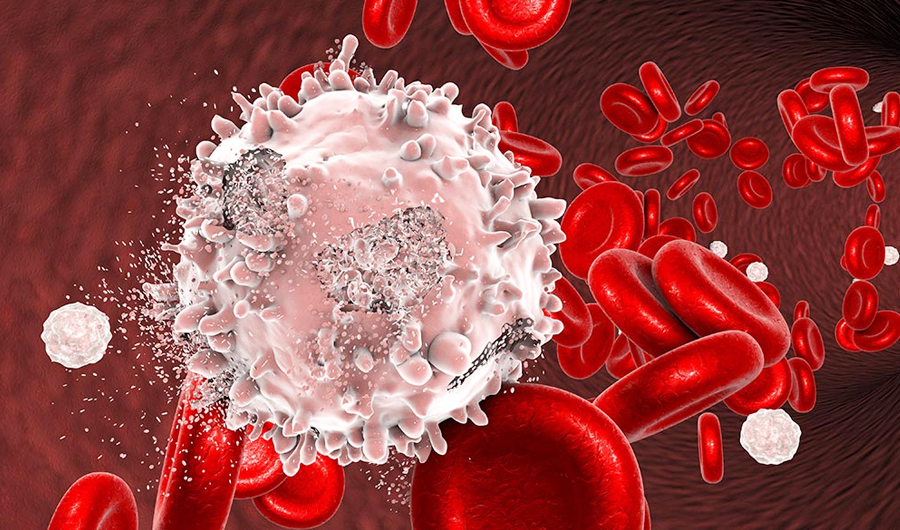
The GPS vaccine succeeded in a Phase III clinical trial in reducing the risk of death by 41% for patients with acute myeloid leukemia, with an application expected to be submitted to the US Food and Drug Administration in 2027.
Translated by Alqyas from Sarmad — Original source
A vaccine for the treatment of acute myeloid leukemia (AML), one of the most lethal types of blood cancer, has succeeded in a phase III clinical trial, according to Sila Lifesciences, the drug’s developer, and Memorial Sloan Kettering Cancer Center, marking a new development in a year that has seen promising positive results in the field of cancer vaccines.
Preliminary data, based on a trial involving 126 patients, showed that the “Galinpebimut-S” (GPS) vaccine reduced the risk of death by 41 percent compared with patients who received other treatments for the disease, according to the company, as reported by The Washington Post.
The vaccine was tested on patients who had reached a second complete remission or a later stage, meaning they had successfully undergone treatment at least twice. AML affects approximately 20,000 people annually in the United States and is typically treated with chemotherapy, but residual cancer cells often persist, making disease recurrence common.
These results follow the success of another cancer vaccine, Intercell, in a phase III trial for the treatment of cutaneous melanoma earlier this year.
The two vaccines differ in their mechanism of action and design: Intercell relies on messenger RNA (mRNA) technology and is custom-made for each patient after a tumor sample is taken, whereas GPS was designed as a standardized treatment that can be used with all patients.
David Scheinberg, head of the Experimental Therapeutics Center at Memorial Sloan Kettering and the vaccine’s developer, said, “This could be an off-the-shelf vaccine, eliminating the need to redesign it for each individual patient.”
Scheinberg also serves on the board of directors of Sila Lifesciences, which has obtained a license to use the vaccine from Memorial Sloan Kettering Cancer Center.
The company stated that it would announce the full results of the trial, including data on secondary endpoints such as leukemia-free survival and relapse-free survival, at a medical conference later this year.
It added that the vaccine was “generally well tolerated,” with the most common side effects being local reactions at the injection site.
Patients were also required to be ineligible for bone marrow transplantation, a common treatment for leukemia.
According to the company, the median survival for patients who received the vaccine was 24 months, compared with 14.7 months for those who received other treatments. The five-year survival rate for patients with AML is generally around 33 percent, according to the U.S. National Institutes of Health.
The trial included patients with AML who had achieved complete remission twice, or complete remission with incomplete recovery, a condition in which cancer cell levels have decreased but certain blood cell types have not returned to normal levels.
Ravi Majeti, professor of medicine and director of the Institute for Stem Cell Biology and Regenerative Medicine at Stanford University School of Medicine, said that this group represents a small subset of AML patients but has historically lacked many treatment options.
Magid added, “These patients do not have good treatment options, and the current vaccine trial could offer them a benefit,” but he urged caution in interpreting the results until the full data from the trial are published. Like other cancer vaccines, GPS works by stimulating the patient’s immune system to attack cancer cells that it would not normally target. Schainberg explained that this helps the body eliminate small residual cancer cells that might be missed by chemotherapy, reducing the risk of disease recurrence.
Silence Therapeutics plans to prepare a submission to the U.S. Food and Drug Administration for approval of the vaccine in the first half of 2027.
