Opening of Kuwait International Book Fair.. Al-Omar: Culture is a pillar for building the modern state
Press coverage 3 newspapers covered this event: Al-Jarida · Sarmad · KUNA →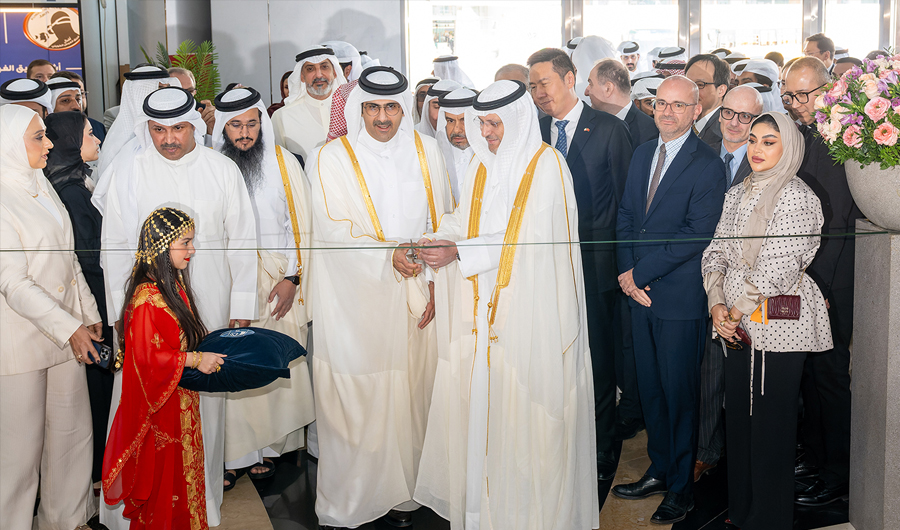
Omar Al-Omar emphasizes the importance of culture in his opening speech, honoring Al-Waqian and with Qatar as guest of honor
Translated by Alqyas from Sarmad — Original source
Kuwait’s Minister of State for Communications and Information Technology and Acting Minister of Media and Culture, as well as Chairman of the National Council for Culture, Arts and Letters, Omar Al-Omar, affirmed on Thursday that culture constitutes a fundamental pillar in building a modern state, rather than an intellectual luxury. He highlighted the importance of books in providing generations with a deeper understanding of their history, language, and values, and in enhancing their capacity to shape the future.
This statement was made by Al-Omar, who represented His Highness the Prime Minister, Sheikh Ahmad Abdullah Al-Ahmad Al-Sabah, during the official opening ceremony of the 49th edition of the Kuwait International Book Fair, held Thursday evening at the Sheikh Jaber Al-Ahmad Cultural Centre.
Minister Al-Omar noted that the high-level patronage of culture by His Highness the Amir of Kuwait, Sheikh Meshal Al-Ahmad Al-Jaber Al-Sabah, and His Highness the Crown Prince, Sheikh Sabah Al-Khaled Al-Hamad Al-Sabah, reflects the nation’s commitment to nurturing and supporting cultural development.
He welcomed the fair’s guests, including Qatar’s Minister of Culture, Sheikh Abdulrahman bin Hamad Al Thani, and described Qatar as the guest of honor for this edition, emphasizing that its presence symbolizes a meeting of peoples bound by kinship, shared memories forged by maritime life, pearl diving, and trade, and strengthened by milestones of cooperation.
He pointed out that key milestones include the 1978 agreement on economic, educational, and media cooperation, the 2016 agreement on cultural and artistic cooperation, and the collaboration between the National Council for Culture, Arts and Letters and the Public Authority for Community Culture (Katara), under the generous patronage of the leaderships of both brotherly nations.
Al-Omar added that the fair’s theme, “We Read and We Rise,” reaffirms the belief that culture is not an intellectual luxury but a foundational pillar in building a modern state, and that books empower generations with a deeper knowledge of their heritage, language, and values, enabling them to better shape the future.
In this context, Al-Omar noted the honoring of writer and poet Dr. Khalifa Al-Waqian, who was selected as the fair’s personality of the year in recognition of his career, which has enriched Kuwait’s literary and intellectual landscape since the 1960s.
He highlighted that Al-Waqian is one of the founders of the National Council for Culture, Arts and Letters, formerly served as Secretary-General of the Writers’ Association, authored the book “Culture in Kuwait,” and has received the State Appreciation Award and the Jerusalem Literary Award.
He expressed gratitude to the National Council for Culture, Arts and Letters and the fair organizers, praising their role in supporting cultural activities and national talents, and welcomed Kuwait’s guests and participating publishing houses from 34 countries.
For his part, writer and poet Dr. Khalifa Al-Waqian affirmed that culture has contributed to documenting Kuwait’s history and civilizational presence, enhancing its status through the scientific, literary, and cultural contributions of its sons, both domestically and internationally. He expressed his thanks to those who conceived and implemented the idea of honoring those engaged in the cultural field, describing culture as one of the tools of soft power.
Al-Waqian stated that Kuwaitis have given culture special attention wherever they reside, and in return, culture has endowed them with its enchanting and penetrating strength, which transcends borders and carries their legacy and identity, rooted in openness and enlightenment.
He added that culture has contributed to documenting Kuwait’s history and cultural presence since the 17th century, citing several scholars whose manuscripts and works have survived, including Sheikh Musaid bin Ahmad bin Musaed, who copied Imam Malik’s “Al-Muwatta” in 1682 and added some annotations; Sheikh Abdullah bin Ali bin Bahar, who copied a jurisprudential treatise on Maliki fiqh in 1726; and Uthman bin Sand, born in Failaka Island in 1766, whose works amounted to approximately 50 books and treatises on linguistics, jurisprudence, history, and poetry.
He clarified that these evidences confirm that cultural history succeeded in documenting the existence of Kuwait and the efforts of its scholars before political sources and facts did so.
He pointed out that the founding fathers bequeathed to subsequent generations a solid cultural foundation by establishing cultural civil society institutions and platforms, including associations, clubs, public libraries, newspapers, and printing presses within Kuwait and in countries where they resided for commercial, scientific, or da’wah purposes, such as India, Aden, Indonesia, Basra, Cairo, and Damascus.
Al-Waqian touched upon the contributions of Kuwaitis to the establishment of the press abroad, highlighting the role of the first generation of Kuwaiti journalists and scholars in the press of Basra. Among them was Mr. Abdulwahab Al-Tabatabai, who founded the newspaper “Al-Dustour” in 1912, followed by “Sada Al-Dustour,” and Mr. Hashim Al-Rifai, who issued the newspaper “Al-Basra Al-Yawmiya” in February 1943. He also noted the contribution of Jassim Hamad Al-Saqer in establishing a publishing and printing house that issued the newspaper “Al-Nas.”
He drew attention to the contributions of Sheikh Abdulaziz Al-Rasheed in publishing two magazines in Indonesia in the 1930s, as well as the magazine “Kuwait,” which he issued in 1928. He also mentioned that Mr. Abdulaziz Hussein oversaw the publication of the magazine “Al-Ba’tha” in Cairo in 1946, and Mr. Abdullah Al-Hatim published the magazine “Al-Fakahah” in Damascus in 1954.
He explained that interest in culture continued through the 1960s, 1970s, and 1980s, and the decades that followed, through two main pillars: the first was civil society work, represented by cultural civil institutions, including the Abdulaziz Saud Al-Babtain Cultural Foundation, Suad Al-Sabah House for Culture and Creativity, and public benefit associations; the second was official work, represented by the Ministry of Information and later the National Council for Culture, Arts and Letters.
Speaking about the Kuwait International Book Fair, Al-Waqian described its launch nearly half a century ago as an important achievement and a beautiful adventure. He noted that the initiative faced initial fears regarding its potential failure and the difficulty of attracting well-known Arab publishing houses without confirming public interest.
He clarified that the success of the first edition exceeded expectations, attributing this to the then-fair director, Mr. Yahya Al-Rubaian, for his efforts in convincing Arab publishing houses to participate, as well as his management of the event. He also praised the role of the Council’s leaders at the time, Mr. Abdulaziz Hussein and Mr. Ahmed Al-Adwani, in encouraging and supporting the initiative.
He added that the fair’s management was subsequently transferred to a group of young people who believed in the importance of books as the primary vessel of knowledge. The success of the initiative encouraged many public benefit associations to organize similar exhibitions.
Al-Waqian emphasized the importance of preserving soft power, embodied by culture, and not relinquishing the cultural heritage left by the founding fathers, in appreciation of their efforts in building the cultural movement and consolidating its presence in society.
The opening ceremony witnessed the honoring of the Minister of State for Foreign Affairs of Qatar, the guest of honor, represented by Qatar’s Minister of Culture, alongside the personality of the current edition, Dr. Khalifa Al-Waqian.
This was followed by a Kuwaiti-Qatari traditional musical session titled “A Voice That Unites Us,” featuring Qatari artist Mansour Al-Mahandi and Kuwaiti artist Salman Al-Amari, in celebration of Qatar as the guest of honor at the 49th Kuwait International Book Fair.
