Kuwait Space Research Center Highlights Importance of Astrophotography in Monitoring Cosmic Changes at Oman Science Festival - Sarmad
Press coverage 2 newspapers covered this event: Sarmad · KUNA →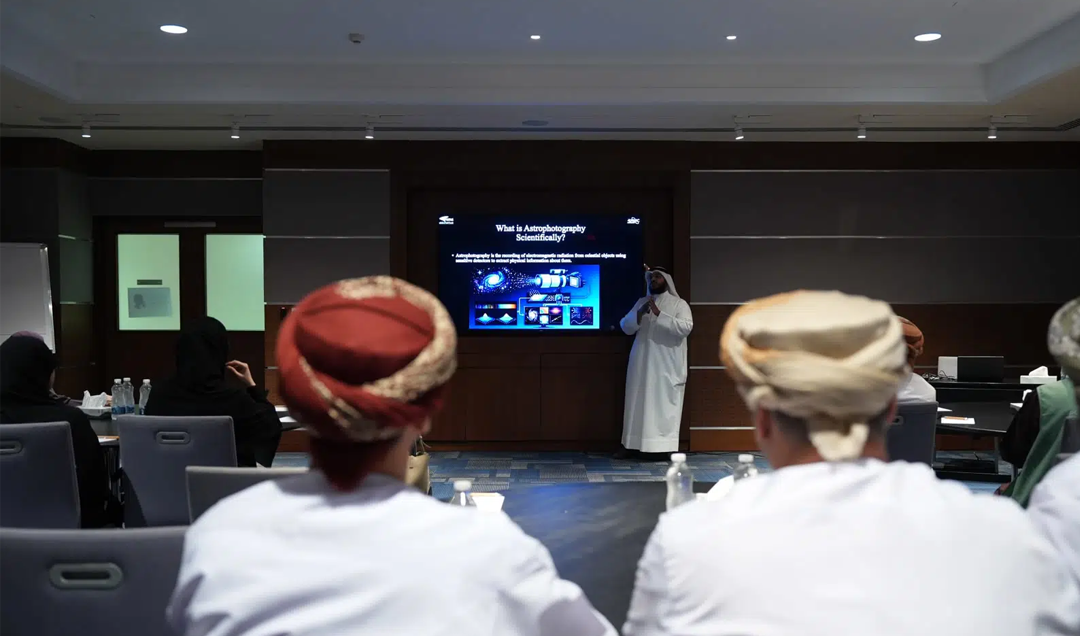
Abdullah Al-Harbi discusses the importance of astrophotography in a workshop at the Oman Science Festival
Translated by Qiyas from سرمد — Original source
(KUNA) – The Kuwait National Center for Space Research, a center under the Kuwait Foundation for the Advancement of Sciences, presented the importance of astrophotography as an accurate tool supporting astronomical research and enhancing the understanding of cosmic changes through observation and documentation during a scientific workshop at the Oman Science Festival 2026.
Abdullah Al-Harbi, a space science researcher and astrophotographer who led the workshop, told Kuwait News Agency (KUNA) on Thursday that astrophotography supports astronomical research and enhances the understanding of the structure of the universe and the evolution of stars, nebulae, and galaxies. It also encourages precise analysis of visual data.
He added that the workshop, titled “Astrophotography: A Scientific Tool for Understanding the Universe,” comprised theoretical and practical components and targeted space and astronomy enthusiasts from various institutions and entities in the Sultanate of Oman.
Regarding its key themes, he said he covered the historical beginnings of astronomical observation in past eras, how ancient peoples dealt with the movement of celestial bodies, and their reliance primarily on seasonal phenomena and stars, as well as their efforts to document these experiences and pass them down to future generations.
He then moved on to the developments in astronomical observation, modern instruments, and equipment, noting how telescopes brought about a “qualitative leap” in the field of astronomy, coinciding with the use of cameras that helped preserve and more deeply analyze astronomical data.
He mentioned that the workshop also addressed the topic of light, electromagnetic radiation, its types, and daily applications, explaining how the gradient of spectral colors and wavelengths can be inferred based on the observed target.
He pointed out that he focused on highlighting the importance of astrophotography for celestial bodies and the scientific details it encompasses, such as light scattering in relation to nebulae, dust density, grain size, and how invisible light and infrared rays captured by the James Webb Telescope are translated into true colors.
In a message to astronomy enthusiasts, particularly astrophotographers, Al-Harbi encouraged initiative in observation, whether using advanced or simple equipment, and called for sharing this with the scientific community. He noted the existence of a global platform called Zooniverse, which connects professional researchers with millions of volunteers worldwide to help analyze vast scientific research data.
Regarding simple equipment that can be used for astrophotography, he said that DSLR cameras can be used, adding that for deeper imaging, cameras with advanced filters can be employed to polarize specific gases, aiding more effectively in analyzing gas components in stellar atmospheres.
Regarding the challenges faced by astrophotographers, he highlighted light pollution—the excessive or unguided use of artificial lighting at night, especially within cities—which obscures the visibility of celestial bodies and stars, complicating astronomical observation, along with its health and environmental repercussions. He called for rationalizing usage and regulating outdoor lighting through direction and control.
Al-Harbi expressed his gratitude and appreciation to the Kuwait Foundation for the Advancement of Sciences and the Kuwait National Center for Space Research for nominating him to participate in this prominent scientific event in the Sultanate of Oman, emphasizing the importance of raising scientific awareness in astronomy and other fields among members of society through lectures, scientific workshops, and research.
The fifth edition of the Oman Science Festival, organized by the Omani Ministry of Education over a ten-day period, kicked off last Monday. It is the most prominent scientific event hosted by the Sultanate, aiming to enhance scientific culture among students in particular, raise awareness of science, technology, and innovation, and create an interactive, stimulating environment for exploration and experimentation.
The Kuwait Foundation for the Advancement of Sciences is participating with a delegation comprising representatives from the Foundation, the Science Center, the Sheikh Sabah Al-Ahmad Center for Giftedness and Creativity, the Kuwait National Space Research Center, and Al-Taqaddum Al-Ilmiya for Publishing and Distribution.
