Global markets decline as Democrats win control of both US Congress chambers - Sarmad
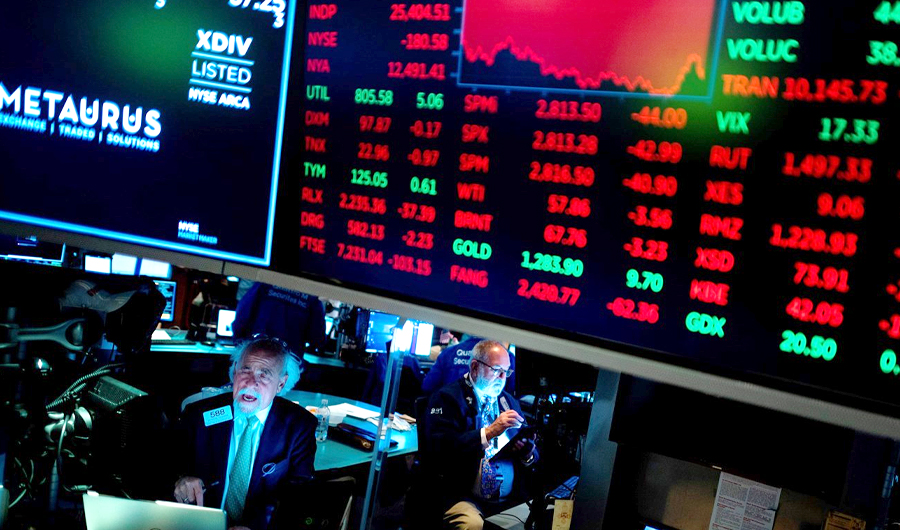
The repercussions of the Democrats' victory in controlling both chambers of the US Congress extended to global markets, with stocks and the dollar falling and Treasury bonds rising, amid expectations that the election results will limit President Donald Trump's ability to push his agenda.
Translated by Qiyas from سرمد — Original source
The repercussions of Democrats’ control of both chambers of the U.S. Congress extended to global markets on Wednesday, with stocks and the dollar falling and Treasury bonds rising, amid expectations that the election results would limit President Donald Trump’s ability to advance his political and economic agenda.
Futures on the S&P 500 index fell 0.3 percent, while futures on the tech-heavy Nasdaq 100 index dropped 0.4 percent. Losses later narrowed as some investors began buying the dip.
The dollar declined against all major currencies in the G10 group, while the yield on the 10-year U.S. Treasury bond fell 3 basis points to 4.93 percent. The MSCI Asia Pacific index also fell 0.2 percent.
Investors view the Democratic wave as a setback for stocks and the dollar, given the prospect of tighter regulatory oversight, particularly on fast-growing technology and artificial intelligence companies. Conversely, Treasury bonds could benefit if political gridlock curtails further tax cuts and government spending, thereby easing concerns about federal borrowing.
Democrats achieved victories in Republican strongholds across the country, winning at least six Senate seats and capturing House seats in districts that Republicans had easily won in the 2024 elections. Several media outlets predicted Democratic control of the House, while Decision Desk HQ projected Democratic control of the Senate.
Trump stated he could work with a Congress controlled by the opposition if Democrats were willing to cooperate: “If the Democrats want to work with me.”
Chris Weston, head of research at Pepperstone, said the blue wave itself may not have been surprising, but the scale of the victory caught markets off guard. He added that the initial reaction involved a sharp repricing of risk, as it was difficult to determine the fair value of assets in sectors exposed to government policy impacts.
However, Wednesday’s moves in U.S. stocks and Treasury bonds represented only a modest pullback from market trends since the start of the year. The S&P 500 remained up approximately 10 percent in 2026, while 10-year Treasury yields had risen by more than half a percentage point.
Stock losses narrowed as some investors bought after the initial sell-off. George Efstathiopoulos, fund manager at Fidelity International, said midterm elections, like any major political event, increased uncertainty and widened the gap between market valuations and economic fundamentals. He added that he began reducing defensive positions, including utility stocks, to buy technology shares in Asia and other markets, while increasing his exposure to India for diversification purposes.
Treasury yields fell across maturities as election results emerged, with the largest decline seen in 5-year bonds, whose yields dropped by as much as 9 basis points to 4.67 percent.
Democratic control of the House would reduce the likelihood of passing additional legislation that increases the budget deficit under the Trump administration. Bond investors are concerned about the U.S. fiscal trajectory, with public debt nearing $40 trillion, and political gridlock may limit the risks of approving additional spending or tax cuts that would require issuing more Treasury bonds.
David Chao, Global Markets Strategist at Invesco Asset Management, said that Democratic control of Congress would make it more difficult for the U.S. administration to pass major partisan legislation. He added that a pullback in fiscal stimulus could curb upward pressures on growth, inflation, and U.S. Treasury yields.
In currency markets, the Swiss franc led gains against the dollar, rising 0.5 percent, while the yen and euro each climbed 0.4 percent.
David Forrester, Chief Strategist at Crédit Agricole CIB in Singapore, said the dollar’s fundamental weakness has become more apparent, given its performance is tied to the artificial intelligence boom. He added that a democratic wave could hinder the expansion of data center construction and limit the growth of AI, which could weigh on the U.S. currency.
In Asia, South Korea’s KOSPI index experienced volatile trading; it rose as much as 3.2 percent shortly after the open, before falling 4 percent, then rebounded to erase its losses.
Bitcoin also fell as much as 2.8 percent amid concerns that Democratic control could disrupt legislation favored by the cryptocurrency sector and tighten oversight of digital asset firms, before the currency later wiped out all its losses.
On the corporate front, AMD’s sales forecasts significantly exceeded analyst estimates, signaling strong demand for data center processors used in AI applications.
Super Micro Computer also projected revenue for the current quarter above market estimates and raised its annual sales outlook, reflecting sustained demand for its servers equipped with AI chips.
Meta Platforms raised $15 billion through a dollar-denominated bond offering amid strong investor demand, joining major tech companies that offer relatively high yields to attract buyers, as investor skepticism grows regarding the scale of sector investments in AI.
In the semiconductor sector, Nexperia filed a lawsuit against its owner, Wingtech Technology, seeking damages exceeding $2 billion, escalating the dispute between the company’s operations in China and its global management.
Meanwhile, Japan Post Holdings, backed by the Japanese government, is holding talks to sell GSR, a company specializing in semiconductor manufacturing materials, to Mitsui Chemicals, in a deal potentially worth more than 1.3 trillion yen ($8.2 billion), according to Reuters citing informed sources.
