Kuwait: Put an End to Attacks and Threats in the Straits of Hormuz and Bab al-Mandab - Sarmad
Press coverage 2 newspapers covered this event: Al-Rai · Sarmad →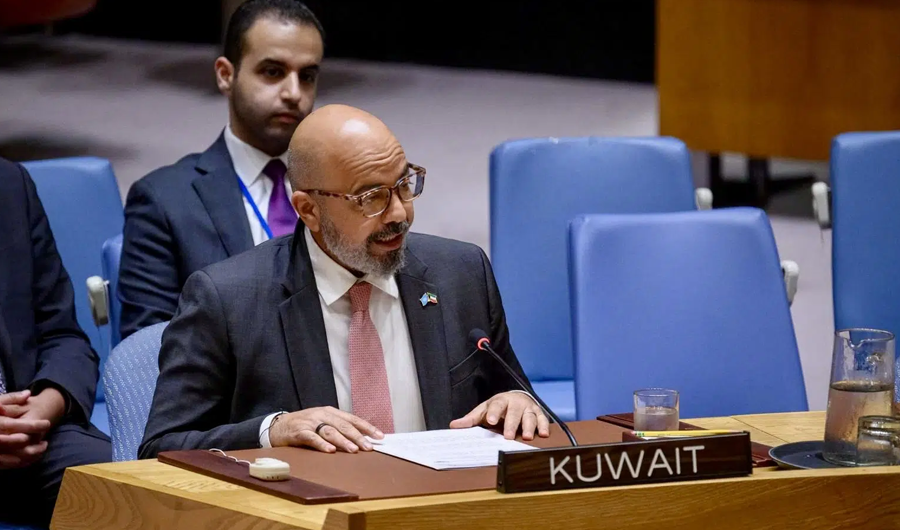
Kuwait's envoy calls on the Security Council to put an end to Iranian attacks on maritime navigation and the use of emerging technologies
Translated by Qiyas from سرمد — Original source
Kuwait has emphasized the necessity of the full implementation of United Nations Security Council Resolution 2817 (2026), which condemns Iran’s heinous attacks on the Gulf Cooperation Council (GCC) countries and Jordan. It stressed the urgent need to put an end to all attacks and threats that obstruct legitimate transit and freedom of navigation in the Strait of Hormuz, or undermine maritime security in the Bab al-Mandab.
This statement was made by Kuwait’s Permanent Representative to the United Nations, Ambassador Tariq Al-Banna, during an evening address on Thursday at a high-level open debate held by the Security Council on “Emerging Technologies and Maritime Security: Implications for International Peace and Security.”
Ambassador Al-Banna stated that protecting sea lanes is a collective responsibility that allows no room for selectivity or double standards. He reaffirmed the necessity of adhering to international law and ensuring freedom of navigation in strategic maritime routes.
In this regard, he called for strengthening international cooperation and establishing responsible controls on the use of emerging technologies, contributing to the protection of maritime navigation and the preservation of international peace and security.
He noted that the Arabian Gulf region has witnessed, during the current year, heinous Iranian attacks targeting the territories of GCC countries and Jordan, as well as their vital facilities. These were accompanied by attacks on oil tankers and ships, including Kuwaiti vessels, threatening the safety of navigation in strategic maritime passages.
He clarified that the use of modern technologies, particularly drones and advanced missiles, in military attacks and maritime threats poses a direct danger to the security of states and the stability of the global economy.
He pointed out that targeting commercial ships or disrupting navigational routes does not only affect the ships or routes themselves; its repercussions extend to global supply chains, energy and food prices, and the stability of economies, particularly those most dependent on maritime trade.
Regarding emerging technologies, Ambassador Al-Banna stated that threats previously confined to piracy and direct attacks on ships have now expanded to include drones, autonomous systems, and cyberattacks on ships, ports, and navigation and communication networks.
He added that while these technologies offer opportunities to enhance the efficiency and safety of maritime transport, they have also enabled state and non-state actors to threaten international navigation at a low cost, with impacts that may transcend national and regional borders.
He warned that artificial intelligence, which contributes to improving risk monitoring and prediction and enhancing navigation safety, could also be used to carry out more complex cyberattacks, operate autonomous systems beyond any effective human oversight, or disseminate disinformation that disrupts navigation and exacerbates tensions.
He stressed the need to keep pace with technological developments through clear international frameworks and responsible controls that prevent the misuse of modern technologies or their deployment to infringe upon state sovereignty and maritime navigation safety.
In this context, he called for expanding international cooperation, information and expertise sharing, and developing the technical capacities necessary to protect ships, ports, and maritime infrastructure from cyberattacks and non-traditional threats.
He urged support for the role of the International Maritime Organization (IMO), capacity-building for developing countries, and ensuring the safe and responsible use of autonomous systems while maintaining human responsibility and accountability.
Ambassador Al-Banna concluded his remarks by stating that technological progress should serve to enhance security and stability, not as a means to expand conflicts or threaten international trade.
He emphasized that the success of the international community is measured by its ability to prevent the misuse of technology, protect lives and sea lanes, and prevent the seas from becoming new arenas for conflict.
