President of Desert Storm Monument Association: Monument Commemorates Sacrifices of Kuwait Liberation Participants - Sarmad
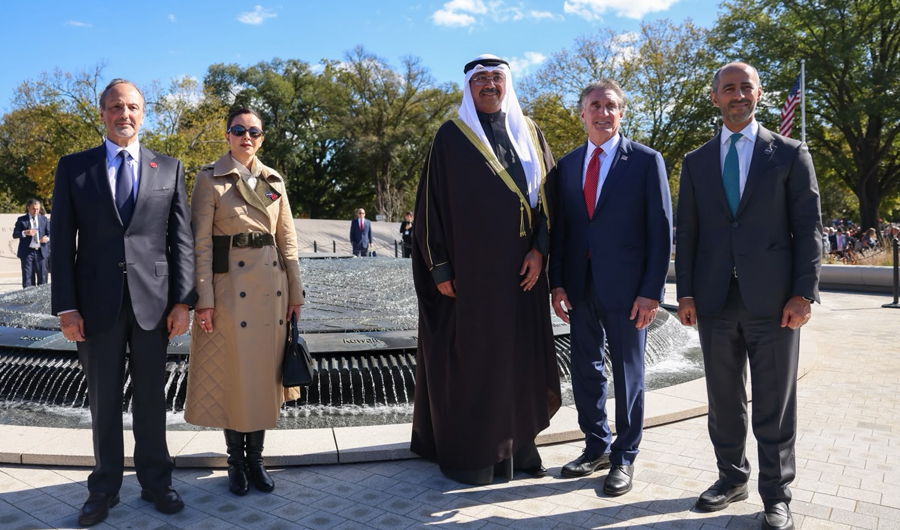
Scott Stump and Saleh Al-Zaman emphasized the monument's importance in conveying lessons of international solidarity and honoring the memory of warriors in Kuwait's liberation.
Translated by Qiyas from سرمد — Original source
The chief executive of the National Desert Storm Memorial Association, Scott Stump, affirmed on Sunday that the memorial embodies an “exceptional chapter” in modern military history and honors the sacrifices of participants in an international coalition comprising more than 30 countries that liberated Kuwait in 1991.
Stump emphasized, in a speech delivered during the opening ceremony of the Desert Storm and Desert Shield memorial at the National Mall in the heart of Washington, D.C., the importance of passing on the lessons of this experience to future generations. He praised the generous support provided by the State of Kuwait and the Kuwait Banks Union for the completion of this significant memorial.
He stated that “this memorial will tell the story to future generations that an international coalition, comprising more than 30 countries from five different continents with diverse religions and backgrounds, united and made sacrifices to achieve freedom.”
He added, “My knowledge that between five and six million people will visit this monument annually makes me realize that this story will remain alive and endure long after we are all gone. The lessons will remain present here, forming a living, vibrant classroom for future generations… This memorial will stand as long as Washington, D.C. exists.”
Addressing the veterans present at the ceremony, he said, “To all my fellow veterans, enjoy this memorial that honors your memory. And to all members of the coalition and the Kuwaiti delegation, this memorial is yours; it is ours all, so enjoy it.”
For his part, former Congressman Phil Roe, a veteran of the U.S. Army, said in a similar speech that “what (Scott) has built goes beyond being merely a memorial; it is an honor to a coalition of nations that stood united in 1990 and 1991 to restore the freedom of Kuwait.”
Roe added, “It is very fitting that our friends from the State of Kuwait stand with us today, as this memorial tells their story as much as it tells ours. It is an enduring international tribute to everyone who served and to everyone who sacrificed their lives during the Desert Shield and Desert Storm operations.”
For her part, Kuwait’s Ambassador to Washington, Sheikha Al-Zain Al-Sabah, affirmed in her speech that the liberation of Kuwait in 1991 represents a historical model of international solidarity and collective action in defense of sovereignty and freedom. She praised the strategic partnership and enduring friendship between Kuwait and the United States.
Sheikha Al-Zain Al-Sabah stated, “There are moments in history that change the destinies of nations and simultaneously remind us of what can be achieved when the international community stands united.”
She added that the United States’ leadership of the international coalition constituted an unparalleled call to action, whose echoes resonated across continents and brought nations together in an exceptional model of unity, determination, and shared purpose.
She continued in her speech, “Today, we are honored to have among us the ambassadors and representatives of many of those coalition countries. Your presence serves as a valuable reminder that the liberation of Kuwait was a shared achievement and that the bonds forged in that historic moment remain intact to this day.”
She commended the completion of the Desert Storm and Desert Shield memorial in the heart of the U.S. capital, noting, “By doing so, we give this great history a permanent place. This is a vision realized thanks to the relentless dedication of a group of visionaries, builders, legislators, artists, and craftsmen.”
She emphasized that this memorial holds profound significance for the Kuwaiti people, as it honors the courage of those who fulfilled their duty and the sacrifices made in defense of freedom. It also celebrates the enduring friendship born in that exceptional moment in our shared history. Within the folds of this friendship lies a gratitude that time cannot diminish or diminish in value.
Sheikha Al-Zain Al-Sabah told the assembled audience, “To all who answered the call of duty: you will always remain present in Kuwait’s national memory and in our hearts, and we will never forget you. More than 35 years have passed since the liberation of Kuwait, and although the world has changed, the principles that united our nations remain as crucial today as they were then: sovereignty, international law, territorial integrity, and the firm belief that collective action based on shared principles can change the course of history.”
For his part, Skip Graham, a research director at the prominent landscape architecture and urban design firm OLIN, which designed the memorial, said that thanks to the monument’s location and ease of access, millions of visitors annually would be able to learn about the significance of this conflict and its impact on American history.
Graham added that the memorial is also close to the State Department headquarters, which led intensive diplomatic efforts to secure multiple United Nations resolutions and rally support for the coalition to liberate Kuwait.
He explained that the design team created the memorial to serve as an “oasis” within the landscape of the National Mall, where the interior space is surrounded by two earth masses resembling sand dunes, akin to the “Burgan” dunes in Kuwait, formed by wind-blown desert sands.
He noted that the sand dunes in the memorial were designed to allow the wall surface and the artworks it features to interact with sunlight throughout the day and across the year. For example, in the afternoon, one can observe that the wreaths are positioned to catch the golden light of the sunset. This is also a subtle but clear reference to your invitation to return here repeatedly throughout the year, even in the evening hours.
He added that the “Storm Wall,” the first wall, is characterized by a highly dynamic quality in the memorial, embodying a formation that reflects the power and speed of military operations. Sculptural works by artist Emily Pedar emerge from the sand dune terrain, depicting stages of the conflict—from military buildup and engagement to combat, culminating in the liberation of Kuwait.
He continued, explaining that this formation reaches its peak at the highest point of the wall, where intricate details and emotions convey the intensity of the battles. The movement paths take a curved shape, mimicking the design of the “Left Hook” maneuver executed during Operation Desert Storm, connecting visitors to all memorial elements that slowly spiral toward the center of the monument.
He said that along this path, two stainless steel elements—created by artist Robert Eckstein—stand out, symbolizing both the United States and Kuwait in a powerful formation expressing the alliance between the two countries. The United States appears as the leader of the victorious coalition returning home, while Kuwait is depicted as liberated, reclaiming its sovereignty and freedom as an independent state.
He went on to describe the memorial, noting that the “Inscription Wall” offers a clear contrast to the “Storm Wall,” characterized by a calmer and more serene atmosphere, centered around two interlocking wreaths representing Operation Desert Shield and Operation Desert Storm.
He said this wall reminds visitors of the sacrifices made by men and women who volunteered for military service thousands of miles from their homelands. At the heart of the memorial lies what is known as the “Unity Shield,” representing the coalition countries that supported the liberation of Kuwait.
Green spaces surround this central area, featuring a fountain designed to evoke an “oasis” atmosphere, providing a place for rest and contemplation in tranquility.
The inauguration ceremony of the memorial monument for Operations Desert Shield and Desert Storm was held in the presence of Kuwait’s Minister of Defense, Sheikh Abdullah Ali Al-Salim Al-Sabah, Kuwait’s Ambassador to Washington, Sheikha Al-Zain Al-Sabah, a large number of U.S. officials, as well as cultural and political figures, diplomats from many countries, and a large group of veterans and their families.
