Kuwait Studies Creating Two Pipelines Through Saudi Arabia and UAE to Bypass Strait of Hormuz - Sarmad
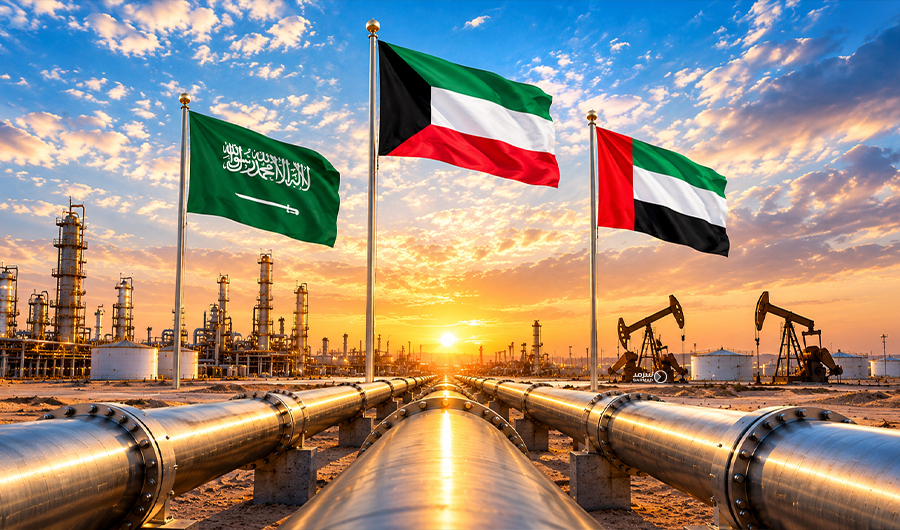
Kuwait Petroleum Corporation is studying the creation of two pipelines through Saudi Arabia and the UAE to transport crude oil away from the Strait of Hormuz
Translated by Qiyas from سرمد — Original source
A Kuwaiti oil official told Bloomberg Middle East that the Kuwait Petroleum Corporation (KPC) is studying the construction of two pipelines to transport crude oil through Saudi Arabia and the United Arab Emirates, a move aimed at providing alternative routes for its exports away from the Strait of Hormuz.
Mohamed Al-Abdulkareem, Deputy Chief Executive Officer for Planning and Innovation at Kuwait Oil Company, said the corporation has agreed with its partners in Saudi Arabia and the UAE to conduct feasibility studies for two separate projects originating from the Ahmadi area in Kuwait. The first pipeline would extend through Saudi Arabia to the Red Sea coast, while the second would run through the UAE to Fujairah.
The first project, still under study, aims to create a crude oil pipeline from Ahmadi to the Saudi coast on the Red Sea, utilizing the East-West Pipeline that connects the kingdom’s oil-producing regions in the east to its western coast.
The second project involves building a pipeline to transport Kuwaiti crude from Ahmadi to Fujairah via the Habshan-Fujairah pipeline in the UAE, enabling oil to reach the coast of the Gulf of Oman outside the Strait of Hormuz.
Existing infrastructure in Saudi Arabia and the UAE provides both countries with the capacity to transport large volumes of crude to ports outside the Strait of Hormuz. The full capacity of Saudi Arabia’s East-West Pipeline is approximately 7 million barrels per day, while the capacity of the UAE’s Habshan-Fujairah pipeline ranges between 1.5 and 1.8 million barrels per day.
KPC emphasized that both projects are still in very early stages, and the agreement to conduct feasibility studies does not constitute a final investment decision to proceed with implementation.
Al-Abdulkareem clarified, “We are still in a very early stage of studying these projects. If we decide to proceed with the construction of any of them, it will take four to five years to build.”
Last June, Sheikh Nawaf Al-Ahmad Al-Jaber Al-Sabah, CEO of KPC, stated that the corporation was discussing with both countries the expansion of pipeline systems to accommodate Kuwaiti oil shipments.
