Arab League Secretary-General: Security of Kuwait and Gulf States an Integral Part of Arab National Security - Sarmad
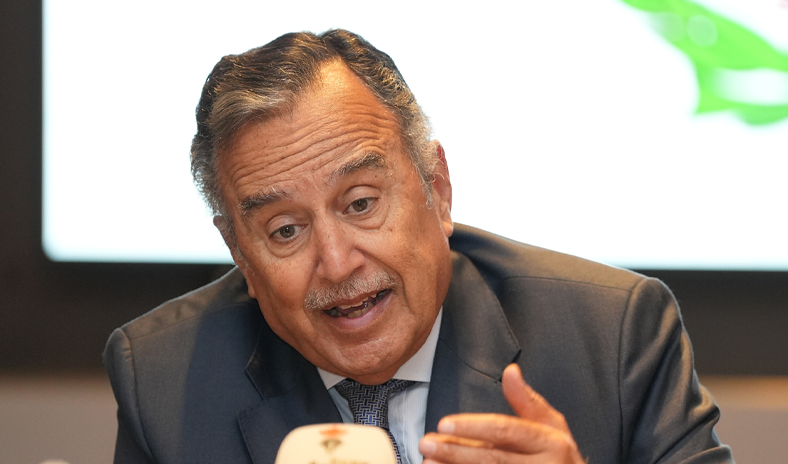
Nabil Fahmy affirmed that Kuwait's security is part of Arab national security and discussed the development of an Arab defense alliance
Translated by Qiyas from سرمد — Original source
(KUNA) – Arab League Secretary-General Nabil Fahmy affirmed that the security of Kuwait and the Gulf Arab states is an integral part of the Arab national security system, stressing that the League would not remain silent in the face of any violation of international law affecting the sovereignty or interests of Arab states, and that it would continue its political and diplomatic efforts to support the security and stability of member states.
Fahmy, speaking at a press conference held today, Monday, on the occasion of his official visit to the country, said that the repeated attacks on the territories, sovereignty, and interests of Gulf states, including Kuwait, particularly from the Iranian side, reflect the scale of the security and political challenges facing the region.
He reaffirmed the Arab League’s readiness to provide various forms of political support and cooperation to help protect Kuwaiti interests and enhance regional stability, noting that his visit to Kuwait stems from a deep appreciation of the country’s Arab positions over decades.
He recalled Kuwait’s role during the stages preceding the country’s liberation and the period that followed, pointing out that Kuwait’s Arab identity has remained a constant pillar of its foreign policy, independent of the fluctuations of events and regional circumstances.
He expressed his pride in the warm welcome he received during the visit, noting that his meetings with senior Kuwaiti officials were characterized by depth and frankness, covering strategic and detailed discussions on current challenges and the future of joint Arab action.
He added that he would return to Cairo carrying Kuwaiti messages and perspectives regarding the next phase and the role of the Arab League, noting that he had outlined aspects of his vision for the work of the Secretariat General, which places the protection of Arab interests at the forefront of its priorities.
In response to a question about the guarantees the Arab League could offer to protect the sovereignty of member states, Fahmy clarified that the League and Arab states form an integrated system in which states direct joint action, while the Secretariat General plays a role in initiative, support, and political coordination.
He stated that the current guarantees are not military or direct security measures, but rather involve activating political and diplomatic mobilization, unifying Arab positions, and confronting any violation of international law that affects Arab interests.
He added, “I am concerned about the Arab situation and uneasy about it,” explaining that the multiplicity of crises and challenges facing Arab states, whether from regional actors or due to internal disagreements, calls for a serious review of joint action mechanisms.
He stressed that respect for international law must be the foundation upon which Arab states rely to protect their sovereignty and collective security, noting that relying on the rule of law rather than the law of force represents a strategic necessity for Arab states.
He indicated that he seeks to enhance the Arab League’s capacity to contribute to developing security guarantees for member states, explaining that achieving this requires joint efforts and continuous cooperation between Arab governments and the Secretariat General.
Regarding the possibility of establishing an Arab defense alliance similar to the North Atlantic Treaty Organization (NATO), Fahmy said that the Arab region already has agreements for joint defense, but they need to be developed and activated in line with the nature of current challenges.
He added that his vision is based on building a comprehensive Arab deterrence system that is not limited to the military aspect, but also includes political deterrence, collective diplomatic action, and economic cooperation.
He pointed out that NATO was originally established to confront a specific threat, whereas the Arab system should be based on the principle of confronting any violation of international law that affects the sovereignty or interests of Arab states.
He affirmed that he would propose ideas and initiatives on this matter for consultation with member states, aiming to reach practical mechanisms that enhance the ability of Arab countries to protect their security and the independence of their political decision-making.
Regarding developments in Yemen and tensions related to the Kingdom of Saudi Arabia, Fahmi condemned the targeting of Saudi civilian sites, considering these attacks a violation of sovereignty and unacceptable practices that warrant accountability, whether for those who carry them out or those who support them.
He pointed out that the Yemeni crisis, which has persisted for decades, reflects a fundamental problem consisting of the absence of sustainable stability for the nation-state, leading to internal divisions, conflicts, and external interventions that have negatively impacted the Yemeni people and the security of neighboring countries.
He clarified that he has begun reviewing developments regarding the Yemen file and consulting on it, but has not yet delved into its detailed resolution, noting that he has held contacts with the Yemeni side regarding recent developments.
He stressed that the stability of the Yemeni state is a fundamental element for regional security, and that the continuation of fragmentation and conflict opens the door to further interventions and multiplies security and humanitarian challenges.
Regarding the possibility of holding an emergency Arab summit to discuss regional tensions and attacks on Gulf countries, Fahmi emphasized the importance of Arab meetings at the level of leaders and foreign ministers as an opportunity for consultation, coordination of positions, and the identification of common priorities.
He noted that the importance of summits is not limited to their convening but is fundamentally linked to proper preparation and the follow-up implementation of decisions issued from them, adding that high-level meetings can serve as a starting point for new initiatives or an occasion to announce decisions that have been prepared in advance.
He stated that Arab diplomatic contacts continue at various levels, and that he will work to intensify them in light of regional developments, while seeking to organize periodic Arab summits that not only address crises but also look toward the future.
Regarding the Palestinian issue, Fahmi affirmed that it will remain the central and priority issue in Arab action, stressing that the continuation of Israeli occupation, settlement expansion in the West Bank, and developments in the Gaza Strip make reaching a political settlement more difficult.
He clarified that efforts made over the past decades have failed to end the occupation or reach a just and comprehensive solution, considering that Israeli intransigence and American security support for Israeli positions have contributed to complicating settlement prospects.
He added that the two-state solution remains the only possible solution to the Palestinian issue, but it has become more difficult compared to five or ten years ago due to settlement expansion and geographical and demographic changes on the ground.
Fahmi warned against the continuation of Israeli settlement policies that threaten the possibility of establishing a Palestinian state on contiguous territory, noting that, in his assessment, Israeli practices aim to undermine Palestinian identity and alter the existing reality.
He reaffirmed Arab countries’ commitment to the foundations of the Arab Peace Initiative adopted at the Beirut Summit in 2002, foremost among them being the end of occupation and reaching a comprehensive settlement.
He stressed that while the Palestinian issue is a priority, it should not prevent addressing other Arab crises, clarifying that the common denominator among them is the necessity of respecting international law and rejecting violations of sovereignty and land occupation.
In comparing the European Union’s experience with the trajectory of joint Arab action, Fahmy argued that one of the key factors behind Europe’s progress lies in its member states’ ability to build their own capacities while maintaining international partnerships.
He noted that Arab countries, at various stages, relied excessively on external actors in the fields of security, politics, and economics, which undermined their ability to develop their own tools and strengthen their decision-making independence.
He pointed out that Arab cooperation achieved significant milestones in key historical moments, including the October 1973 War and the liberation of Kuwait in 1991, which witnessed forms of political and military Arab solidarity and participation.
He emphasized that what is required today is not isolation from the world, but rather striking a balance between international cooperation and building Arab self-capacity, thereby enhancing national decision-making independence and limiting the impact of shifts in the policies of major powers.
Fahmy revealed his intention to launch a renewed Arab agenda based on three main pillars: addressing crises, developing the Arab cooperation system, and promoting economic and social development.
He clarified that the first pillar focuses on dealing with existing political and security crises, while the second aims to develop Arab institutions and mechanisms, including the Arab League. The third pillar concentrates on providing development opportunities and fulfilling the aspirations of new generations.
He highlighted that approximately 65 percent of the Arab world’s population is under the age of 30, imposing a doubled responsibility on Arab governments and institutions to provide a better future and economic opportunities commensurate with youth aspirations.
He stressed that achieving high economic growth rates and strengthening the self-capacity of Arab states are two fundamental conditions for protecting the independence of sovereign decision-making, warning that excessive reliance on external actors in economic, security, or political fields leads to a narrowing of the scope for national decision-making.
In response to criticisms that the Arab League limits itself to issuing statements of condemnation and denunciation, Fahmy explained that the coming phase requires a shift toward institutional action and practical initiatives, as well as restoring the credibility of the joint Arab cooperation system.
He noted that since assuming his position, he has called for the development of Arab national security tools and the enhancement of collective deterrence capabilities, alongside updating political, economic, and developmental work mechanisms.
He added that he will work on elaborating the executive details of the new agenda during the period from September to March next year, paving the way for consultations with member states and the establishment of programs for gradual implementation that may span three to five years, depending on the nature of each file.
He stated that he is not offering promises of immediate solutions to Arab crises, but rather presenting a vision, objectives, and mechanisms that are adaptable and implementable, stressing that the success of Arab action requires initiative, future planning, and the provision of necessary tools for movement.
Fahmy concluded by affirming that his unanimous selection for the position of Secretary-General is both an honor and a significant responsibility, and that he will work in consultation with member states to enhance the effectiveness of the Arab League and restore confidence in joint Arab action, based on a commitment to protecting Arab interests and respecting international law.
