Intervention Efficiency and Impact Governance: Kuwait's Integrated Humanitarian Response Strategy - Sarmad
(KUNA) — Kuwait continues to write exceptional chapters in the history of international giving and consolidates its status as a vibrant global capital of humanitarian action through a pioneering development strategy and cross-continental structural solutions based on intervention efficiency and governance.
Translated by Qiyas from سرمد — Original source
(KUNA) — Kuwait continues to write exceptional chapters in the history of international giving, consolidating its status as a vibrant global capital of humanitarian action through the formulation of a pioneering developmental strategy and cross-continental structural solutions based on intervention efficiency and impact governance.
Kuwaiti humanitarian diplomacy is currently leading a new phase of flexible, multi-dimensional response, extending across a map of landmark projects that are reshaping the contours of stability and development from the Middle East to the heart of the African continent.
In line with its commitment to supporting the United Nations Sustainable Development Goals and activating field responses based on impact, Kuwaiti humanitarian bodies and institutions have launched a package of integrated developmental, medical, and relief projects in several countries in the Middle East and Africa. These initiatives focus on transitioning from direct material aid to institutionalizing support, building local capacities, and providing sustainable solutions.
In a distinctive medical initiative reflecting Kuwait’s humanitarian generosity, the Insan Charity Association, in collaboration with the Kuwaiti Children’s Heart Charity Association, deployed the Kuwaiti flag and the expertise of its medical staff to Tanzania. This specialized campaign aims to treat children suffering from congenital heart defects, offering them new opportunities for life and alleviating the suffering of their families. The campaign included examinations for 100 children, the performance of 14 complex surgeries in the capital, Dodoma, alongside providing treatment for cases that did not require surgical intervention.
Dr. Othman Al-Khamis, Chairman of the Board of Directors of the Insan Charity Association, told the Kuwait News Agency (KUNA) that the campaign is part of Kuwaiti humanitarian efforts to support health services in needy communities and provide treatment opportunities for children with heart diseases, thereby reducing their suffering and that of their families.
Al-Khamis added that the Kuwaiti medical team conducted a comprehensive assessment of the cases and successfully performed all scheduled surgeries, in addition to providing pharmaceutical treatments for children whose conditions did not require surgery. He clarified that the campaign also included training for doctors and nursing staff in Tanzania to transfer specialized expertise in diagnosing and managing pediatric heart diseases, thereby enhancing the capacity of the local health sector to provide these services in the future.
He noted that cooperation between Kuwaiti charitable and medical institutions contributes to implementing initiatives that combine direct treatment with capacity building, emphasizing the association’s commitment to expanding its medical programs and reaching more needy children in beneficiary countries.
For his part, Dr. Faisal Al-Saaidi, Chairman of the Children’s Heart Charity Association and Consultant in Pediatric and Adult Congenital Heart Surgery at the Kuwait Ministry of Health, stated in a similar interview with KUNA that medical charitable work has become a comprehensive humanitarian mission that goes beyond direct treatment to unify expertise and resources among charitable and medical institutions. This contributes to reaching the most vulnerable groups and achieving sustainable health impact.
Al-Saaidi said that exporting Kuwaiti medical expertise to countries lacking specialized fields, particularly pediatric heart diseases and surgeries, represents an advanced model of humanitarian work. It combines treating cases, dispatching specialized teams, transferring knowledge, and training local staff, thereby enhancing their ability to continue providing care in the future.
He added that the Children’s Heart Association looks forward to expanding its partnerships with charitable, medical, and humanitarian bodies, based on its belief that integrated efforts multiply the impact of initiatives. He affirmed that every child deserves a chance for treatment and that every medical expertise can save a life and make a real difference that transcends borders.
In the Jordanian capital, Amman, the Islamic World Charity Organization (IWCO) opened a new path toward empowerment and economic independence by launching the manuals for the “Masar” program for small projects, designed for both trainers and trainees. This was accompanied by the signing of an agreement to implement the program on the ground in a developmental initiative that bets on human potential and the ability of individuals to create their own opportunities by developing the management, planning, and marketing skills of micro and small enterprise owners. This helps them transform their ideas into more stable and sustainable projects.
Ibrahim Al-Badr, Deputy General Manager of Projects at IWCO, told KUNA that the program represents a transition from the organization’s experience in project financing to building an integrated training methodology that links financing with knowledge, qualification, practical application, and impact measurement.
Al-Badr added that project success does not depend on financing alone; it requires empowering beneficiaries with tools that help them understand the market, manage resources, make appropriate decisions, and handle challenges that may face their projects.
He explained that the program relies on two integrated manuals: one provides a clear methodology for trainers, while the other accompanies project owners through practical tools and exercises. He noted that the field application in Jordan targets approximately 2,000 participants across 80 training courses in various governorates.
He pointed out that the participation of entities from Palestine, Yemen, Lebanon, and Turkey, along with the Islamic Development Bank, gives the program a broader dimension for exchanging expertise and developing the methodology. He affirmed IWCO’s aspiration to consolidate “Masar” as an applicable and developable tool that helps beneficiaries transition from receiving support to production and self-reliance.
In Turkey, Al-Najah Charity Association continued its support for Syrian refugee families through a relief visit preceding the winter season. The visit included providing food, health, educational, and clothing assistance to needy families, orphans, and patients, as part of its efforts to alleviate the living burdens on the most vulnerable groups.
Eng. Thamer Al-Sahib, Director of Zakat Salwa under Al-Najah Charity Association, told KUNA that the aid reached 1,133 families, comprising more than 5,600 beneficiaries, and was distributed according to the living, health, and educational needs of each category.
Al-Sahib added that the assistance included food baskets, clothing for families of orphans, school bags, and stationery, in addition to supporting families with infants to help them provide basic needs for their children.
He clarified that the health aspect was present through financial assistance to families comprising patients and persons with disabilities, as well as families of orphans, aiming to alleviate treatment burdens and support them in facing their daily conditions.
He noted that these initiatives reflect the values of solidarity that characterize Kuwaiti society, explaining that the support provided by benefactors and donors contributed to diversifying projects to include food, health, education, and clothing under the umbrella of the “Kuwait is by Your Side” campaign.
In Côte d’Ivoire, Namaa Charity, under the Social Reform Association, embodied the meaning of sustainable human development through an important project whose impact extends beyond providing housing to opening doors to stability, education, and a dignified life for families. The association inaugurated a complete residential village comprising houses, a school, a mosque, and an artesian well, granting the local community the essentials for a safer and more stable life and providing basic needs in one place.
Khaled Al-Shammari, Head of Programs and Initiatives Sector at Namaa Charity, told KUNA that the project represents a model of integrated projects that respond to population needs in multiple areas and provide infrastructure that helps families improve their living conditions sustainably.
Al-Shammari added that the village includes 67 houses benefiting 67 families, alongside a school accommodating approximately 210 students, thereby supporting children’s right to education and providing a suitable educational environment within the beneficiary community.
He explained that the project includes a mosque serving residents, in addition to a solar-powered artesian well benefiting approximately 5,000 people, providing a sustainable water resource and serving a wider range of the area’s population.
He noted that combining housing, education, water, and community services reflects Namaa’s approach to building projects with long-term impact, appreciating the support of benefactors and donors who contributed to turning the project into a reality serving families, students, and local residents.
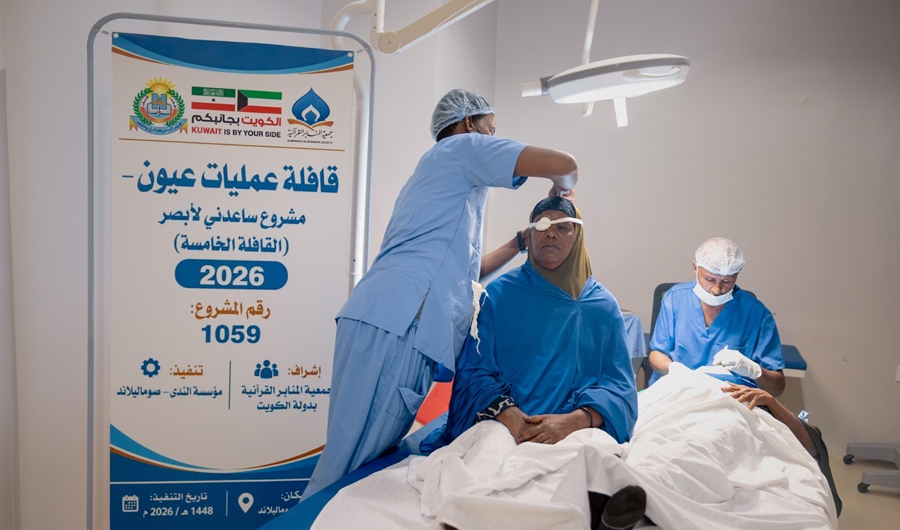
In Somalia, Al-Manaber Al-Quraniya Association brought hope to patients who lost the blessing of sight or whose vision had deteriorated, through a medical caravan as part of the “Help Me See” project. The initiative contributed to performing eye surgeries for 125 needy patients in a humanitarian effort that goes beyond medical treatment to re-empowering patients to live better lives and alleviating the burdens borne by their families.
Dr. Mohammed Al-Amran, General Manager of Al-Manaber Al-Quraniya Association, told KUNA that restoring sight is not limited to treating the medical condition; it gives humans a greater opportunity to learn, work, become self-reliant, and return to practicing the details of their lives normally.
Al-Amran added that reaching patients in Somalia with the project embodies the direct impact that charitable work can have when donor support transforms into treatment that changes human reality and opens new opportunities for life.
He clarified that the project reflects the value of solidarity and the importance of directing charitable initiatives toward urgent health needs, emphasizing that its continuation depends on donor trust and contributions to reach the most needy patients.
He noted that Al-Manaber Al-Quraniya Association seeks through these programs to transform donations into tangible humanitarian impact that restores a significant part of a patient’s independence and enhances their ability to participate in family and social life.
These Kuwaiti efforts come under high directives within the “Kuwait is by Your Side” campaign, embodying the extension of the state’s humanitarian approach in supporting the needy and providing the essentials for a dignified life.
