Gulf Finance Ministers and Central Bank Governors hold meeting with IMF in Manama - Sarmad
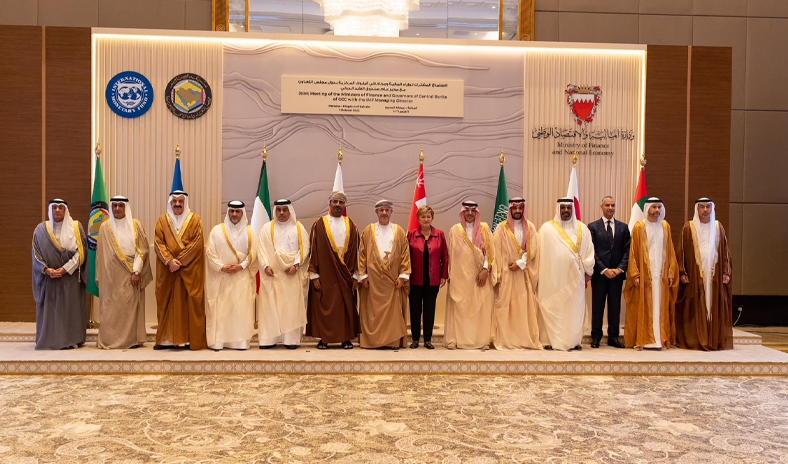
(KUNA) – The Bahraini capital, Manama, hosted on Thursday a joint meeting of finance ministers and central bank governors from the Gulf Cooperation Council (GCC) countries with International Monetary Fund (IMF) Managing Director Kristalina Georgieva, under the theme “Economic Outlooks and Political Challenges: Strengthening Resilience to Geopolitical Shocks.”
The meeting, hosted by the Kingdom of Bahrain, was chaired by Bahrain’s Minister of Finance and National Economy, Sheikh Salman bin Khalifa Al Khalifa, who conveyed greetings from Bahrain’s King Hamad bin Isa Al Khalifa and Crown Prince and Prime Minister Sheikh Salman bin Hamad Al Khalifa to the participants, wishing the meeting success. He expressed his gratitude to the IMF management and the GCC Secretariat General for their participation and continuous cooperation.
In a speech during the meeting, Bahrain’s Minister of Finance and National Economy emphasized that the GCC countries’ experience of malicious Iranian aggression and attempts to undermine maritime security and international trade confirmed that the resilience and capacity of GCC states to confront various regional and international challenges and changes have become a fundamental pillar in supporting global security, stability, and economic prosperity.
He highlighted the vital importance of security and freedom of navigation in strategic waterways, foremost among them the Strait of Hormuz and the Bab al-Mandab, and their pivotal role in facilitating global trade flows, enhancing energy security, and sustaining international supply chains.
He also noted that strengthening resilience to challenges and building stronger, more diversified, and interconnected economies remains a priority for GCC countries amid rapid global economic changes and escalating geopolitical challenges. He stressed the importance of continuing economic diversification, enhancing fiscal and investment frameworks, and investing in strategic infrastructure, trade routes, logistics, energy security, digital connectivity, and human capital.
He affirmed that the economic resilience of GCC countries is rooted in regional cooperation, pointing out the importance of the collective ability of GCC states to coordinate and respond when pressures arise on trade routes, logistics networks, financial systems, or key supply chains, noting that resilience is a carefully planned process, not a matter of chance.
He welcomed the participation of the IMF, noting its positive impact on the outcomes of the joint meeting, which helps achieve the desired objectives and aspirations.
He clarified that decades of economic diversification in the Kingdom of Bahrain have contributed to non-oil activities accounting for more than 86 percent of GDP, emphasizing that this diversification has enabled key sectors to continue growing and advancing.
He pointed to the capacity of GCC economies to enhance development pathways in line with the visions and aspirations of GCC leaders, stressing the importance of further strengthening the resilience of GCC economies and their ability to cope with various changes and challenges by continuing economic diversification efforts, developing fiscal and monetary frameworks, enhancing the security of energy and commodity supply chains, expanding trade and logistics routes, strengthening digital connectivity, and continuing investment in human capital development to support sustainable growth and enhance adaptability to future changes.
He emphasized that strengthening cooperation among Gulf Cooperation Council (GCC) countries constitutes a central pillar of this effort, noting that greater integration of markets, infrastructure, trade networks, investment flows, financial systems, and digital environments would expand collective capabilities, enhance competitiveness, and bolster the region’s economic resilience.
He underscored the importance of continuing to enhance the GCC’s readiness to keep pace with rapid developments in artificial intelligence and to harness the opportunities it offers to support growth and competitiveness through investments in digital infrastructure, talent and skills development, and the creation of regulatory and institutional frameworks that foster innovation and entrepreneurship.
In this context, he highlighted the growing significance of digital assets within the economic transformation process, noting that they provide unique opportunities that contribute to improving payment efficiency, deepening capital markets, and strengthening the GCC’s position as a leading global hub in finance and innovation.
He pointed out that the increasing interconnectedness of digital financial systems requires effective oversight and close cooperation among GCC countries and other nations to safeguard financial stability.
The meeting included a speech by GCC Secretary-General Jassem Al-Budaiwi, who addressed joint initiatives undertaken by the member states.
The meeting also featured remarks by International Monetary Fund (IMF) Managing Director Kristalina Georgieva, who discussed the GCC Economic Surveillance Note for 2026, the region’s macroeconomic and financial resilience, economic outlook, and policy priorities.
On his part, the Director of the Middle East and Central Asia Department at the IMF presented an overview of recent developments and policy priorities aimed at maintaining economic stability and enhancing the GCC’s resilience in the face of geopolitical challenges, along with several topics concerning current economic conditions.
