Trump announces 'moral binding' agreement with AI companies - Sarmad
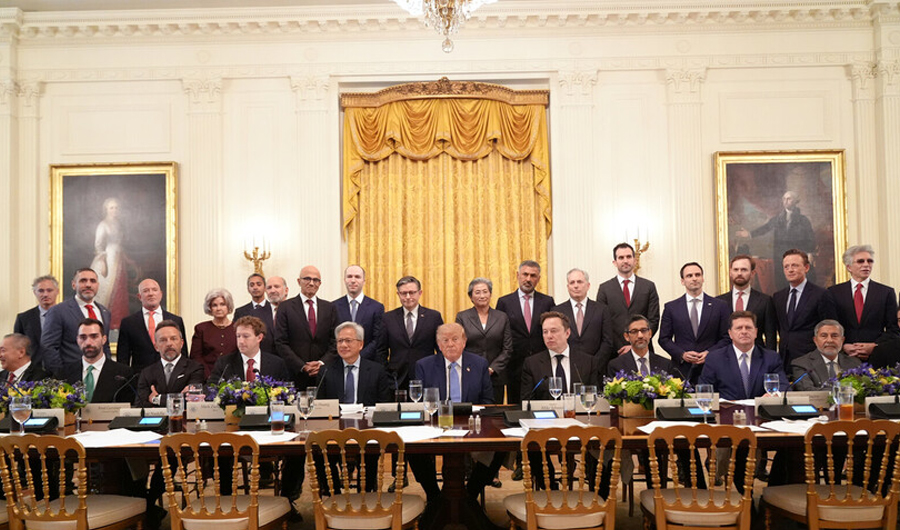
US President Donald Trump announced on Tuesday that executives from technology companies had signed a “binding ethical agreement” aimed at establishing adequate safeguards for the use of this rapidly evolving technology.
Speaking after a meeting at the White House attended by several leading figures in the artificial intelligence sector, Trump stated that technology companies would “self-regulate,” even as calls within Congress intensify for stricter oversight of the industry.
He added that he would officially rename the technology in government documents from “artificial intelligence” to “superintelligence,” explaining to reporters: “Because it is not artificial.”
Participants in the meeting included Elon Musk, Jeff Bezos of Amazon, Mark Zuckerberg of Meta, Satya Nadella of Microsoft, Sundar Pichai of Google, and Jensen Huang of Nvidia, alongside Trump and US House Speaker Mike Johnson.
Anthropic CEO Dario Amodei and OpenAI President Greg Brockman also attended.
Among the 31 guests, only two were women: White House Chief of Staff Susie Wiles and Lisa Su, CEO of AMD.
The meeting took place amid growing concerns in Washington over the rapid advancement of artificial intelligence, with mounting pressure on lawmakers to curb or slow the development of this technology out of fears that it could displace workers and trigger widespread societal changes.
The Republican leader in the House of Representatives stated that industry players “must be involved” in discussions regarding potential protective safeguards, adding that they are “best informed” about the intricacies of this technology.
Debate over AI security has intensified in Washington as the midterm elections on November 3 approach. A CNN poll showed that 82% of Americans are concerned about the speed of the technology’s development.
While Trump, backed by Jensen Huang and David Sacks, is pushing for unrestricted AI development to compete with China and bolster the US economy, the data centers associated with this technology have raised concerns regarding electricity bills, water consumption, and land use. Trump rejected these criticisms, warning that opposing them could leave communities “backward and poor.”
Democrats, including Chuck Schumer, have called for “real controls” on the sector, while Mike Johnson spoke of the need to strike a balance between innovation and regulation.
In response, Dario Amodei called for slowing down development, a stance supported by Sam Altman, Demis Hassabis, Elon Musk, and Satya Nadella. Meanwhile, Jensen Huang argued that losing control of the technology necessitates refraining from releasing uncontrolled products, maintaining that its risks can be addressed technically. Republican John Thune called for a “plan and safeguards” approach with a “light touch” in regulation.
The AI community is divided between a camp led by Amodei, Altman, and Hassabis advocating for sector regulation, and another closer to Trump, including Huang and Zuckerberg. Despite the heated debate in Congress, no law is expected before the elections, and the parliamentary session on the issue has been postponed until early November.
Anthropic, the developer of the Claude model, warned that AI could pose an “existential threat to humanity,” according to the Financial Times.
