Red Crescent confirms moving forward with expanding partnerships to enhance its role in serving humanity - Sarmad
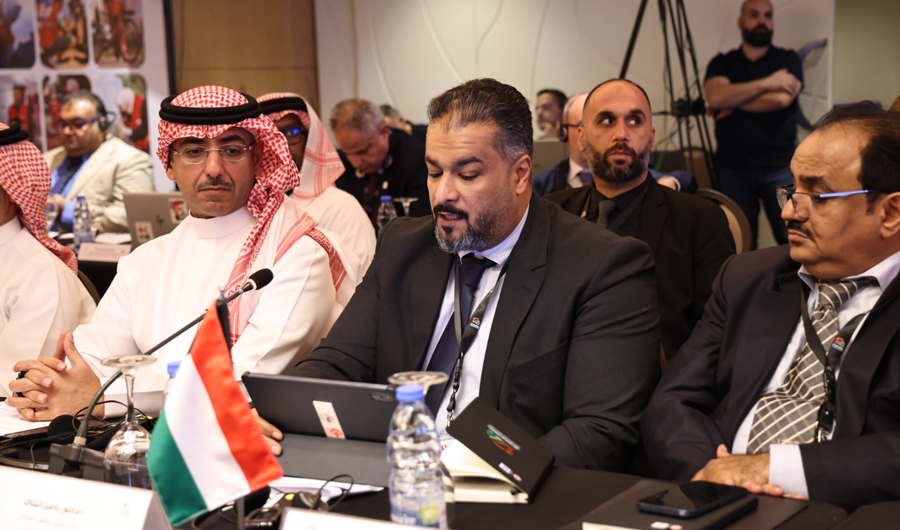
(KUNA) — The Kuwait Red Crescent Society (KRCS) affirmed its commitment to advancing its national readiness, expanding humanitarian partnerships, and strengthening its international presence, in line with the established humanitarian approach of the State of Kuwait and to enhance the Society’s role in serving humanity wherever needed.
Speaking to KUNA on Saturday during his participation in the 12th Regional Conference of the Red Cross and Red Crescent Societies in the Middle East and North Africa, hosted in Beirut, Dr. Nasser Al-Tanakh, Vice Chairman of the KRCS Board of Directors, said the Society “places great importance on participating in the regional meeting to engage with our humanitarian partners, exchange ideas that strengthen our humanitarian and relief roles, coordinate efforts to develop our services for our communities, particularly in difficult times and circumstances, and deliver optimal performance in emergency situations.”
Al-Tanakh added that the Society “strives to maintain its active presence at meetings of the International Federation of Red Cross and Red Crescent Societies, the Arab Crescent and Red Cross Society, and various humanitarian forums, exchanging experiences with sister national societies and supporting joint coordination in disaster response, volunteer work, humanitarian financing, and capacity building.”
He emphasized the importance of this participation in regional and international meetings, noting their role in unifying and coordinating efforts and improving performance to achieve more effective humanitarian work that serves local communities and supports humanity wherever needed.
In his speech during one of the conference sessions, Al-Tanakh outlined the KRCS’s journey over the past two years, a period during which the Society sought to “combine the continuity of its humanitarian and relief role abroad with strengthening its national readiness and developing its institutional framework in accordance with the principles of the International Red Cross and Red Crescent Movement.”
He noted that on the humanitarian and relief level, the Society continued its response to crises and disasters in several countries, prioritizing the most affected and needy areas, foremost among which are the occupied Palestinian territories. The Society intensified its efforts to support the population of the Gaza Strip through relief campaigns, dispatching urgent aid, and facilitating air and land bridges in coordination with official authorities and sister national societies. Additionally, it studied and implemented projects in the sectors of health, shelter, water and sanitation, education, and direct relief.
He pointed out that the Society continued to provide humanitarian support in several Asian and African countries through medical and relief aid, as well as health and social projects, in cooperation with national societies and specialized humanitarian organizations.
On the health front, Al-Tanakh stated that the Society “has paid increasing attention to developing its interventions, moving from traditional relief aid to more sustainable programs that include supporting health facilities, providing medicines and medical supplies, contributing to the treatment of patients, and studying the establishment of field medical capacities that can be utilized in disasters and emergencies.”
He highlighted the KRCS’s efforts to expand cooperation with sister national societies and international humanitarian organizations, developing memoranda of understanding and partnership programs in disaster preparedness and risk reduction, health and community resilience, and capacity building, including continued cooperation with several national societies in Asia and the Arab region.
He noted that on the national level, enhancing emergency preparedness has been a core pillar of the Society’s work in recent periods. In this regard, it raised its readiness to handle emergencies in coordination with state agencies, prepared shelter sites, provided basic needs and medical supplies, and allocated necessary resources for rapid response.
Al-Tanakh pointed out that these efforts included “recruiting and sorting more than 100 volunteers, organizing teams to work in shifts, and activating specialized teams in first aid, field response, and disaster management, thereby enhancing the supporting role the Society plays alongside official authorities in the State of Kuwait.”
Regarding local work, he said the Society “continued its social and humanitarian programs targeting families and the most vulnerable groups within Kuwait, including food, educational, and health aid, among other forms of support. At the same time, it worked on developing the regulatory and supervisory frameworks governing the provision of this aid to enhance justice and transparency, preserve the dignity of beneficiaries, and ensure that donations are directed to their intended purposes.”
He clarified that on the institutional level, the KRCS has, over the past two years, “reviewed and developed several internal regulations and financial and administrative systems, strengthened governance and supervision mechanisms, reorganized certain competencies and committees, and worked on developing the administrative structure, salary scale, and internal control mechanisms to build a more efficient and sustainable institution capable of responding to growing humanitarian needs.”
He noted that the Society contributed to national efforts related to the regulation and protection of the Red Crescent and Red Cross emblems, and participated in discussions on legislation governing charitable and humanitarian work, driven by its commitment to aligning national regulatory requirements with the Society’s specific nature as the National Red Crescent Society of Kuwait and a member of the International Red Cross and Red Crescent Movement.
He affirmed the Society’s focus on developing its capabilities in innovation, training, and the use of modern technologies, including training projects using virtual reality technology, to enhance the efficiency of staff and volunteers and strengthen their readiness to handle disaster and emergency scenarios.
He pointed out that the Society launched a Mental Health Office in February 2026, a step taken as the third national society in the region to do so. It also established an AI-powered response service to calm citizens and residents following the air raid sirens triggered by the recent Iranian aggression.
Al-Tanakh said, “What has been achieved over the past two years was not merely an expansion in the volume of activity, but part of a strategy aimed at developing the Society’s humanitarian work model, combining rapid response, quality implementation, governance, sustainability, and the enhancement of national and international partnerships.”
He added, “On this occasion, the Kuwait Red Crescent Society reaffirms its commitment to the principles of the International Red Cross and Red Crescent Movement, foremost among which are humanity, neutrality, impartiality, independence, unity, and universality. It is keen to continue cooperating with sister national societies and exchanging experiences with them to enhance our collective capacity to respond to growing humanitarian challenges.”
Al-Tanakh concluded his presentation by emphasizing the KRCS’s continued development of its national capacities and capabilities, expansion of its humanitarian partnerships, and strengthening of its international presence, building on past achievements to serve the “established humanitarian approach of the State of Kuwait and enhance the role of our national society in serving humanity wherever needed.”
For his part, Dr. Hossam Al-Sharqawi, Regional Director of the International Federation of Red Cross and Red Crescent Societies for the Middle East and North Africa, told KUNA, “This conference is held at a particularly difficult stage for our region. While wars, conflicts, and disasters have divided us, our humanity unites us today under the umbrella of the Red Cross and Red Crescent Societies. These societies are present on the ground in neighborhoods and streets, working daily to meet humanitarian needs and hasten to relieve and serve everyone in need during critical conditions and times of crisis.”
He added, “The humanitarian role of these societies and their convergence on a noble goal—serving humanity and protecting life—contribute to building bridges between peoples and nations through humanitarian action.”
He noted that the societies meet every two years to discuss various topics in the region, and their current meeting comes “at a sensitive time for the region, which we address with the seriousness and attention our humanitarian message demands.”
It is worth noting that the Kuwait Red Crescent Society is participating in the conference, whose closed sessions extended for two days yesterday (Friday) and today, through Dr. Nasser Al-Tanakh, Vice Chairman of the KRCS Board of Directors, and Dr. Mohammed Al-Mutairi, Advisor to the Chairman of the Board.
The conference, hosted by the Lebanese Red Cross in cooperation with the International Federation of Red Cross and Red Crescent Societies, discussed topics including volunteer safety and partnerships within the International Red Cross and Red Crescent Movement.
