Qatar's Emir: Gulf crisis is the result of temporary solutions and unrealistic policies
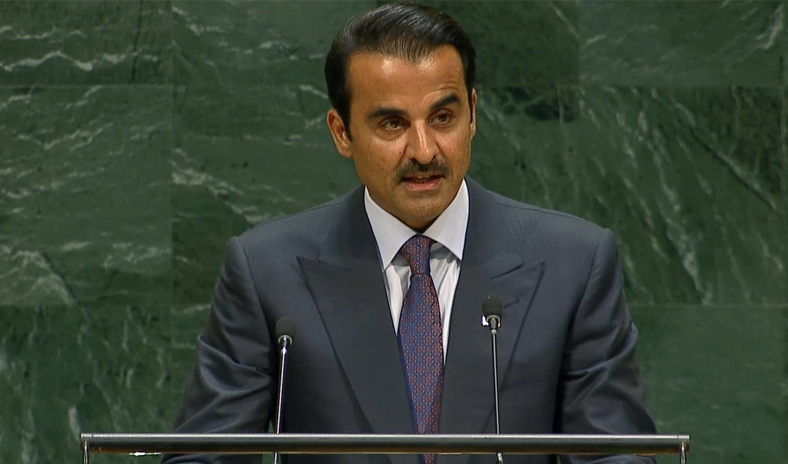
(KUNA) – Qatari Emir Sheikh Tamim bin Hamad Al Thani stated on Tuesday that the crisis facing the Gulf region is not a surprise, but rather the cumulative result of years of postponement, managing crises through temporary solutions, and unrealistic policies.
He made these remarks in a speech delivered during the high-level general debate of the 81st session of the United Nations General Assembly in New York City.
The Qatari Emir said that the “essence of the dangerous situation we are witnessing” lies in the absence of a regional collective security system that respects the sovereignty, territorial integrity, and unity of states, encourages the peaceful resolution of conflicts, and refrains from interfering in the internal affairs of countries.
He affirmed that despite the developments in the region, his country remains convinced that the Gulf crisis can be resolved through diplomatic means by opening the Strait of Hormuz to navigation and returning to negotiations, stressing that “the opportunity for a possible and realistic peaceful diplomatic solution must not be missed.”
Regarding the Palestinian issue, Sheikh Tamim stated that what is happening in the Gaza Strip constitutes “a genocide in every sense of the word and a stain of shame on the forehead of humanity as a whole,” adding that it is impossible to speak of a fair international system “as long as Palestine remains a blind spot within it.”
He held the international community directly responsible for pushing toward the implementation of the ceasefire agreement in Gaza and for not leaving its application at the mercy of a party accustomed to breaking its promises whenever the field is clear.
He warned against the continuation of what he described as oppression, apartheid, and settler terrorism in the occupied West Bank, the desecration of Islamic and Christian holy sites, foremost among them Al-Aqsa Mosque, and the deprivation of the Palestinian people of their rights, most notably the establishment of their independent state with East Jerusalem as its capital.
The Qatari Emir noted that “dealing with Israel, curbing its harm, and restraining its unlawful behavior is the true test” by which the international community proves its seriousness in upholding values and the rule of law.
Regarding Syria, he affirmed his country’s stance alongside the Syrian people in the phase of recovery and reconstruction, supporting state institutions, sovereignty, independence, and national and regional unity.
On the Sudanese issue, he called for a comprehensive dialogue leading to a sustainable peace that preserves Sudan’s unity and sovereignty.
He affirmed Qatar’s support for the Lebanese state institutions and its sovereignty over its entire territory, and condemned Israeli aggression against it, stressing the necessity of adhering to the ceasefire and United Nations Security Council Resolution 1701.
With regard to Yemen, the Qatari Emir affirmed his country’s support for UN efforts aimed at reaching a comprehensive political settlement based on the outcomes of the National Dialogue, in a manner that preserves Yemen’s unity and sovereignty and achieves security and stability.
