Kuwait's Healthcare System: A Quantum Leap Led by Remote Robotic Surgery - Sarmad
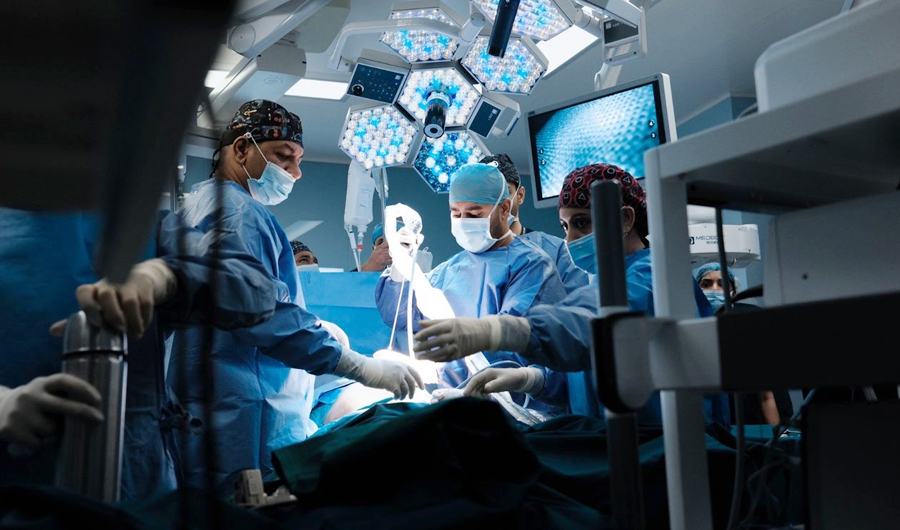
Developing surgical services in Kuwait using robotics.
Translated by Qiyas from سرمد — Original source
A qualitative leap is being achieved by Kuwait’s healthcare system, driven by the noticeable expansion in integrating modern and smart technologies into the medical sector, with robotic remote surgery leading the way. This has contributed to updating healthcare and developing services provided to patients across various government and specialized hospitals.
Kuwait’s leadership in developing its healthcare system is built on a wide infrastructure that has served as a real catalyst for this sector, enabling it to keep pace with and expand the scope of health, therapeutic, and emerging technologies, ultimately anticipating the future and the latest scientific advancements in therapeutic and preventive technologies.
In implementation of the high directives of His Highness the Amir of Kuwait, Sheikh Meshal Al-Ahmad Al-Jaber Al-Sabah, may God protect and guard him, Kuwait attaches great importance to the health sector through diligent and strategic efforts toward an integrated system that rivals global systems in its development, ensuring the provision of high-quality healthcare that meets patients’ needs. At the same time, the “New Kuwait 2035” vision prioritizes public health to ensure a better health and life for current and future generations.
Enhancing this path no longer focuses solely on providing traditional medical care but has extended to adopting the latest advancements in modern medicine, particularly remote robotic surgery, given the direct and tangible impact of this technological development on the quality of life and medical services benefiting patients in Kuwait.
Robotic remote surgery relies on delivering highly precise therapeutic programs through tools controlled by the surgeon via an advanced control platform, which provides a high-definition three-dimensional view of internal body tissues, granting the surgeon greater control and guidance that surpasses ordinary human capabilities.
Undersecretary of the Ministry of Health, Sheikh Dr. Salman Khalifa Al-Sabah, told the Kuwait News Agency (KUNA) on Monday that the development of surgical services is based on building sustainable national capacities that combine human efficiency, equipment quality, and safe practice, noting that the value of medical progress is measured by what it adds to the quality of care and patients’ lives.
Sheikh Dr. Salman Al-Sabah stated that robotic surgery covers multiple specialties at “Sheikh Jaber Al-Ahmad” Hospital, “Farwaniya” Hospital, “New Jahra” Hospital, “Pulmonary Diseases” Hospital, and “Sheikh Sabah Al-Ahmad” Kidney and Urology Center, reflecting the diverse application of the technology according to therapeutic needs and the expertise of specialized teams.
He noted that robotic surgery at Sheikh Jaber Al-Ahmad Hospital began in 2019, witnessing an expansion in specialties and expertise, reaching 1,145 surgeries as of September 4, 2026. These include urology, bariatric surgery, upper gastrointestinal surgery, hernia, colon and rectal surgery, liver surgery, gynecology and women’s diseases, and otolaryngology.
He added that the orthopedic surgery department at Sheikh Jaber Al-Ahmad Hospital began performing robot-assisted surgeries in January 2024, with over 115 cases performed using the technology, highlighting the extension of the technology’s applications to orthopedic surgeries and the growing national expertise in this field.
He pointed out that New Jahra Hospital launched its robotic surgery program with its first surgery on April 27, 2025, reaching a total of 155 surgeries as of September 6, 2026, within general surgery, urology, and specialized surgical procedures.
Sheikh Dr. Salman Al-Sabah stated that the procedures included colon and kidney tumor removal, reconstructive surgeries, bariatric surgeries, and abdominal wall hernia repairs. A total of 100 procedures were completed in less than six months since the start of operations, reflecting the rapid acquisition of expertise and the integrated performance of the surgical and nursing teams.
He noted that the Chest Diseases Hospital witnessed the use of robotics in chest and heart surgeries, with 30 procedures performed in thoracic surgery and 25 in cardiac surgery, as part of specialized applications of robotic surgery.
Regarding the impact of these technologies, he clarified that they provide capabilities to enhance visualization, control of instruments, and the performance of precise tasks. They may help in performing limited surgical interventions for suitable cases. However, measuring their impact on length of stay and recovery requires monitoring outcomes based on the type of surgery and patient condition, and comparing them with alternatives according to clear scientific indicators.
He said that the choice of technology should be based on the patient’s best interest and accompanied by documenting and reviewing results. The increase in the number of procedures gains its value when accompanied by sustainable quality and safe performance.
The Ministry of Health did not limit itself to developing the use of robotics within hospitals; its experience extended to remote surgery, allowing specialized expertise to reach patients by linking different geographical locations within Kuwait and abroad.
The Deputy Minister of Health stated that the Sheikh Sabah Al-Ahmad Kidney and Urology Center began performing remote robotic surgeries on December 20, 2024, successfully completing 15 procedures, including 12 international operations and three via local links within Kuwait.
He explained that the international operations were distributed as follows: eight from Shanghai, China; two from Strasbourg, France; one from Muscat, Sultanate of Oman; and one from Padua, Italy. Meanwhile, patients at the center in Kuwait received care from the team present beside them.
He mentioned a documented case of a radical prostatectomy led by a Kuwaiti surgeon from Strasbourg for a patient at the center. The procedure was broadcast live during an international conference in July 2025, allowing for the presentation of national expertise and knowledge exchange regarding remote surgery applications.
Sheikh Salman Al-Sabah emphasized that these experiences highlight the capabilities of national cadres to utilize advanced communication to provide specialized surgical services, while stressing the importance of continuing direct patient care and the integration of roles among all team members.
Regarding performing surgery on a patient abroad, cooperation emerged between Sheikh Jaber Al-Ahmad Hospital and the “Scola” center at “Cruz Vermelha” Hospital in Brazil. A medical team in Kuwait performed surgery on a patient in Brazil, an achievement documented by Guinness World Records on September 23, 2025, with a distance of 12,034.92 km between the patient and the surgeon. The cooperation also included a procedure performed by a team in Brazil on a patient in Kuwait, presenting a model of cross-border mutual surgical cooperation.
At the local level, cooperation between the Gynecologic Oncology Unit at Sheikh Jaber Al-Ahmad Hospital and the Obstetrics and Gynecology Department at Al-Jahra Hospital resulted in three remote surgeries for patients with uterine cancer, announced by the Ministry in October 2025. This reflects the potential to expand the utilization of specialized expertise among institutions.
November 2025 witnessed collaboration between the surgery department at Al-Farwaniya Hospital and Sheikh Sabah Al-Ahmad Center for Patient Care, involving a patient who required gallbladder and left kidney removal. The gallbladder surgery was performed remotely from Al-Farwaniya Hospital while the patient was at the center, followed by kidney surgery conducted by the center’s urology team, with a surgeon from Al-Farwaniya Hospital’s team standing by the patient, ready to intervene if necessary. This approach demonstrated clear role delineation, emergency preparedness, and team integration in such procedures.
The Deputy Minister of Health stated that these achievements are the fruit of collective efforts deserving recognition, and it is our responsibility to build upon them through continuous qualification, scientific evaluation, and enhanced inter-institutional cooperation. Every individual in the medical, nursing, and technical teams has made a valued contribution to the success of this system.
Regarding strategic vision, investment, and regulation, he noted that the development of robotic surgery is linked to strengthening the integration of healthcare services and digital infrastructure, making medical expertise more accessible to those in need. He emphasized the importance of connection reliability, data protection, and the sustainable operation of systems.
He added that investment evaluation encompasses equipment, training, maintenance, and supporting facilities, and that resource allocation should be tied to clinical need, usage efficiency, and outcomes, ensuring that technological expansion is matched by sustainable operational capacity.
On regulation, he stressed the importance of clear qualification requirements, professional responsibility, and informed consent, particularly in cross-border surgery. Continuous regulatory alignment is essential to safeguard patient rights and define the responsibilities of participating parties.
Sheikh Dr. Salman Al-Sabah did not overlook the importance of graduated training, simulation, skills assessment, and knowledge exchange, involving surgeons, anesthesiologists, nursing staff, and technical teams. He noted that developing advanced simulation capabilities enables the preparation of personnel and training for emergency scenarios before they are encountered clinically.
Regarding equipment failures or connection interruptions, he clarified that any expansion in remote surgery must be based on a clear emergency plan, a qualified team present with the patient, and the ability to switch to an appropriate alternative when necessary, along with readiness testing and response training.
He mentioned that building patient trust begins with explaining the doctor’s role and control over the robotic system, providing understandable information about benefits, risks, and alternatives, as well as the location of the surgeon and the care team, alongside respecting privacy and listening to the patient’s experience.
The Deputy Minister of Health stated that Kuwait’s aspiration is to consolidate a national medical capability that combines science, expertise, and responsibility, leveraging cooperation and technology to serve humanity. The fruits of progress should reflect in patient safety and quality of life, enhancing Kuwait’s reputation in the healthcare sector.
The sustained success of robotic surgery in Kuwait is linked to a comprehensive strategic vision aimed at investing in national medical personnel and training them according to the latest international standards. Through expanding remote surgery applications, Kuwait seeks to solidify its position as a leading regional hub for providing modern medical services.
