Research Institute: Kuwait-IAEA partnership a model for the peaceful use of technology - Sarmad
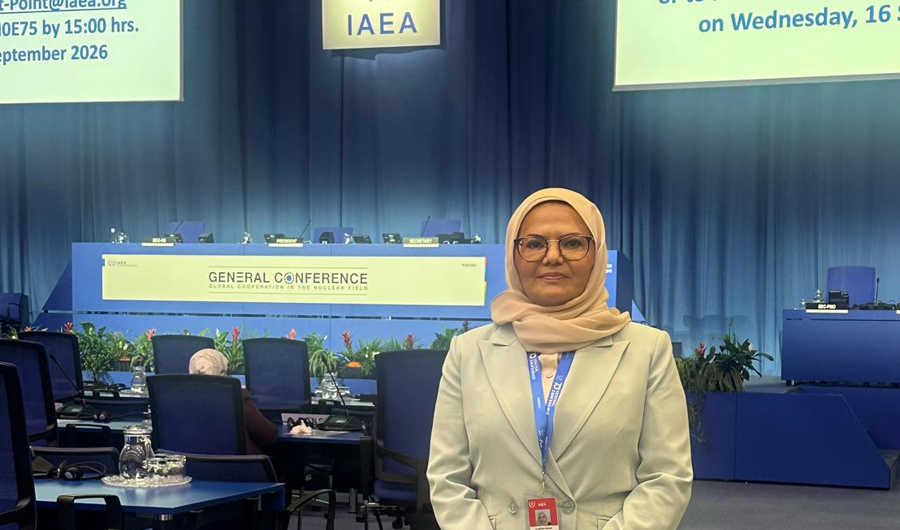
(KUNA) — Dr. Habiba Al-Muneai, the National Focal Point for the International Atomic Energy Agency (IAEA) at the Kuwait Institute for Scientific Research (KISR), affirmed that “cooperation between the State of Kuwait and the Agency represents a long-standing and solid partnership based on reliability and continuity in the fields of peaceful uses of nuclear technology.”
Speaking to the Kuwait News Agency (KUNA) following the conclusion of the Agency’s 70th General Conference, which opened in Vienna, Austria, last Monday and concluded this Friday, Al-Muneai stated that the continuation of cooperation and the achievements realized in nuclear and isotopic technologies reflect the strength of international efforts in promoting peace, security, and sustainable progress.
She added that bilateral cooperation during the period from September 1, 2025, to August 31, 2026, achieved significant milestones that contributed to enhancing national capabilities, transferring modern technologies, and supporting vital developmental sectors. She clarified that KISR plays a pivotal role in monitoring and directing technical cooperation programs toward national priorities in coordination with beneficiary entities.
Al-Muneai noted that among the most prominent achievements of the past year was the signing of the framework for the State of Kuwait’s National Program for the period (2026–2035), which serves as the strategic reference for technical cooperation over the next decade. The program identifies areas where nuclear science and technology can be leveraged to support sustainable development plans, serving as a cornerstone for capacity building and technology transfer.
She explained that cooperation with the IAEA’s Technical Cooperation Section for Asia and the Pacific resulted in the approval of five national projects under the (2026–2027) documentation cycle. These projects include treating cancerous diseases through improved tumor targeting, and studying groundwater layers to identify major sources of pollutants using stable isotope techniques.
Al-Muneai clarified that the projects also include enhancing food safety by identifying chemical and microbiological contaminants in milk, and studying the impact of coke agglomeration on the performance of an upflow fluidized bed reactor using nuclear techniques. Additionally, the projects involve establishing a national laboratory for neutron activation analysis, as well as extending two projects related to feed production via mutation breeding and cancer treatment.
She reported that the current year has been marked by the commencement of strategy implementation and the active participation of Kuwaiti personnel in regional and international projects and training programs. She noted that the total budget allocated to Kuwait within the Technical Cooperation Program for the years (2026–2027) amounts to approximately 600,000 euros.
Al-Muneai highlighted the Technical Cooperation Section’s appreciation of KISR’s regional role and its training partnerships, confirming the Institute’s readiness to provide the necessary capabilities to implement projects linked to the Technical Cooperation Section.
She pointed out that the State of Kuwait hosts four regional service and cooperation centers with the IAEA in the fields of medicine, marine environment, radiation protection, and radioactivity measurement laboratory, leveraging its expertise and advanced equipment to support the Agency’s research programs.
Al-Muneai indicated that the Kuwaiti delegation met with the Technical Cooperation Section in the presence of Bashar Al-Duwaisan, Deputy Ambassador of the State of Kuwait to Austria, and Khalid Al-Dikhan from the Embassy in Vienna. During the meeting, efforts to facilitate the completion of national projects were commended. She added that the delegation also participated in a meeting of the ARASIA agreement on research, development, and training in the nuclear field, to which Kuwait joined in 2016.
She stated that Kuwait completed the implementation of eight regional projects under ARASIA in December 2025 in the environmental, agricultural, and health sectors, and initiated five new projects while participating in the coordination for the next cycle, during which heads for four projects for the upcoming documentation cycle were selected.
Al-Muneai confirmed that the Integrated Nuclear Security Support Plan was reviewed in the presence of relevant authorities, resulting in the preparation of a “Nuclear Risk Matrix” as part of a risk assessment project for potential threats facing the country, completed in December 2025.
She explained that the delegation met with officials from the Nuclear Safety and Security Section to develop the capabilities of personnel in national institutions, including the General Department of Customs, the Ministry of Interior, the General Department of Civil Defense, and the Ministry of Health (Radiation Protection Department). This was achieved through training courses for frontline personnel on handling radiological incidents and using advanced detection devices.
Al-Muneai reported that cooperation continues, based on the National Integrated Nuclear Security Plan, as a mechanism to enhance institutional capabilities in monitoring radioactive sources, combating illicit trafficking, and border monitoring.
She noted that the delegation also discussed future cooperation avenues with the IAEA’s Incident and Trafficking Database (ITDB) Section.
Dr. Al-Muneai affirmed Kuwait’s continued fruitful cooperation through the Technical Cooperation Program as a capacity-building mechanism. She praised the efforts of Fawaz Al-Boursali, Ambassador and Permanent Representative of the State of Kuwait to the International Organizations in Vienna, Deputy Ambassador Bashar Al-Duwaisan, and the embassy staff in strengthening cooperation with the Agency and facilitating the tasks of the Kuwaiti delegation.
