Arab League Hosts Second Al-Babtain Prize Ceremony for Excellence in Service of the Arabic Language - Sarmad
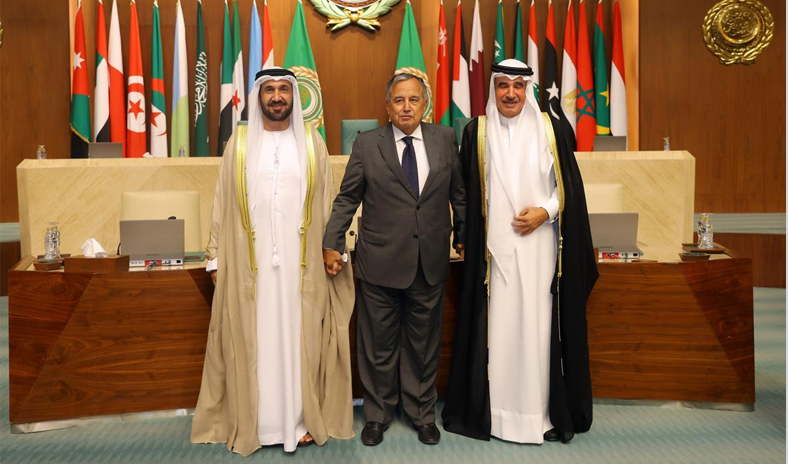
(KUNA) – The Arab League headquarters hosted on Thursday the award ceremony for the second edition of the Abdulaziz Saud Al-Babtain Prize for Creativity in Service of the Arabic Language. This year’s theme focused on teaching Arabic to non-native speakers, with the participation and attendance of prominent Arab figures in the fields of culture, linguistics, and parliamentary work.
In a speech during the ceremony, Arab League Secretary-General Nabil Fahmy affirmed that teaching Arabic to non-native speakers represents a window for presenting Arab culture to the world and an effective tool for promoting the Arab nation’s soft power.
Fahmy welcomed the attendees, foremost among them the Speaker of the Arab Parliament and Chairman of the Prize’s Board of Trustees, Mohammed Al-Yamahi, and Saud Abdulaziz Al-Babtain, Chairman of the Board of Trustees of the Abdulaziz Saud Al-Babtain Cultural Foundation.
He stated that the holding of this event embodies a distinguished model of “Arab cultural diplomacy” and crowns the tripartite strategic partnership inspired by the noble principles and vision of the late poet and intellectual Abdulaziz Saud Al-Babtain, who dedicated his life to serving the Arabic language and nurturing creativity within it.
He added that the first edition of the prize was not merely a passing event but a foundational milestone that launched a new dynamic in service of the Arabic language and entrenched standards of excellence and innovation in academic and cultural circles.
He clarified that the second edition reflects the maturity of the initiative and the expansion of its impact through its focus on teaching Arabic to non-native speakers, a field of strategic and civilizational importance.
He noted that teaching Arabic to non-native speakers is among the effective tools for disseminating Arab culture and enhancing its presence globally.
For his part, Al-Yamahi stated in his address that celebrating the Abdulaziz Saud Al-Babtain Prize for Creativity in Service of the Arabic Language is not merely an awards ceremony, but a celebration of an idea that believes Arabic is not just a vessel for heritage, but a tool for creating knowledge, a bridge for dialogue with the world, and an authentic component of Arab identity.
Al-Yamahi explained in his speech that the partnership between the Arab Parliament and the Al-Babtain Foundation embodies a shared belief that serving the Arabic language is not a cultural luxury, but an Arab responsibility linked to the future of the nation and its capacity to produce knowledge.
He pointed out that the selection of the second edition’s theme, “Teaching Arabic to Non-Native Speakers,” carries deep significance for enhancing the presence of the Arabic language and opening up avenues for its spread, noting that teaching it to non-native speakers opens the door to a venerable civilization and a rich culture.
Al-Yamahi congratulated the winners of the second edition: the Center for Developing Education of Foreign Students at Al-Azhar Al-Sharif and the Islamic Educational, Scientific and Cultural Organization (ISESCO) Center for Arabic Language for Non-Native Speakers in the institutions category; and Dr. Khaled Abu Amsha and Dr. Sayed Ezzat Abu El-Wafa in the individuals category. He affirmed that honoring them represents confidence in their ability to deliver more, and that the prize should serve as an incentive to continue innovating in the face of the ever-renewing challenges facing the Arabic language.
He expressed his appreciation to the Al-Babtain Foundation, under the leadership of Saud Al-Babtain, for its support of the prize, and to the General Secretariat of the Arab League for hosting the ceremony annually, thereby affirming that attention to the Arabic language is an integral part of the system of Arab common action.
Al-Yamahi extended his thanks to the Arab League Secretary-General for his attendance at the ceremony, affirming that the Arab Parliament will remain committed to keeping the Arabic language at the forefront of its priorities and supporting all efforts to elevate it.
For his part, Saud Abdulaziz Al-Babtain, Chairman of the Board of Trustees of the Abdulaziz Saud Al-Babtain Cultural Foundation, stated that preserving the Arabic language is a responsibility that requires continuous effort, as reflected in the Foundation’s projects spanning decades in service of the Arabic language and its culture.
Al-Babtain highlighted the significance of the occasion coinciding with September, recalling the University of Oxford’s celebration on September 15, 2016, of the re-funding of the Arabic Language Chair, established in 1636 and named after Abdulaziz Al-Babtain in recognition of his contributions. He affirmed that this connection reflects the broadening horizon of the mission and the capacity of the Arabic language to secure its place in the most venerable forums of scholarship.
He emphasized that Arabic is not merely a tool for communication, but rather the vessel of the nation’s culture and memory, and the bridge between its past and future. He clarified that preserving the language requires not only celebrating its past, but also supporting its present, developing its tools, and opening doors for researchers and creators.
He noted that this conviction led to the partnership with the Arab Parliament through a prize bearing his father’s name, dedicated to excellence in serving the Arabic language.
He confirmed that the prize continues its journey in its second edition, having received 142 entries, including 124 books and 18 educational projects on “Teaching Arabic to Non-Native Speakers.” He considered this level of participation a reflection of the growing interest in the Arabic language, and stated that honoring creators serves as an incentive for further research and innovation.
He stated that the best way to honor his father’s legacy is to translate his values into projects that reach new generations.
Following the speeches, the winners of the Abdulaziz Saud Al-Babtain Prize for Excellence in Serving the Arabic Language, in its second edition, were honored. The edition was dedicated to two main categories: individuals in the field of digitalization in service of the Arabic language, and institutions in the field of language planning and policies.
In the individuals category, dedicated to “Digitalization in Service of the Arabic Language” and carrying a prize of $40,000, the award was won by the book “Foreign Strategies in Teaching Arabic to Non-Native Speakers” by Dr. Khalid Abu Amsha and Dr. Sayyid Azat Abu Al-Wafa.
In the institutions category, dedicated to language planning and policies and carrying a prize of $60,000, the award was shared equally between the “Center for Developing Education of Foreign Students at Al-Azhar Al-Sharif” and the “ISESCO Center for Arabic Language for Non-Native Speakers” (Mishkat).
