"Cabinet: Repeated Iranian Attacks Are a Flagrant Violation of Kuwait's Sovereignty and a Direct Threat to Its Security" - Sarmad
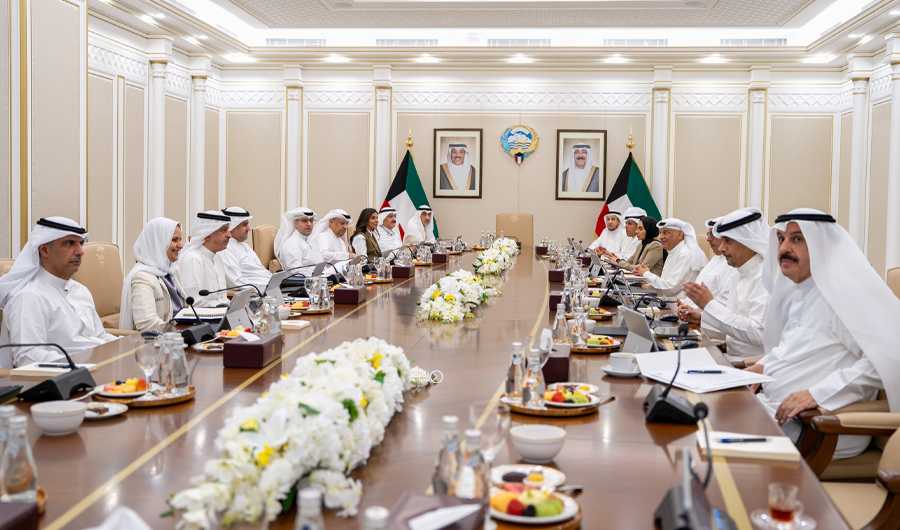
The Cabinet held its meeting today, Wednesday, presided over by the Acting Prime Minister and Minister of Interior, Sheikh Fahad Al-Yousef.
Following the meeting, Deputy Prime Minister and Minister of State for Cabinet Affairs, Sharidh Al-Muwasharji, stated that the Council expressed its strong condemnation and rejection of the repeated, despicable Iranian attacks using hostile missiles and drones, which targeted several sites in the country, including a residential complex last week. These attacks constitute a blatant violation of the country’s sovereignty, a direct threat to its security and stability, and a danger to the safety of its citizens and residents. They also represent a serious breach of international law, the UN Charter, and a clear violation of UN Security Council Resolution 2817. The Council described these actions as a dangerous escalation that threatens regional security and stability and undermines diplomatic efforts aimed at de-escalation. It reaffirmed Kuwait’s full right to take all necessary measures to safeguard its sovereignty, protect its security and interests, and defend its territory and vital installations against any aggression or threat, based on its inherent right to self-defense under Article 51 of the UN Charter and international law.
For its part, the Council expressed its strong condemnation and rejection of the Houthi militia’s attacks that targeted civilian and economic landmarks in several cities of the Kingdom of Saudi Arabia, the brotherly kingdom, resulting in the injury of dozens of civilians, including women and children. These attacks constitute a blatant violation of the Kingdom’s sovereignty, a direct threat to the security and safety of its citizens and residents, a breach of international and international humanitarian law, and an unjustified escalation that could undermine regional security and stability.
The Council also expressed its condemnation of the Houthi militia’s continued targeting of commercial ships in the Red Sea, which poses a direct threat to the security and safety of maritime navigation, global energy supplies, and international trade. It affirmed Kuwait’s absolute solidarity with the Kingdom of Saudi Arabia, its steadfast support for all measures taken by the Kingdom to safeguard its sovereignty, protect its security, stability, and interests, and shield its people and residents. It emphasized that the security of the Kingdom is an integral part of Kuwait’s security and the security of the Gulf Cooperation Council (GCC) countries.
In this context, the Council expressed its strong condemnation and rejection of the despicable Iranian attack on the Saudi tanker “Sidr” as it transited the Strait of Hormuz, which resulted in the deaths of the tanker’s crew last week. This attack constitutes a blatant violation of international law and UN Security Council Resolution 2817, and a direct threat to the security and safety of maritime navigation and global energy supplies. The Council stressed the urgent need for an immediate halt to all escalatory actions and adherence to international law rules that guarantee freedom of navigation. It reaffirmed Kuwait’s rejection of any attack on the security and safety of maritime navigation, and reiterated Kuwait’s full solidarity with the Kingdom of Saudi Arabia, its steadfast support for all measures taken by the Kingdom to safeguard its sovereignty, protect its security, and defend its interests.
The Council of Ministers also expressed its strong condemnation and rejection of the reprehensible Iranian attacks that targeted the sisterly Kingdom of Bahrain last week, which constitute a blatant violation of its sovereignty and a clear breach of the principles of international law, the UN Charter, and Security Council Resolution 2817. It stressed the necessity of halting these escalatory practices and prioritizing de-escalation, dialogue, and adherence to the rules of international law and principles of good neighborliness, in order to safeguard the region’s security and stability and spare its peoples further tension and escalation. It reaffirmed the State of Kuwait’s full solidarity with the sisterly Kingdom of Bahrain and its support for all measures taken to preserve its sovereignty, security, and stability.
Likewise, the Council of Ministers expressed its strong condemnation and rejection of the continued reprehensible Iranian attacks that targeted the sisterly Hashemite Kingdom of Jordan with a number of missiles, the latest of which occurred at dawn on Wednesday. These attacks constitute a blatant violation of Jordan’s sovereignty and a flagrant breach of the principles of international law, the UN Charter, and Security Council Resolution 2817. It stressed the necessity of stopping these attacks and prioritizing de-escalation, dialogue, and adherence to the rules of international law, in order to safeguard the region’s security and stability and spare its peoples further tension and escalation. It reaffirmed the State of Kuwait’s full solidarity with the sisterly Hashemite Kingdom of Jordan and its support for all measures taken to protect its sovereignty and preserve its security and stability.
On another note, the Council of Ministers heard a briefing from Minister of Defense Sheikh Abdullah Al-Sabah on the latest developments in the region and current military developments in light of the reprehensible Iranian attacks that targeted the State of Kuwait last week. He affirmed the readiness of the Armed Forces and their continued performance of their duties and responsibilities with efficiency and competence, as well as their adoption of all necessary measures and precautions to safeguard the sovereignty and territory of the State of Kuwait, preserve its security and stability, and protect citizens and residents.
On a separate note, the Council of Ministers heard a briefing from Minister of Foreign Affairs Sheikh Jaraah Jaber Al-Ahmad on the political and diplomatic efforts undertaken by the Ministry of Foreign Affairs and its diplomatic missions abroad to keep pace with the latest developments on the regional and international fronts.
Within this framework, Minister of Foreign Affairs Sheikh Jaraah Jaber Al-Ahmad informed the Council of Ministers of the substance of the meeting he held last week with the Minister of Foreign Affairs and International Relations of the Kingdom of Lesotho, Limpho Tao, during his official visit to the country. The meeting discussed bilateral relations between the two friendly countries and ways to enhance and develop them across various fields, as well as issues of mutual interest and the latest regional and international developments.
Minister of Foreign Affairs Sheikh Jaraah Jaber Al-Ahmad also informed the Council of Ministers of the substance of a phone call he held with His Excellency Muhammad Ishaq Dar, Deputy Prime Minister and Minister of Foreign Affairs of the friendly Islamic Republic of Pakistan. The call reviewed cooperation relations between the two friendly countries and ways to develop them, in addition to discussing the latest regional developments and efforts aimed at enhancing security and stability in the region.
On another note, the Council of Ministers approved the draft decree-law amending certain provisions of Law No. 49 of 2016 concerning Public Tenders. The law aims to simplify procedures, address difficulties and issues arising from practical realities, and enhance the flexibility of concerned entities in dealing with actual circumstances, thereby serving the interests of work and ensuring the implementation of public tender procedures with speed, efficiency, transparency, and fairness.
The Council of Ministers submitted a draft decree-law amending certain provisions of Law No. 49 of 2016 concerning public tenders to His Highness the Amir, Sheikh Meshal Al-Ahmad Al-Jaber Al-Sabah.
The Council of Ministers reviewed a number of agenda items, reports, and minutes of ministerial committees, and approved them. It also decided to refer several items to the relevant ministerial committees for study and to submit appropriate recommendations regarding them to complete the procedures for their implementation.
