US polls alarm the occupation: American youth support Hamas more than Israel - Sarmad
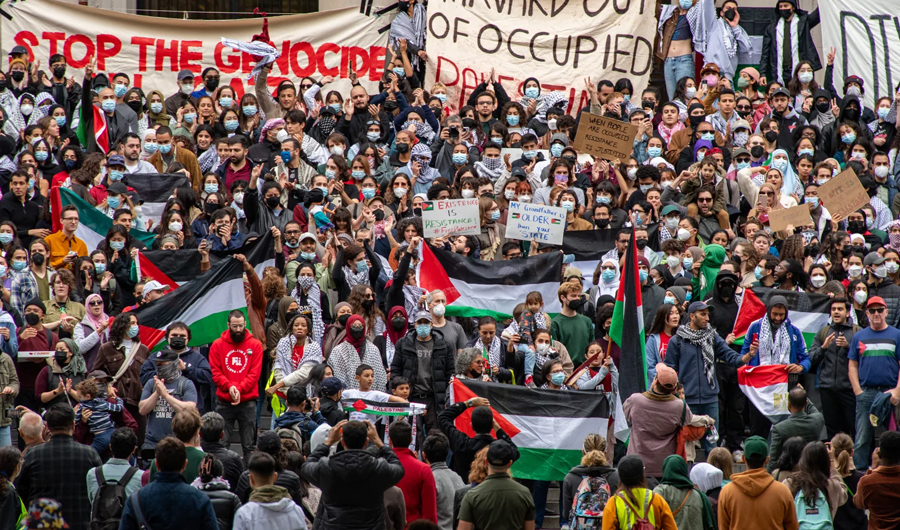
Successive American opinion polls reveal an increasing challenge facing the Israeli occupation in the United States, particularly among the youth, coinciding with strained relations between the administration of U.S. President Donald Trump and the Israeli occupation government led by Benjamin Netanyahu.
Although the decline in support for the occupation among American youth is no longer a new topic in Israeli circles, recent data suggest that the problem may extend beyond positions related to the war or partisan disagreements, reaching Americans’ own views on the nature and identity of the Israeli occupation.
Propaganda affairs expert Gadi Ezra, in an article published in the newspaper “Yedioth Ahronoth,” stated that the “Harvard University and Harris Polls monthly survey project” repeatedly highlights this issue.
Ezra explained that one of the most prominent indicators is the “consistent preference for Hamas over Israel among American youth aged 18 to 24.”
According to Ezra, results from most surveys published by the project since the beginning of the year showed greater support for Hamas than for Israel among this age group, with only two exceptions where Israel gained a narrow lead.
Ezra believes the problem is not limited to younger demographics, noting that the “good news” for the occupation is that this trend does not represent other age groups in the United States. However, he argues that focusing on youth may obscure a “deeper problem concerning Israel’s image and identity” among the American public.
He bases this on results from a recent survey by the same project, which asked Americans about their stance on Israel’s right to be a homeland for the Jewish people.
The results, according to Ezra, showed that a large majority of Americans support this right, while the 18-to-24 age group appeared almost evenly divided, with 49 percent in favor and 51 percent opposed.
However, another question posed by the survey revealed a different kind of division that does not clearly correlate with age. Participants were asked whether Israel should be a Jewish state or a state without any official religion or ethnic identity.
Ezra pointed out that the results were similar across different age groups, with 46 percent of respondents believing that “Israel should be free of any official religion or ethnic identity.”
Ezra considers these results to reflect a disagreement within American society regarding the concept of “Israel’s Jewishness,” noting that the implicit alternative proposed by this position is to view Israel as “a state for all its citizens,” rather than a state with a Jewish identity.
The author attributes part of this to the nature of American society, stating that many Americans may not view Judaism solely as a religion but are also unaware of its national dimension, in a society where the separation of church and state holds a central place.
Ezra says this perception does not necessarily mean the American stance is hostile to Israel, but may instead reflect an “American civic ideology” that believes the state should not be based on religious or ethnic grounds.
He believes this point touches the core of the Zionist perception, which, according to his framing, is based on restoring Jews to their position as a nation, not merely as followers of a religion.
