Robots enter the war... China prepares for battles without soldiers - Sarmad
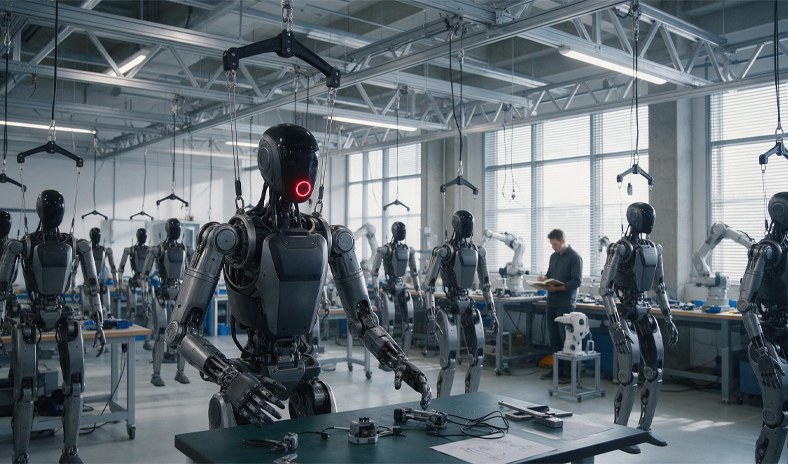
From dancing and boxing, to displaying agility in front of crowds, to training for breaching buildings and engaging in combat… robots in China are taking a new step that could move them from exhibition stages to battlefields.
Beijing, whose companies dominate the global market for this technology, is intensifying its research to develop “robotic soldiers” capable of operating alongside human forces, in a race that goes beyond creating a smarter machine to redefining the very nature of warfare itself.
Just days after the conclusion of the World Humanoid Robot Games hosted by China last month, which featured robots jumping, dancing, and boxing—with some models even outpacing Jamaican sprinter Usain Bolt’s 100-meter record—China’s military establishment has cast these exhibitions in a new light.
Two days after the games ended, an official newspaper affiliated with the Chinese army called on researchers to accelerate the transfer of advanced technologies from laboratories to military training grounds, paving the way for the development of robotic “fighters.” Meanwhile, Chinese military institutions are intensifying their research into the military applications of humanoid robots, with plans to eventually develop and deploy them on battlefields, according to a Reuters review of more than 100 Chinese military procurement announcements, an academic study, a patent, an official publication, a government record, and a document linked to defense companies.
From the Laboratory to the Field
Unpublished records have revealed that Chinese military institutions are testing humanoid robots under field conditions, seeking to purchase robots and the necessary technologies to train them, while also exploring ways to operate them in tandem with human forces.
These efforts have gained momentum in 2025 and 2026, with a growing focus on robots’ perception and maneuvering capabilities, as well as the collection and development of training data to enhance their efficiency. Chinese manufacturers accounted for approximately 95% of global shipments of these robots in 2025, according to Bank of America Global Research.
This commercial dominance gives the Chinese military access to a rapidly expanding industry, enabling the development of specialized military applications based on commercially available technology.
China’s interest in military robots also reflects a broader shift in the nature of technology used in modern warfare. The Russia-Ukraine war has highlighted the growing role of semi-autonomous systems. AI-enabled drones have changed reconnaissance and attack tactics, while other robots have been used to transport supplies and evacuate the wounded and dead.
Denis Hong, a professor of mechanical and aerospace engineering at the University of California, Los Angeles, stated that one of the most compelling motivations for developing robots is the ability to send them to places humans are unwilling to go. He added that losing a robot on the battlefield could mean avoiding the loss of human life, making the machine expendable instead of the soldier.
Robots for Urban Assault
China’s vision does not limit the use of robots to support or reconnaissance missions. Military research has begun examining their potential role in combat within urban areas. In one scenario outlined in Chinese research, six combat robots—whether humanoid, quadrupedal, or unmanned vehicles—are distributed among two teams of attacking forces.
These robots operate alongside ground forces during operations to clear enemy-held buildings, floor by floor and room by room.
Last December, the Chinese Army’s Eastern Theater Command released AI-generated video clips showing military robots—including humanoid models and quadrupedal units—participating in an assault on Taiwan’s defenses within a hypothetical scenario for a future conflict. Although these clips do not indicate that such systems have entered actual service, they reflect how the Chinese military establishment has begun to envision the role of robots in future wars.
U.S. Army Competition
China is not alone in this direction; the U.S. Army has also begun testing the potential of humanoid robots for military use. Last year, it launched a competition to develop “military-oriented humanoid robot capabilities” that could operate alongside soldiers in the future.
According to the U.S. Army, potential tasks for these robots include reconnaissance, security, obstacle clearance, and handling hazardous materials, as well as conducting offensive and defensive operations in urban environments.
